
Certification planning for US and EU appliance launches
Share:
-

-

-

-


Copied
Share:
-
-
-
-
Copied
Planning for certification to US and EU appliance launches.
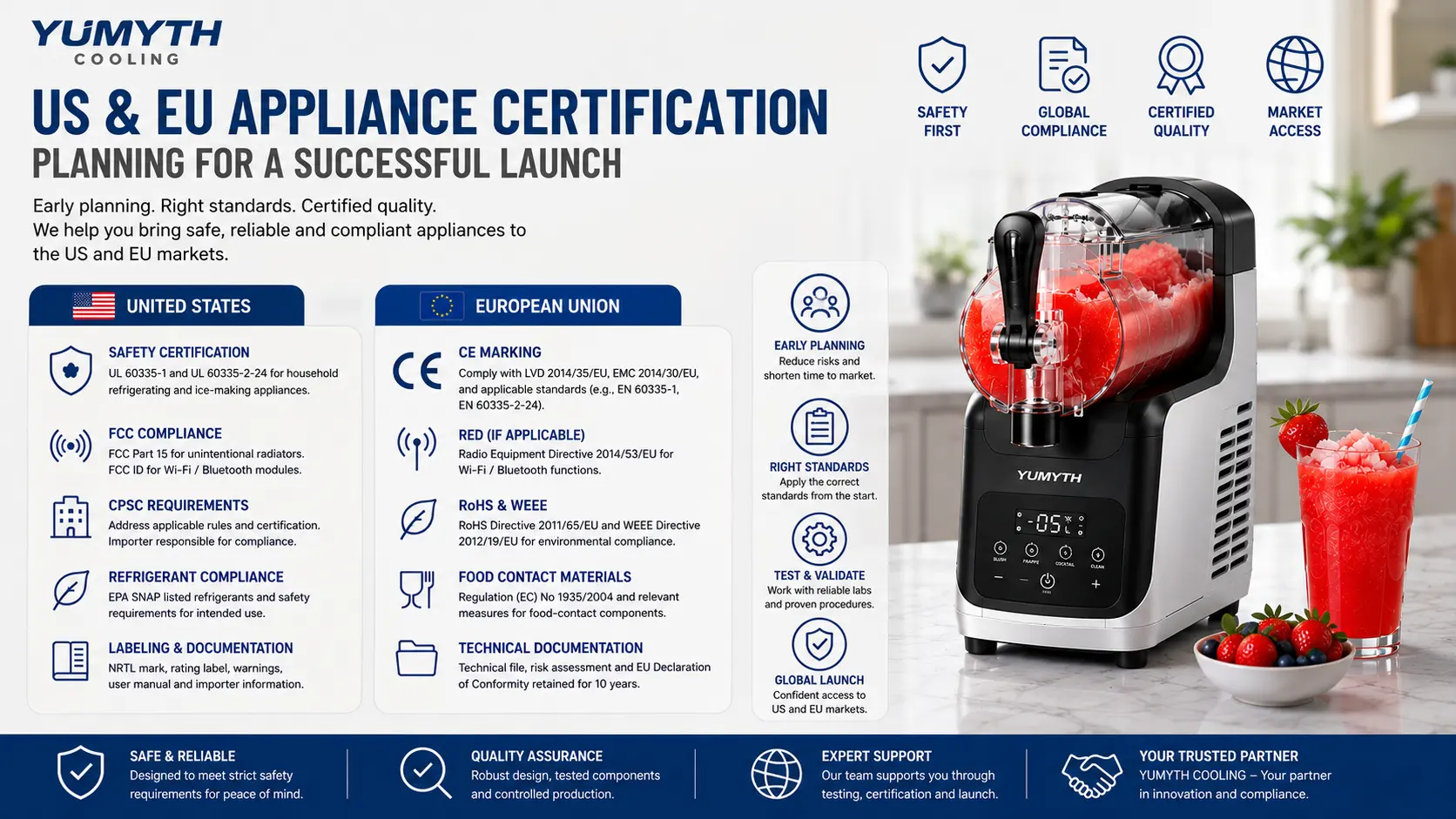
Dobson notes that creating a new product to be sold in the United States and European Union isn't as simple as sending the final product to a lab. A wide range of product safety, electromagnetic compatibility, food-contact materials, refrigerants, labeling, technical documentation, packaging, and importer-related matters may impact market access.
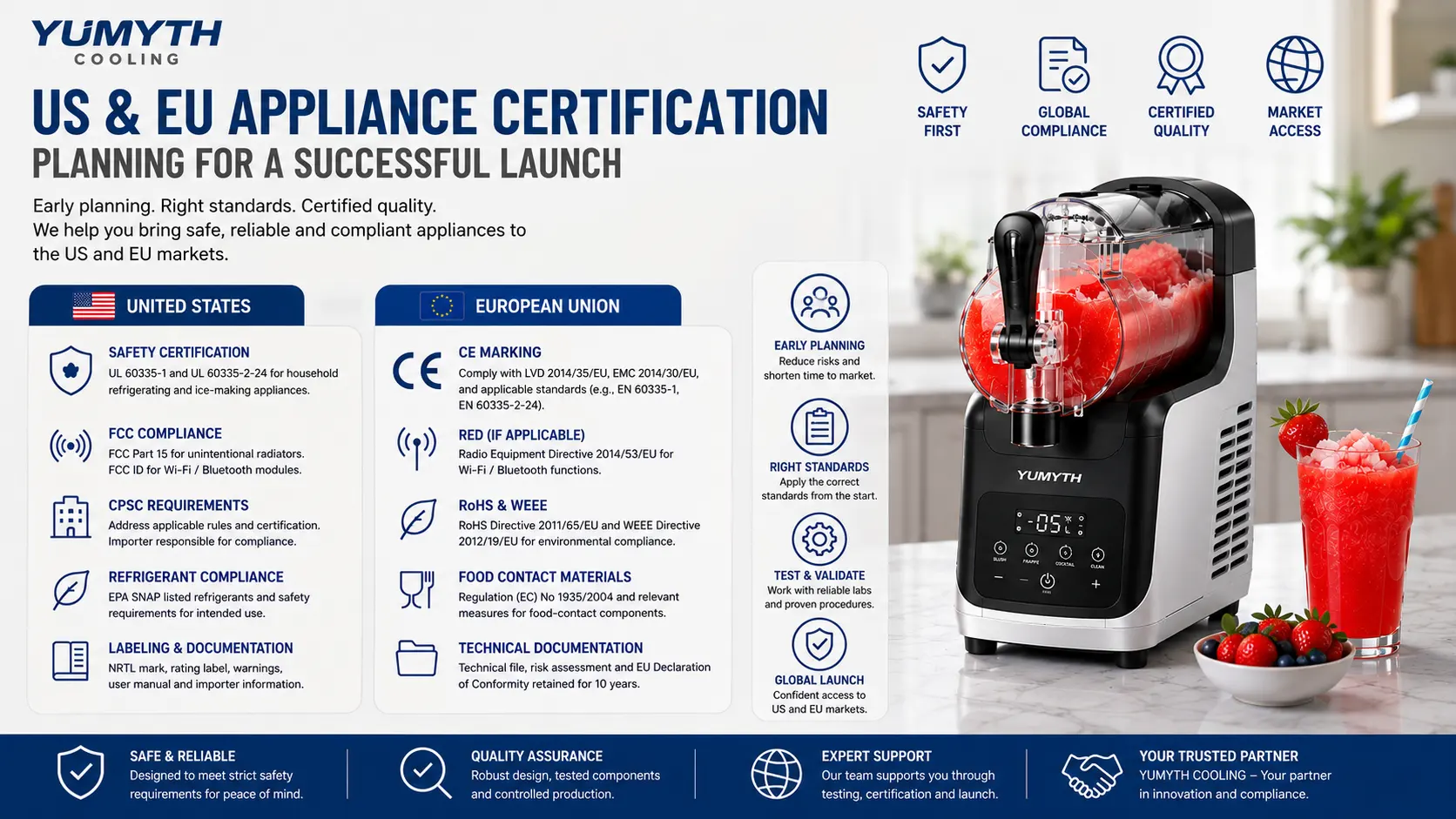
Therefore, it is important to start planning certification during the stage of product definition. If compliance testing is not conducted until the tooling is completed, a failed compliance test could result in a change to the enclosure, PCB board, wiring, compressor, ventilation openings, components that come into contact with food, software, or packaging. By planning in advance, costs of redesign are minimized and brands get a more predictable launch schedule.
Prior to selecting standards, classify the Appliance.
First of all, it is necessary to set up precisely what the product will be doing and how it will be sold.
The elements of refrigeration, mechanical mixing, digital controls, dispensing components, and removable food contact parts can all be incorporated into a household slush machine. A commercial version could be different from a model designed to be used only at home. The Wi-Fi or Bluetooth may have further radio needs, and if using R290 refrigerant, there are certain flammability issues.
The product specification should clearly define:
- Used at home or in the workplace;
- * Current and voltage ratings; and
- * Refrigeration architecture;
- * Property of the fluid; and
- * Beverage capacity;
- * Intended ingredients;
- * Wireless functions;
- * Food-contact materials;
- * Target sales countries;
- * Installation environment.
This IEC 60335-1:2020 (and its amendment in 2025) specifies general safety requirements for household and similar electrical appliances. Household refrigerating appliances, ice makers, ice-cream appliances and compression type appliances with flammable refrigerants are covered specifically in IEC 60335-2-24:2025. The precise application of the Part 2 standard should be determined by a qualified laboratory in accordance with the intended use and functions of the end product.
Construct Separate US and EU Compliance Matrix
There is not a one-size-fits-all approval process for the U.S. and the E.U. Sometimes test reports can be used for both projects, but the legal responsibilities, the labels, the declarations, standards and market surveillance requirements are different.
The compliance matrix needs to include:
- * Applicable laws and directives;
- * Product safety standards;
- * Safety, security, and electrical communications; and
- * Refrigerant restrictions;
- * Food-contact requirements;
- * Environmental obligations;
- * Required labelling and warnings;
- * Responsible legal entities;
- * Technical file requirements;
- * Production inspection obligations.
The matrix should include responsibility for the appliance brand, OEM factory, importer, laboratory, component suppliers and packaging provider. This helps to avoid someone else taking over a task without completing it.
Outline the US Safety Certification Route
There is no CE marking in the USA. The appliance brands typically partner with a Nationally Recognized Testing Laboratory (NRTL) like UL Solutions, Intertek, CSA, TÜV Rheinland, SGS or one that is recognized by the standard.
The National Recognized Testing Laboratory program (NRTL) is designed by OSHA to accept private laboratories that test and certify products to applicable safety standards. Each NRTL has a scope of recognized standards and each NRTL will have its own registered certification mark. Brands should ensure that the laboratory chosen is the one that is recognised for the particular appliance standard and not just the price.
With a household compressor based slush or frozen drink appliance, the evaluation can start with UL 60335-1 along with the appropriate product specific standard. UL 60335-2-24 applies to household refrigerating appliances, ice-cream appliances and ice makers, including the requirements for low GWP refrigerants and flammable refrigerants. The laboratory needs to verify if the appliance is completely compliant with that scope, or if extra requirements exist.
Safety testing can include (but is not limited to):
- *History of past events; and
- – 32 mA is the maximum grounding current, and the leakage current is not more than 25 mA.
- * Abnormal operation;
- * Motor overload;
- * Compressor protection;
- * Mechanical hazards;
- * Surface temperatures;
- * Fire resistance;
- * Refrigerant leakage risks;
- * Stability and accessibility;
- * Component suitability.
Production control is part of the certification. Once approved the factory is obligated to keep using the approved construction and approved controlled critical components.
Include FCC Requirements Early
An appliance can be an unintentional radiator if it has digital control boards, displays, switching power supplies, and microprocessors, and they fall under FCC Part 15. The Supplier's Declaration of Conformity procedure is often used in such products.
Intentionally radiated devices that are digital in nature are normally approved using SDoC, according to the FCC. The responsible party shall be in the United States and the importer of record may become the responsible party.
If added with Wi-Fi, Bluetooth, or another radio transmitter, the intentional radio transmitter is likely to require FCC certification. While adhering to the pre-certified wireless module requirements can make testing easier, the host appliance must still be reviewed, labeled correctly, controlled by the antenna, and meet the installation requirements of the module.
Design for EMC should be started at the PCB and wiring design stage. After the molds and internal structures have been set, it is more difficult to make corrections on filters, grounding, shielding, motor suppression, cable routing and switching frequencies.
Know CPSC and Importer Responsibilities.
Appliance brands and importers of the United States should check if there is a specific rule in place by the Consumer Product Safety Commission that covers the product. Regulated general use products may need to be tested and have a General Certificate of Conformity.
CPSC's electronic filing system is now applicable to import planning. The U.S. Customs and Border Protection (CBP) will begin accepting electronically filed certificate information of most regulated consumer products effective July 8, 2026. Brands should verify its coverage before shipment, and prepare compliance data.
Manufacturers, importers, distributors and retailers are required to report a product when information suggests that the product may be defective, causing a substantial risk of injury or unreasonable risk of serious injury or death, even if the product does not have a CPSC certificate. The complaint monitoring, incident escalation, traceability and recall procedures should therefore form part of compliance planning.
Shortage of preparedness for the EU CE-Marking Project.
CE marking is not a one-off certificate issued by a laboratory. It is a manufacturer's statement that the product meets all relevant EU regulations.
The typical compliance framework for a mains powered countertop appliance is the Low Voltage Directive 2014/35/EU and the Electromagnetic Compatibility Directive 2014/30/EU. The LVD is applicable to electrical equipment with an operating voltage of 50 to 1,000 volts AC and the EMC Directive applies to electromagnetic emissions and immunity.
The RoHS requirements should also be considered since it limits the use of certain hazardous materials in electrical and electronic products. WEEE obligations are connected with registration, collection, recovery and recycling of electrical equipment, and are enforced via national systems in EU member-states.
A connected appliance, which is normally expected to comply with the Radio Equipment Directive 2014/53/EU rather than just with the standard EMC route, will be subject to other provisions if it is not.Where a connected appliance is not subject to the Radio Equipment Directive 2014/53/EU, then it will be subject to the other provisions. RED sets standards for radio spectrum use, EMC and safety.
The relevant harmonized standards shall be compared with the latest references in the OJEU. Not using the latest standard could lessen the presumption of conformity even though the product has already been laboratory-tested.
Take action on the General Product Safety Regulation
Since 13 December 2024 the EU General Product Safety Regulation (2023/988) has been in force. It enhances the safety, traceability, recall, online-sales and economic-operator requirements for consumer products.
The manufacturer or relevant EU economic operator should be clearly identified on the product, in the packaging and in the instructions, as well as on the products' on-line listing. The business should have procedures for complaints, accidents, corrective action, recalls, and working with the market surveillance authorities.
Instructions and safety information shall be available in languages as required by the countries in which the appliance is sold. No one English manual will provide an automatic solution to an EU-wide launch.
Confirm the Separate Components of Food in Contact Separately
Certification does not guarantee compliance with food-contact requirements when it is only electrical safety that is being certified.
The regulatory classification of a food contact article in the United States varies by substances involved and conditions and methods of use. Brands should have strict control over the exact resin, colourant, additive, silicone, coating, adhesive and metal used in the production.
The general principles of safety and inertness of food contact materials are laid down in the EU Regulation (EC) No 1935/2004. Other product-specific measures could be relevant, especially for plastic products.
Testing must simulate conditions of actual contact such as beverage acidity, alcohol level, temperature, frequency of use, exposure in dishwashers, etc. A general “food-grade” report from another material supplier or colour formulation is not acceptable.
Confirm Refrigerant Rules – for both markets
The team should assess safety and environmental concerns when using R290 or other refrigerants in an appliance.
EPA SNAP listings provide guidance on whether a refrigerant is suitable for a specific end use, and may set use conditions. It is important that manufacturers do not presume that if an appliance is approved for one refrigeration type, it will be approved for a different type.
In the EU, Regulation 2024/573 regulates all fluorinated GHGs, and it is re-emphasising the need for low GWP refrigeration platforms. Although R290 is not a fluorinated greenhouse gas, its flammability has to be taken into account in appliance safety design, manufacturing control, labelling and the relevant product standard.
Complete a Technical File
The technical file should be created during the project, not the last-minute before delivery.
It should include:
- * Product specifications;
- * Risk assessment;
- * Circuit diagrams;
- * Refrigeration drawings;
- * Bill of materials;
- * Critical component certificates;
- * Software versions;
- * Airfield documents; and
- * Food-contact declarations;
- * Refrigerant information;
- * Label artwork;
- * User instructions;
- * Production inspection procedures;
- EU Declaration of Conformity.
The LVD and EMC Directive requires manufacturers to keep the technical documentation and EU Declaration of Conformity for 10 years after the product is put on the market. The EMC Directive stipulates procedures to ensure that the series production continues to comply when there are changes in design, characteristics or referenced standards.
How to control changes after certification.
If mass production is done with different components a certified sample is not sufficient.
Alterations to the compressor, PCB, relay, motor, power cord, thermal protector, fan, refrigerant circuit, insulation, enclosure material, food contact resin, firmware, and/or ventilation design could result in non-compliance.
OEM factory should have a formal engineering-change process. Do not replace a controlled component without a technical review, brand approval, and, if necessary, a laboratory review.
Production with the final tooling, approved suppliers, production workers, final software and intended inspection procedures should be used for pilot production. Samples should be compared with the certified construction prior to the first commercial shipment from the pilot run.
Conclusion
Compliance planning from the product-definition phase is a key to successful appliance launches in the US and EU. Before tooling is completed, brands should determine the type of appliance, identify relevant standards, ensure legal obligations and engage qualified laboratories.
The United States needs coordinated planning for safety certification, FCC authorization, CPSC responsibilities, refrigerant regulations and importer documentation. The European Union demands a full compliance with CE legislation, GPSR, RoHS, WEEE, food-contact materials, technical documentation and market-specific instructions.
The best appliance programs don't consider certification the end of the road. They embed compliance within engineering, supplier management, production control, packaging, traceability and after sales monitoring. This way, the launching of the production is reduced and helps to make sure all the production units are in line with the approved design.
Related Articles
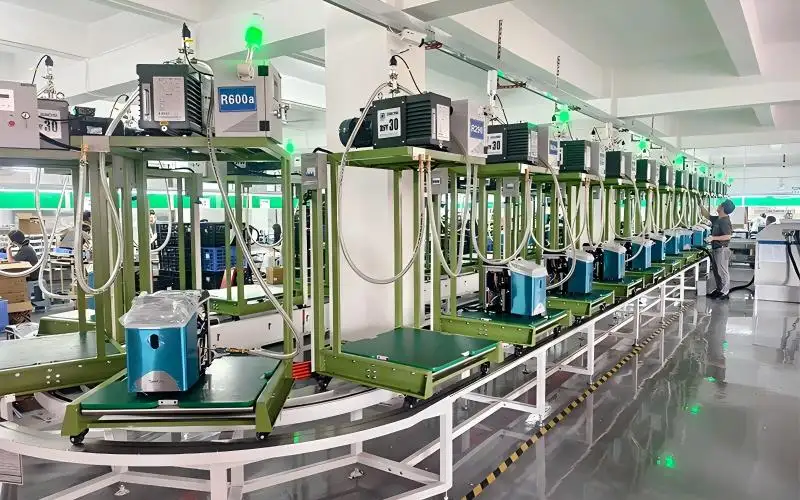
How We Test Every Ice Maker Before Packaging
2026-09-15
BY YUMYTH
A step-by-step look at refrigerant handling, cooling verification, leak detection, corrective action and electrical safety testing For an ice maker, reliable performance is determined long before the carton is sealed. ...
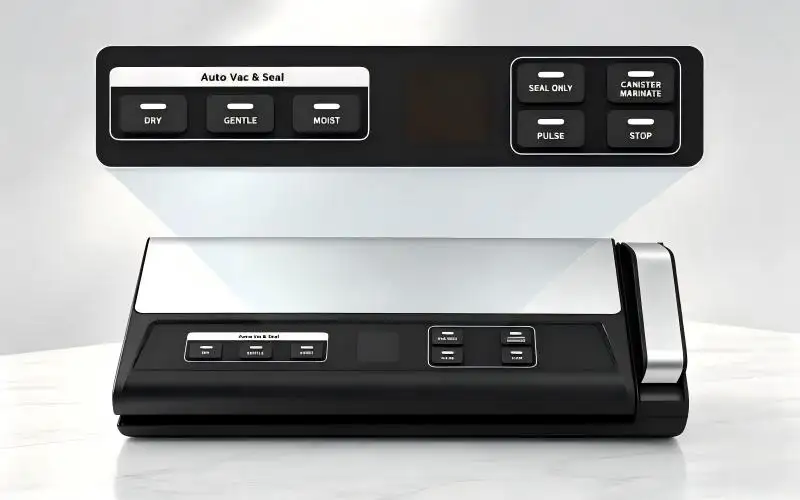
Guide for Brands Looking for a Reliable Vacuum Sealer OEM Supplier
2026-09-14
BY YUMYTH
When you are sourcing kitchen appliances for your retail brand, finding a dependable vacuum sealer OEM supplier is rarely just about getting the lowest unit price. It is about protecting ...

Why Ice Shape Matters: Understanding 10mm × 15mm Cylindrical Nugget Ice
2026-09-14
BY YUMYTH
More Than Ice Production — The Ice Itself Shapes the Consumer Experience When sourcing a nugget ice maker, buyers often focus first on production capacity, water tank size, ice basket ...

Ice Maker Sourcing Guide: How to Find the Right Factory
2026-09-10
BY YUMYTH
Sourcing an ice maker looks straightforward on paper. Find a supplier, agree on a price, place an order. But anyone who has actually done this knows the process is rarely ...