
What Features Should a Home Slushie Machine Have? (The Complete 2026 Checklist)
Share:
-

-

-

-


Copied

Share:
-
-
-
-
Copied
A good home slushie machine needs: a built-in compressor (no ice required), a tank sized for your household (1–2.5L), quiet operation under 70 dB, removable easy-clean parts, a spigot dispenser, and at least one cocktail-compatible mode if you plan to make frozen drinks for adults. Everything else is a bonus.
You've decided you want a home slushie machine. You've opened three browser tabs. Every machine claims to do everything — "professional-grade," "easy clean," "perfect texture every time." The marketing all sounds identical, and the prices range from $60 to $350 with no obvious explanation for why.
Here is the honest truth: most slushie machine buying guides are written by people who have never built one. At YUMYTH, we manufacture compressor-based home slushie machines from the ground up — our engineers make decisions about every component on this list. This guide is that decision framework, translated into plain language for home buyers. Ten features, in priority order, with the data to back each one up.
Feature 1 — Compressor-Based Freezing (The Most Important Decision)
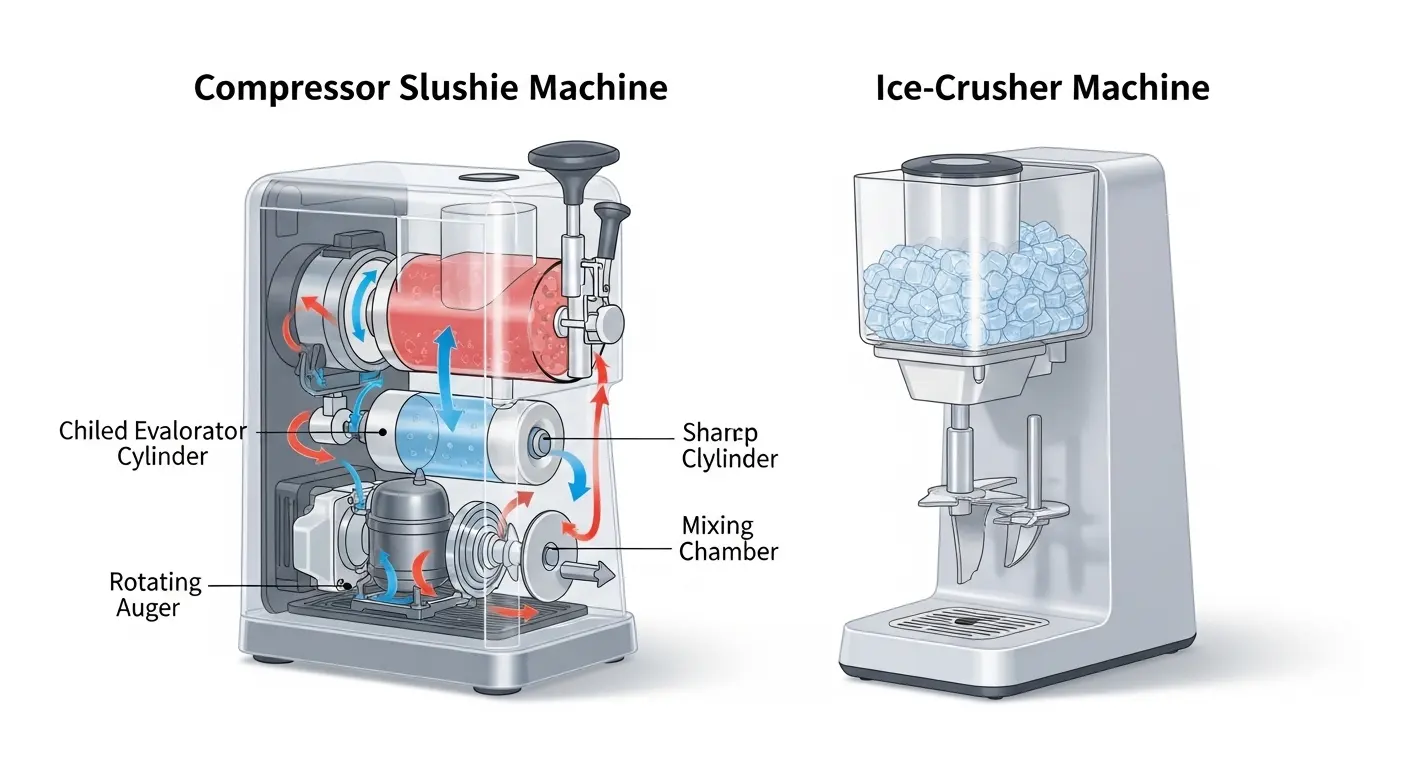
Before you evaluate any other feature — noise level, capacity, smart controls, price — you need to make one foundational hardware decision: compressor machine or ice-crusher machine?
This single choice determines everything else about your slushie experience.
A compressor slushie machine has a built-in refrigeration system — the same technology your fridge uses, miniaturized into a countertop appliance. A metal evaporator cylinder inside the tank gets cold. You pour your liquid in, it contacts that cold cylinder, and ice crystals start forming at the edges. A rotating auger scrapes those crystals off continuously, keeping them fine and uniform. The result: smooth, consistent slush from a liquid you poured in — no ice required.
An ice-crusher / blender slushie maker does none of that. You make ice cubes in advance, load them in, and the machine crushes them into your flavored liquid. Cheaper upfront, but with a significant catch: the ice dilutes your drink as it melts. By the third cup, your slushie is noticeably more watery than the first. You also need to think about ice supply every time — no ice in the freezer means no slushie.
The data comparison:
| Compressor Slushie Machine | Ice-Crusher Machine | |
|---|---|---|
| Ice required | No | Yes |
| Wattage | 150–400W | 60–120W |
| Freeze time | 18–40 min (no prep) | 5 min + 20–30 min ice-making |
| Noise during use | 55–68 dB | 75–90 dB (crushing phase) |
| Texture consistency | Fine, uniform crystals | Coarse, variable, melts fast |
| Drink dilution | None — freezes the liquid itself | Yes — ice melts into the drink |
| Price range | $80–$350 | $30–$100 |
| Best for | Daily use, consistent quality | Budget, occasional use |
For the slushie machine buying guide for home, the compressor is the non-negotiable starting point. If the machine you're looking at doesn't have a built-in compressor, it is not worth evaluating on any other criterion for regular daily use.
The compressor technology in home slushie machines is the same mechanism used in home ice cream makers — if you're weighing both appliances, see our guide on how slush machines compare to ice cream makers before deciding.
Why "No Ice Needed" Is More Than a Convenience Feature
The "no ice needed" claim isn't just about saving a trip to the freezer — it's about drink quality across every pour.
When an ice-crusher machine makes your first cup, the ice is fresh and cold. By the second or third cup, the remaining ice in the tank has partially melted, releasing water into the mix. The slushie gets thinner, more diluted, less flavorful. The last cup out of an ice-crusher machine tastes noticeably different — and worse — than the first.
A compressor machine freezes the actual liquid you poured in. There is no separate ice to melt. The flavor concentration stays constant from the first cup to the last. For families making multiple servings throughout an afternoon, or for anyone who cares about quality consistency across a batch, this difference is the whole argument.
Feature 2 — Tank Capacity (Matching the Machine to Your Household)
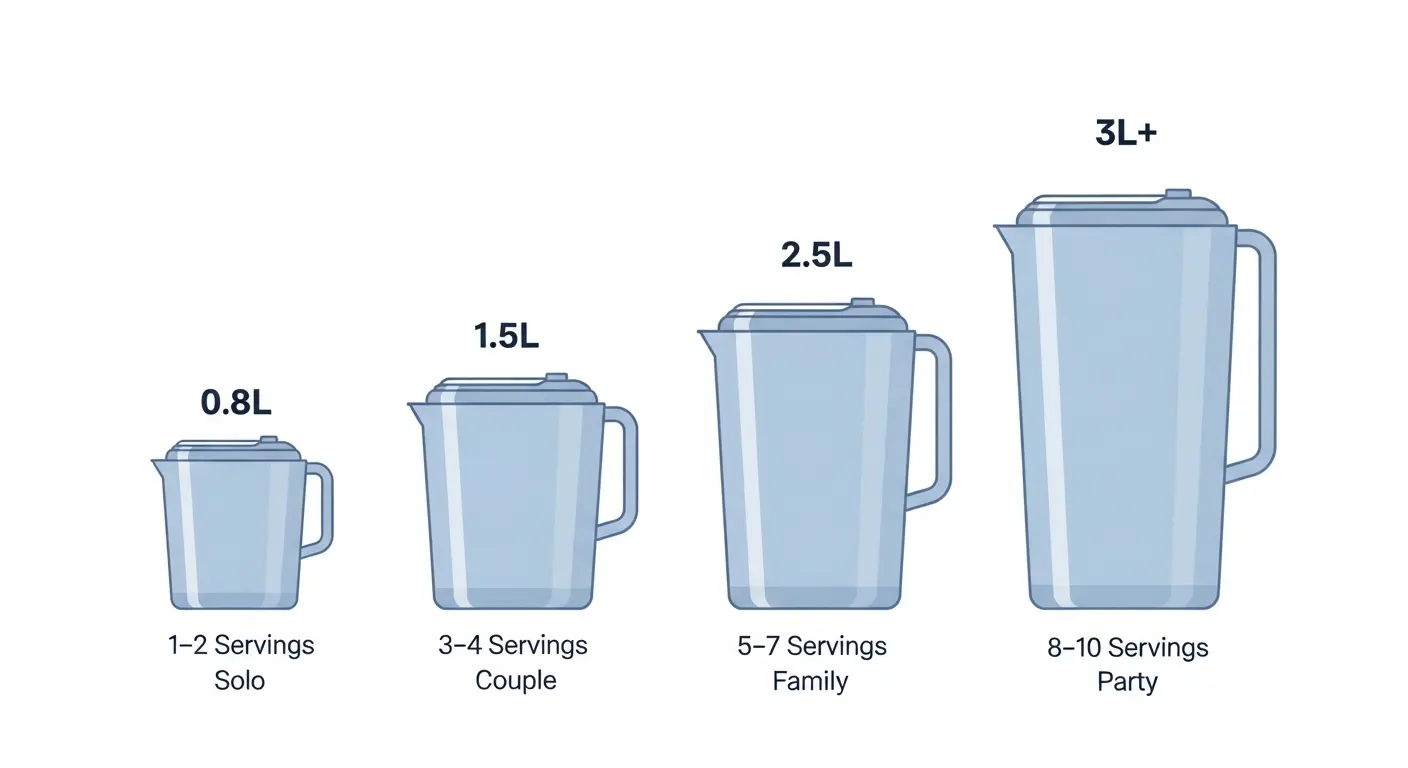
Tank capacity is the second most important feature — and the most commonly misjudged in both directions. Buy too small and you're constantly refilling and recleaning. Buy too large and you're wasting unused slush and waiting longer for each batch to freeze.
A standard serving of slush is approximately 250–350ml (8–12 oz). Here is the household-to-capacity guide:
| Tank Capacity | Servings Per Batch | Best For |
|---|---|---|
| 0.5–0.8L | 1–2 servings | Solo daily use, office desk machine |
| 1–1.5L | 3–4 servings | Couple or small family occasional use |
| 1.5–2.5L | 5–7 servings | Family of 3–4, regular use |
| 2.5–3L | 8–10 servings | Regular entertaining, larger households |
| 3L+ | 10–12+ servings | Frequent parties, near-commercial use |
For most home buyers, the 1.5–2.5L range is the practical sweet spot. The ASTRALSHIP 85oz (2.5L) is a good benchmark for a family-sized home machine — its spec sheet recommends filling to 64oz (1.9L) for optimal texture and freeze performance per batch.
The common mistake is buying a 3L+ machine "for parties" that gets used twice a year — and then living with a large, slow-freezing machine on your counter for the other 363 days. If parties are your primary use case, see our use-case guide for slushie machines for entertaining. If daily use is the priority, a 1.5L machine sized for your actual household is the better daily companion.
Our Mini Slush Machine is specifically engineered for the 1–2 person daily use scenario — a compact tank that freezes a fresh batch in under 25 minutes without wasting product or counter space.
Single-Tank vs. Multi-Tank: Do You Need Multiple Flavors?
Commercial slushie machines often feature 2–3 tanks for simultaneous multiple flavors. For home use, this is almost always unnecessary.
Most home users make one flavor at a time and clean between batches. Multi-tank home machines add significant counter footprint, more cleaning complexity, and a higher price — for a capability most home buyers use maybe twice a year. The only scenario where a multi-tank home machine earns its place is if you host parties regularly and want guests to choose between two simultaneous flavor options without waiting. For everyone else, single tank is the smarter buy.
Feature 3 — Noise Level (The Most Overlooked Home Feature)
In a commercial kitchen, an 80 dB machine is an acceptable trade-off for volume output. In a home kitchen at 9pm — or in an open-plan living area while children are watching television in the next room — it is a serious problem.
Noise is the most overlooked feature in every competitor buying guide for home slushie machines. It consistently appears as a top complaint in product reviews, Reddit threads, and Facebook groups. And yet no published buying guide quantifies it with actual data.
Here are the numbers:
| Sound Source | Approximate dB Level |
|---|---|
| Refrigerator hum | 40–50 dB |
| Normal conversation | 60 dB |
| Home compressor slushie machine | 55–68 dB |
| Vacuum cleaner | 75 dB |
| Ice-crusher during crushing phase | 75–90 dB |
| Blender | 80–90 dB |
| Hair dryer | 90 dB |
A compressor home slushie machine running at 55–65 dB is comparable to a normal conversation — noticeable but entirely livable. You can talk over it, watch television near it, have it running while guests are in the kitchen.
An ice-crusher machine during its crushing phase hits 75–90 dB — louder than a vacuum cleaner, comparable to a blender. In a small apartment or open-plan home, this is disruptive. For evening use it becomes genuinely inconsiderate.
What to look for on the product listing: any noise rating between 55–68 dB for a home compressor machine is good. Anything above 70 dB should be a flag. Many budget machines and all ice-crusher machines omit noise data entirely — which is usually a sign the number wouldn't help sell the product.
The way YUMYTH engineers noise out of our machines starts at the compressor housing design — the compressor mount, vibration dampening, and motor insulation are all specified with home kitchen context in mind. For our engineering approach, see our industry insights blog.
Feature 4 — Ease of Cleaning (The Feature That Determines Long-Term Use)
The #1 reason home slushie machines stop being used after the first month is not texture or noise or capacity. It is cleaning. If the machine is a significant effort to clean, it moves to the back of a cabinet by week four.
What to look for in a home slushie machine's cleaning design — in order of importance:
1. Auto-clean / self-rinse cycle
The most valuable cleaning feature on a 2025–2026 home machine. Pour plain water into the tank, press the clean button, and the machine flushes water through the auger and spigot in 3–15 minutes depending on the model. Dirty water dispenses out through the spigot into a waiting container or sink. Between batches, this is sufficient for daily use — it removes residual syrup and flavor without disassembly. The ASTRALSHIP 85oz, for example, completes a self-cleaning cycle in 15 minutes with one button press.
2. Fully removable, dishwasher-safe parts
The tank, auger, drip tray, and spigot should all detach without tools for weekly deep cleaning. Non-removable components — especially non-removable augers or spigots — require manual wiping inside the tank, which is time-consuming and often leaves residue in hard-to-reach areas. Check the product listing explicitly: "dishwasher-safe vessel and auger" vs. "wipe clean only."
3. Accessible, removable spigot
The spigot is in contact with every cup of slush that leaves the machine. It needs to be fully disassembled for proper weekly cleaning. A spigot that can only be wiped externally is a long-term hygiene risk in a home kitchen.
Weekly cleaning time benchmarks:
- Machine with auto-rinse + fully removable parts: 10–15 minutes weekly full clean + 3–5 minutes daily auto-rinse
- Machine with removable parts, no auto-rinse: 15–20 minutes weekly full clean
- Machine with non-removable components: 20–35 minutes weekly manual clean with cotton swabs and pipe cleaners
If you're using the machine daily, the auto-rinse cycle becomes a non-negotiable time-saver. If you use it weekly or less, removable dishwasher-safe parts matter more than the auto-cycle.
Our Slush and Ice Cream Maker features a fully removable tank and fully disassembling spigot for complete cleaning access after every session.
What an Auto-Clean Cycle Actually Does (and Doesn't Do)
An auto-clean cycle is not a steam clean or a sanitization. It is a water flush — and home buyers sometimes expect more than it delivers.
When you run the auto-clean cycle: water contacts the auger, the evaporator cylinder, and the internal tank surfaces, then flows out through the spigot into a waiting bowl. Residual syrup, sugar, and flavor from the previous batch are flushed out. For daily use with the same flavor, the auto-rinse between batches is entirely adequate.
For weekly deep cleaning — or when switching between very different flavors — the auto-cycle alone is not sufficient. Disassemble the tank and spigot, wash with warm dish soap, rinse thoroughly, and allow to dry before reassembling. This takes 10–15 minutes and should happen at least once per week for food-safe hygiene.
Feature 5 — Preset Drink Modes (What Matters vs. What Doesn't)
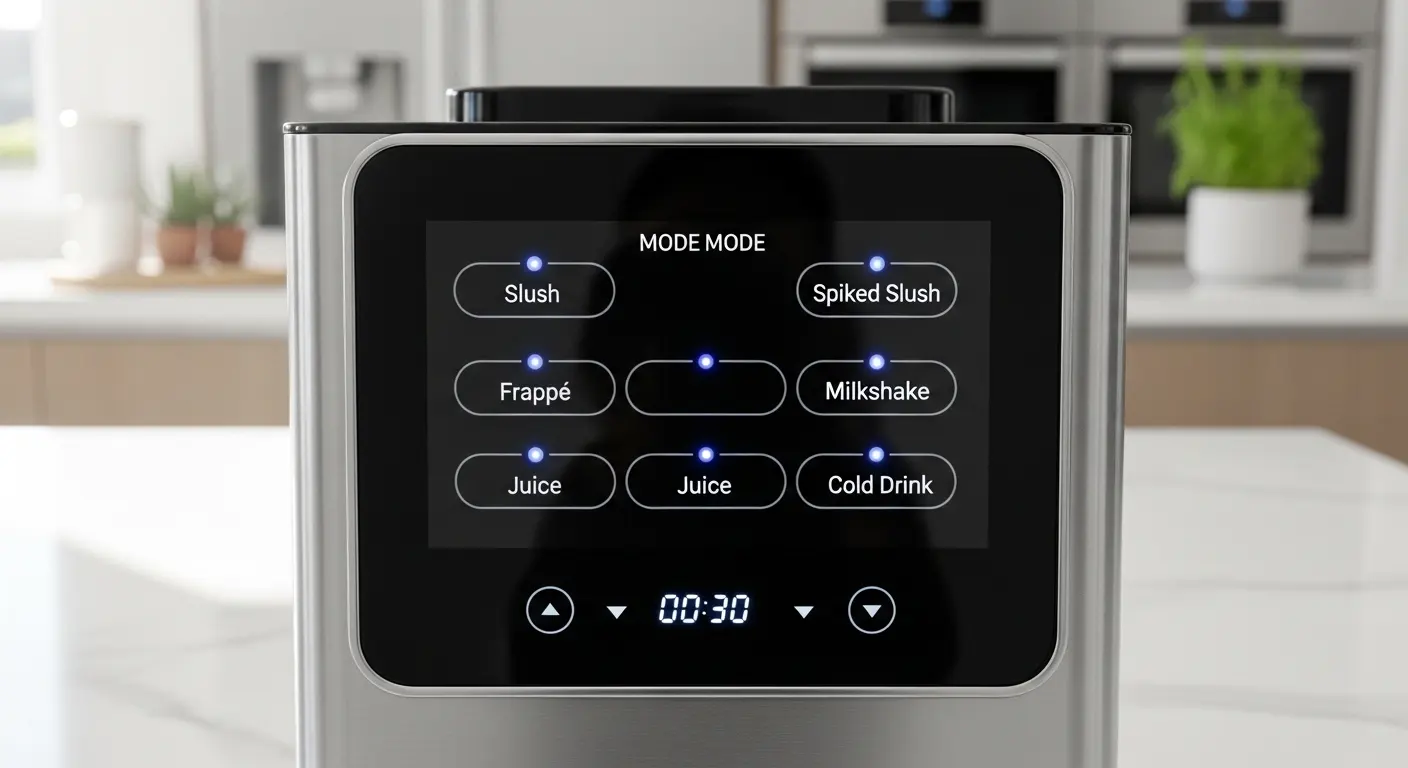
Modern home compressor slushie machines offer between 2 and 6 preset modes. Understanding what each mode actually does helps you decide whether you need the full suite or just the basics.
The core preset modes explained:
| Mode | What It Does | Who Needs It |
|---|---|---|
| Slush | Full compressor + auger power — for high-sugar, zero-alcohol drinks | Everyone — the standard mode |
| Spiked Slush / Frozen Cocktail | Reduced compressor intensity — calibrated for alcohol-containing mixes | Anyone making cocktails at home |
| Frappé | Slower auger + warmer target — produces thicker, creamier consistency | Coffee drink lovers |
| Milkshake | Slowest auger, warmest target — maximum creaminess, minimum ice crystal | Household with children / milkshake fans |
| Juice / Cold Drink | Chills without fully freezing — serves cold liquid at ~5–8°C | When you want cold drinks, not slush |
| Frozen Yogurt / Ice Cream | Specific to dual-function machines like the YUMYTH Slush and Ice Cream Maker | Families wanting both products |
For most home buyers, two to three modes cover 90% of real use: Slush (for juice and soda slushies), Spiked Slush (for cocktails), and one of Frappé or Milkshake if your household drinks those regularly. The ASTRALSHIP 85oz offers all 6 modes plus a smart sugar/alcohol detection system that alerts you when brix is too low (E1 error) or ABV is too high (E7 warning) in real time.
The Ninja SLUSHi FS299 by comparison offers 2 preset programs. For most home buyers, 2 is sufficient. Six modes are genuinely useful if your household drinks span slushies, cocktails, coffee frappes, and milkshakes regularly. If you're primarily a slushie-and-occasional-margarita household, two modes are enough.
Do You Need a Cocktail / Spiked Mode?
If there is any chance you will ever make a frozen margarita, a rosé slushie, a hard lemonade slushy, or any alcohol-containing frozen drink — yes, a dedicated spiked slush or frozen cocktail mode matters.
Without it, a machine running standard slush mode applies too much compressor intensity to an alcohol-containing mix. Alcohol lowers the freezing point of liquid — the machine ends up over-cooling the edges while the center stays liquid, producing inconsistent slushy texture. The cocktail mode dials back the compressor and auger speed to work with the freeze chemistry of the alcohol rather than against it.
If you only plan to make non-alcoholic juice and soda slushies, the cocktail mode is irrelevant and shouldn't factor into your buying decision.
Feature 6 — Spigot and Dispenser Design
The spigot is the one part of the machine you physically interact with every single time you pour a drink. It deserves more attention than it gets in buying guides.
Three common home machine spigot designs:
Lever push spigot — The most common. Press the lever to dispense; release to stop. Easy to use but tends to drip slightly between servings as residual slush slowly flows to the nozzle. Fine for regular home use; can make a mess if children are self-serving.
Locking faucet spigot — Twist or push to lock the flow open; twists closed automatically when released. Cleaner dispensing, less drip, better for self-serve. Preferred for home entertaining where guests pour their own.
Single-press button dispenser — Press once to start flow, press again to stop. Easiest for hands-free pouring but requires attention to stop at the right volume. Better for adults than children.
What to check before buying:
- Is the spigot fully removable for cleaning? Non-removable spigots are a hygiene issue over time.
- Is there a drip tray included and does it catch the full spigot footprint?
- Is the nozzle opening wide enough to dispense thicker slush without clogging? Narrow nozzles are a common complaint in Facebook groups for budget machines.
Feature 7 — Tank Visibility / Transparency
A small feature that makes a meaningful difference during home entertaining. A fully transparent or see-through tank lets you monitor slush level and consistency without opening the machine or checking a digital readout — useful when you're hosting guests and managing multiple drinks simultaneously.
What to look for:
- Full 360° visibility (not just a narrow window strip)
- Clearly marked MIN and MAX fill lines visible from outside the tank — critical for correct operating volume and preventing over/under-filling errors
- BPA-free material certification — polycarbonate and Tritan are the standard materials in quality home machines in 2025–2026
Fully opaque tanks require you to rely on a digital level indicator (if the machine has one) or physically open the lid to check. For daily solo use, opaque tanks are fine. For party use where you need to quickly assess how much is left and whether to start a new batch, transparency is a genuinely useful feature.
Feature 8 — Smart Controls and Digital Display
Entry-level machines from 2021–2022 used a single on/off switch. Modern 2025–2026 home compressor machines increasingly feature touch panels, LED mode displays, temperature indicators, auto-shutoff, and night mode. Not all of these matter equally.
What actually matters for home use:
Auto-shutoff — The most practically valuable smart feature on this list. When your slush reaches target consistency, the machine pauses the freeze cycle and holds the temperature, rather than continuing to run and potentially over-freezing. You can start the machine, leave the kitchen, and return to perfect slush. Without auto-shutoff, leaving a compressor machine running too long can result in the mix hardening to the point where the auger motor strains.
Temperature / texture control — Some 2025–2026 machines (the ASTRALSHIP, for example) offer 10 adjustable texture levels so you can fine-tune from soft-serve-style slush to firmer Italian ice consistency. For most home users, preset modes cover this adequately — but adjustable texture is a legitimate differentiator for buyers who want precise control.
Night mode — Dims or turns off the LED display lighting during standby. Minor feature, but relevant for open-plan homes where the machine is visible from a living area and the backlit display creates unwanted light in the evening.
Sugar / alcohol smart detection — The ASTRALSHIP's E1/E7 alert system detects when sugar content is too low (below 5%) or alcohol content is too high (above 16%) and alerts you before you run a batch that won't freeze properly. This is a genuinely useful error-prevention feature for new users who haven't learned recipe balancing yet. Not yet standard across all brands, but worth noting as the direction the category is moving.
Feature 9 — Footprint and Counter Fit
A machine that doesn't fit on your counter doesn't get used. This is obvious in retrospect and overlooked at the time of purchase more often than any other dimension.
What to measure before buying:
- Available counter width and depth in your kitchen
- Clearance height under overhead cabinets — standard UK/US kitchen overhead cabinet clearance is 40–50cm
- Distance to the nearest power outlet — most machines have a 1–1.5m power cord
- Whether you plan to store it on the counter permanently or put it away between uses (permanent counter placement requires a compact footprint; storage-friendly machines need to be light enough to move regularly)
Home machine size benchmarks:
- Compact class: sub-30cm height — designed for under-cabinet permanent counter placement
- Standard class: 35–45cm height — most home compressor machines; fits most kitchens with standard clearance
- Large class: 45–55cm+ — near-commercial size; requires open counter space or dedicated appliance area
The YUMYTH Mini Slush Machine is specifically engineered for the compact class — designed to fit permanently on a standard kitchen counter under overhead cabinets without requiring appliance storage between uses.
Feature 10 — Alcohol Compatibility Ratin
If there is any possibility you will make frozen cocktails — even a few times a year — verify that the machine is explicitly rated for alcohol-containing recipes before buying. This is not a given.
The reason: alcohol lowers the freezing point of liquid. A machine without a cocktail mode and without a compressor calibrated for lower-temperature alcohol chemistry may produce adequate slush at 0–5% ABV but will struggle above 8–10% ABV. The liquid chills but never reaches proper slush consistency.
What to verify in the product listing:
- Explicitly states "spiked slush," "frozen cocktail mode," or "alcohol compatible" — not just "make frozen drinks"
- States the ABV operating range in the manual or spec sheet (standard home compressor machine: up to 8–10% ABV; advanced calibration machines: up to 12–16% ABV)
- Compressor wattage is 150W or above — under-powered compressors struggle with alcohol chemistry
The practical ABV rule for home use: no more than 1–1.5 oz of spirit per 12–16 oz of total mix in the tank. This keeps your final ABV in the 6–9% range — within the operating window of any quality home compressor machine. For detailed margarita recipe calibration, see our full guide on how a slushie machine compares to a margarita machine.
For adult households where frozen cocktails are a regular use case, our Slush and Ice Cream Maker handles cocktail-compatible recipes alongside its ice cream function — a dual-purpose machine for households that want both.
Features That Sound Good But Are Often Not Worth the Extra Cost
Honest buying guidance requires saying this clearly: there are features heavily marketed in the slushie machine category that deliver less real value for home users than their price premium suggests.
Multiple tanks — In a commercial bar, two simultaneous flavors is a revenue feature. At home, most users make one flavor at a time and clean between batches. Multi-tank machines add $80–$150 to the price, a significantly larger counter footprint, and double the cleaning work — for a capability most home buyers use fewer than five times per year.
Very large capacity (3L+) — Larger tanks sound impressive and make the machine look more capable. In practice, most home users never fill above 1.5–2L in a session. Larger tanks take 10–15 minutes longer to freeze, waste unused product at the end of sessions, and consume more energy per batch. Unless you regularly serve 10+ people from one machine, 2.5L is the practical ceiling for home use.
Premium brand name on the housing — Margaritaville is the best example. Their machines are well-made, attractively branded, and use identical compressor and auger mechanisms to machines at half the price. A Margaritaville Bali at ~$230 and a well-specified home compressor machine at ~$120 produce indistinguishable frozen margaritas with the same diluted recipe. You are paying for brand identity and the island-lifestyle aesthetic — not for meaningful performance improvement.
For households where a separate ice source is needed alongside a slushie machine, a compact standalone unit is more efficient than buying a larger combo machine — see our compact ice makers for options that pair well with any slushie machine.
The Complete Feature Checklist: What to Look For by Use Case
Home Slushie Machine Features — Priority by User Type
| Feature | Must-Have / Nice-to-Have / Skip | Families with Kids | Cocktail Enthusiasts | Daily Solo Use | Party Hosts |
|---|---|---|---|---|---|
| Compressor (no ice) | Must-Have | ✅ | ✅ | ✅ | ✅ |
| 1.5–2.5L tank capacity | Must-Have | ✅ | ✅ | ⚠️ 1L sufficient | ✅ 2.5L+ |
| Noise below 70 dB | Must-Have | ✅ Critical | ✅ | ✅ | ✅ |
| Auto-clean / self-rinse | Must-Have for daily use | ✅ | ✅ | ✅ Critical | Nice-to-Have |
| Removable dishwasher-safe parts | Must-Have | ✅ | ✅ | ✅ | ✅ |
| Spiked / cocktail mode | Must-Have if cocktails | Skip | ✅ Critical | Depends | ✅ |
| Multiple preset modes | Nice-to-Have | ✅ (milkshake/frappé) | ✅ | Skip | ✅ |
| Transparent tank | Nice-to-Have | ✅ | Nice | Nice | ✅ Useful |
| No-drip spigot (lockable) | Nice-to-Have | ✅ Critical | Nice | Nice | ✅ Useful |
| Smart controls / auto-shutoff | Nice-to-Have | ✅ Useful | ✅ Useful | ✅ Useful | Nice |
| Digital display / night mode | Optional | Nice | Nice | Nice | Optional |
| Sub-30cm compact footprint | Depends on kitchen | ✅ | Nice | ✅ | Skip |
| 3L+ large tank | Skip (for most) | Skip | Skip | Skip | Maybe |
Frequently Asked Questions
What is the most important feature to look for in a home slushie machine?
The most important single feature is the freezing mechanism — specifically whether the machine has a built-in compressor or requires pre-made ice. Compressor machines produce better texture, require no ice prep, maintain consistent quality across multiple servings, and operate more quietly than ice-crusher machines. Every other feature is secondary to this foundational hardware choice.
What tank size is best for a home slushie machine?
For a single person or couple, 1–1.5L is ideal. For a family of 3–4 using the machine regularly, 1.5–2.5L is the practical sweet spot. Only buy 3L+ if you regularly serve 10 or more people from one machine. Larger tanks take longer to freeze, waste more unused product, and consume more energy per batch than the smaller size you actually use.
How many watts does a home slushie machine need?
A good home compressor slushie machine uses between 150–300W in standard operation. Higher wattage (200–400W) delivers faster freeze times and better performance with alcohol-containing recipes. Budget ice-crusher machines use 60–120W but require pre-made ice and produce inferior texture. For daily home use with cocktail capability, 150–250W is the target range.
How loud are home slushie machines?
Compressor-based home slushie machines operate at approximately 55–68 dB — comparable to normal conversation. Ice-crusher machines hit 75–90 dB during the crushing phase, comparable to a vacuum cleaner. For open-plan homes, evening use, or homes with young children, a compressor machine's 55–68 dB operating level is entirely livable; an ice-crusher machine at 80+ dB is genuinely disruptive.
Do home slushie machines have self-cleaning features?
Many 2025–2026 home compressor slushie machines include an auto-rinse cycle — pour plain water into the tank, press the clean button, and the machine flushes water through the auger and spigot in 3–15 minutes. This handles daily between-batch cleaning adequately. A full disassembly clean with dish soap remains necessary weekly for complete food-safe hygiene. Not all machines include this feature — check the spec sheet explicitly.
How long does a home slushie machine take to make a slushie?
With pre-chilled liquid (refrigerator temperature), a good home compressor machine reaches proper slush consistency in 18–25 minutes. With room-temperature liquid, expect 28–40 minutes. Pre-chilling your mix in the fridge for 2+ hours before using is the single most effective way to cut freeze time without any other changes.
Can a home slushie machine make frozen cocktails?
Yes — if the machine has a dedicated cocktail or spiked slush mode and your recipe keeps the final ABV below approximately 8–10%. Machines with higher-power compressors and cocktail-calibrated modes can handle up to 12–16% ABV. The practical home recipe rule: no more than 1–1.5 oz of spirit per 12–16 oz of total mix. Standard slush-only machines without a cocktail mode will produce inconsistent results above 8% ABV.
What slushie machine features are not worth paying extra for?
Three features commonly marketed but over-priced for home use: multiple tanks (home users rarely need simultaneous flavors), very large capacity above 3L (most home sessions use under 2L), and premium brand names like Margaritaville (same compressor mechanism as well-specified machines at half the price). Focus spending on compressor quality, noise level, cleaning design, and cocktail mode compatibility for best value per dollar.
Ready to Apply This Checklist to a Real Machine?
YUMYTH builds home compressor slushie machines with every feature on this list engineered deliberately — not assembled from the lowest-cost components available. We manufacture frozen drink machines for brands across 92+ global markets, and our home machine line applies that same compressor engineering to a kitchen-friendly form factor.
Every YUMYTH home machine includes:
- ✅ Built-in compressor — no ice required
- ✅ Quiet operation — engineered for home kitchen use
- ✅ Fully removable, cleanable components
- ✅ Compact footprint for standard kitchen counter placement
- ✅ BPA-free materials, CE/ETL/RoHS certified
Choose your machine:
- Mini Slush Machine — Compact, compressor-powered, quiet. Built for 1–2 person daily home use. Fits under standard overhead cabinets. Perfect first home slushie machine for the buyer who checked every item on this list.
- Slush and Ice Cream Maker — Dual-function: frozen drinks and homemade ice cream from one mid-size home unit. Ideal for families wanting both adult cocktail slushies and frozen treats for children.
- Explore all YUMYTH home machines — Full range, direct from the manufacturer, with complete spec sheets.
Related Articles
How We Test Every Ice Maker Before Packaging
2026-09-15
BY YUMYTH
A step-by-step look at refrigerant handling, cooling verification, leak detection, corrective action and electrical safety testing For an ice maker, reliable performance is determined long before the carton is sealed. ...
Guide for Brands Looking for a Reliable Vacuum Sealer OEM Supplier
2026-09-14
BY YUMYTH
When you are sourcing kitchen appliances for your retail brand, finding a dependable vacuum sealer OEM supplier is rarely just about getting the lowest unit price. It is about protecting ...
Why Ice Shape Matters: Understanding 10mm × 15mm Cylindrical Nugget Ice
2026-09-14
BY YUMYTH
More Than Ice Production — The Ice Itself Shapes the Consumer Experience When sourcing a nugget ice maker, buyers often focus first on production capacity, water tank size, ice basket ...

Ice Maker Sourcing Guide: How to Find the Right Factory
2026-09-10
BY YUMYTH
Sourcing an ice maker looks straightforward on paper. Find a supplier, agree on a price, place an order. But anyone who has actually done this knows the process is rarely ...