
Does YUMYTH Offer OEM and ODM Services?
Share:
-

-

-

-


Copied

Share:
-
-
-
-
Copied
Yes. YUMYTH Cooling provides OEM and ODM services of frozen drink machine and some small kitchen appliances. It offers customization service for projects from private label usage to product design, engineering development, prototyping, tooling, testing, mass production, quality control, packaging and delivery.
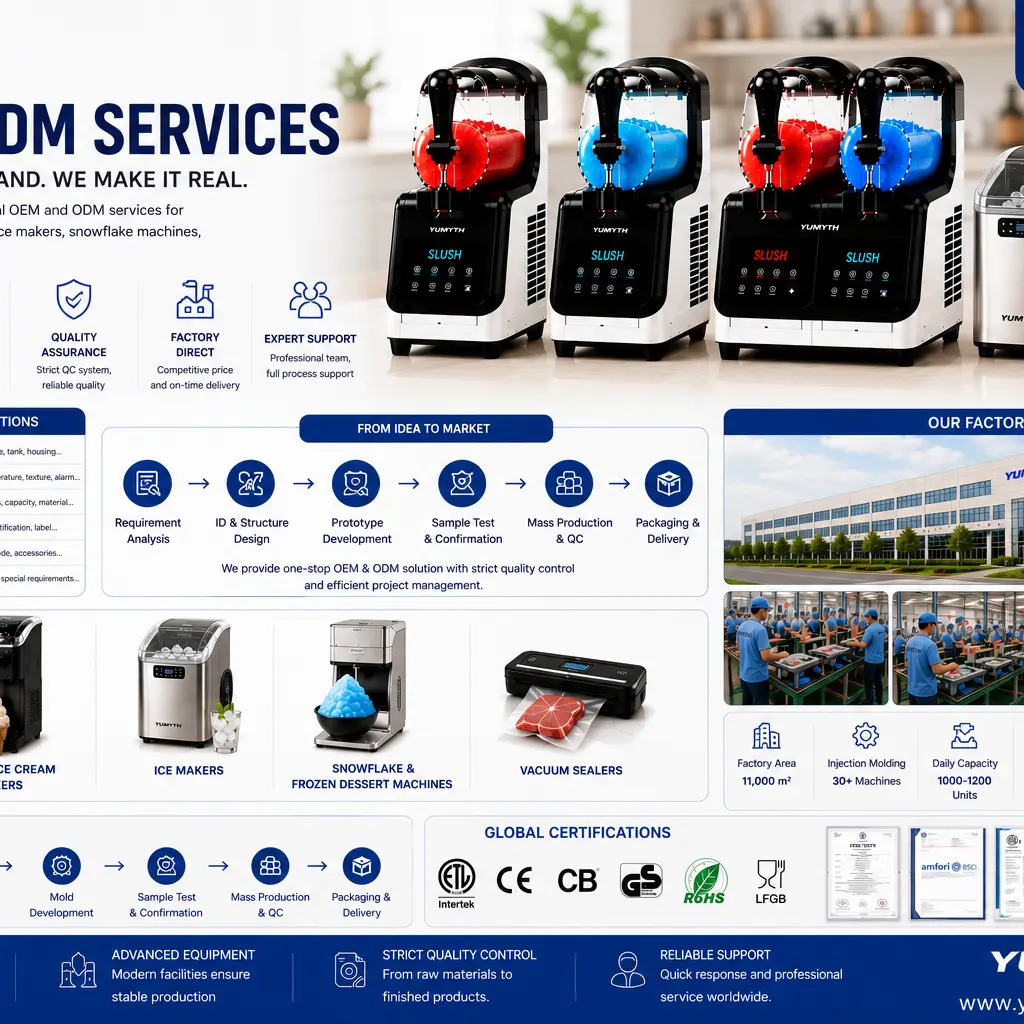
According to YUMYTH, their service system covers all aspects of the product creation, right from the initial idea to the ready-to-be-produced appliances. It is designed for appliance brands, importers, distributors, retailers, and product developers who are looking for an existing platform to build upon or a more differentiated frozen drink appliance.
The Difference between OEM and ODM?
OEM/ODM projects may encompass varying degrees of ownership and development of the product.
In a conventional OEM project, the customer gives detailed product requirements and technical specifications, drawings, or a product concept. The manufacturer can then create or make the appliance based on those requirements.
In an ODM project, typically, the customer starts with a platform developed by another manufacturer. From there the product can be modified via branding, colors, functions, control programs, packaging, electrical configurations, and/or selected structural changes.
For many appliance brands, ODM is a quicker and riskier alternative to development since the refrigeration, mixing and control platform is already developed. OEM development is more differentiating but might involve more engineering, tooling, testing and certification preparation costs.
Both can be used with YUMYTH. It has been published as an OEM/ODM, which covers product design, research and development, prototyping, manufacturing, and quality control.
Create customizations for private-label and branding.Develop private-label and branding customizations.
The basic level of cooperation is private-label customization.
A brand can start with an existing YUMYTH appliance and tailor aspects like:
- * Brand logo;
- * Nameplate;
- * Product labels;
- * Control-panel graphics;
- * Housing color;
- * User manual;
- * Recipe guide;
- * Retail carton;
- * Warranty documentation;
- * Accessories.
This is for companies who wish to introduce a frozen drink machine without altering the mechanical and refrigeration systems in place.
Reusing a platform will minimize engineering validation work. It can also give the customer a chance to test demand using the equipment before they purchase new molds, electronic controls, or refrigeration equipment.
The private label information provided by YUMYTH is an integrated design-to-delivery service designed to assist in branding, product presentation, production management, pilot orders and market entry.
Appearance and Industrial Design Options
If the brands want to be more visually differentiated, they can ask to have more than just a logo printed.
There may be customisation options available when it comes to how it looks, such as:
- * Exclusive housing colors;
- * solid colors; and
- * Decorative panels;
- * Control-panel shapes;
- * Button layouts;
- * Dispensing-handle designs;
- * Tank markings;
- * Product dimensions;
- * Surface textures.
Existing molds can be used to make some changes with colored or printed graphics. Others need mold inserts, changes to their tools or brand new moulds.
Any new housing, beverage tank, lid, auger or dispensing component should be examined carefully as changes in the housing can impact the assembly, cleaning, leakage, airflow, refrigeration performance and certification.
This project must therefore differentiate cosmetic customization from engineering modifications which involve changing the physical appliance.
How to configure the Control Panel and Firmware.
YUMYTH's slush machine platforms can be customized for control panels and functions.
Based on the current electronics and project requirements, the following modification(s) could be requested by brands:
- * Program names;
- * Icons and languages;
- * Display content;
- * Temperature settings;
- * Texture levels;
- * Cleaning programs;
- * Completion alerts;
- * Error codes;
- * Auger reversal;
- * Motor-protection logic;
- * Startup screens.
For instance, the YX1801 Mini Slush Machine comes with several pre-programmed settings, a custom setting, six temperature settings, an intelligent auger reversal feature, a quick rinse cycle and removable auger cleaning parts. The YX1802 has five preset programs and one custom mode, 6 texture settings, and slush and soft ice cream modes.
When the functions are not changed, it is rather easy to change graphics. The development and testing of the new operating logic will also necessitate firmware development as it may impact the compressor, auger motor, sensors, preparation time, final texture, and overload protection.
Drink Programs and Recipe Compatibility
Brands may wish to have programs that are targeted for particular groups of consumers or regions.
Potential programs include:
- * Standard slush;
- * Frozen cocktail;
- * Wine slush;
- * Frozen coffee;
- * Milkshake;
- * Juice;
- * Soft ice cream;
- * Custom texture.
A program should not be just a new name on the control panel, it should be an approved operating process.
The way a beverage freezes depends on its sugar content, alcohol content, dairy content, volume and starting temperature. Sometimes it's what doesn't work rather than what does.
Recipe testing, temperature changes, development of compressor-cycles, motor-current monitoring, and new user instructions may be necessary for customized programs. Any product claims should be supported by the recipes and operating ranges that have been tested.
Customized structures and mechanisms.
Projects are more advanced ODM/OEM projects may require modification of the tank, auger, lid, valve, nozzle, drip tray or removable cleaning parts.
Changing the beverage tank can affect:
- * Working capacity;
- * Refrigeration load;
- * Freeze time;
- * Liquid circulation;
- * Cleaning access;
- * Product dimensions.
The impact of changing the auger can include a change in mixing, ice scraping, motor load, noise, texture and jam risk. The new dispensing valve design could affect flow, leakage, cleaning and the life of the dispensing seals.
Typical changes include engineering drawings, prototypes, functional testing, durability testing and production-representative samples.
If it needs to be a new injection mold, it is important for the customer to verify the costs, ownership, service life, sample progress, maintenance costs, and minimum production volume of the mold before the mold is made.
Refrigeration-System Development
A refrigeration system designed to meet special requirements is a more advanced development project.
Changes may involve:
- * Compressor model;
- * Refrigerant;
- * Condenser;
- * Evaporator;
- * Fan;
- * Capillary tube;
- * Refrigerant charge;
- * Insulation;
- * Cabinet airflow.
These are all a part of a single system that needs to be balanced. Increasing the compressor size will result in faster freezing speeds, but will also lead to higher noise, heat rejection, power consumption, and cost.
According to their website YUMYTH is a refrigeration-appliance manufacturer using special production facilities for slush and ice production. The slush machine products are based upon stable core platforms designed to enable long-term OEM production and scalable customization.
Changing refrigeration is a benefit that should be requested by brand only if it is going to provide an actual benefit, e.g. increase in refrigeration capacity, faster freezing, better high ambient performance, less noise or a market specific refrigeration solution.
Market-Specific and Electrical Versions.
Different versions for OEM/ODM customers in different countries may be required.
These can be customized items such as:
- * Rated voltage;
- * Frequency;
- * Plug type;
- * Power cord;
- * Rating label;
- * Warning information;
- * Manual language;
- * Certification markings.
Rather than simply changing the plug, a market conversion requires a number of other steps. Compressor, Motor, Fan, PCB, Relay, Power Supply and Protective Parts should be proper for the voltage and frequency of the application.
The product's certificate of conformance must also be the same as the final configuration. Laboratory review or further testing may be needed if the critical components, refrigerant systems, control logic, or enclosure structures are changed.
Packaging and Accessory Development.
Another crucial aspect of YUMYTH's OEM/ODM service is packaging.
Brands may request:
- * Full-color retail cartons;
- * Shipping cartons;
- * Stainless steel pieces; and
- * Accessory boxes;
- * Recipe books;
- * Cleaning brushes;
- * Measuring cups;
- * Replacement seals;
- Custom bar codes and shipping marks.
Package should be designed based on the finished package size and package weight. The “transparent” tank, dispensing system, control panel, compressor mounts, and internal refrigeration tubing must be protected during transportation in a production representative package.
The quantity of custom packages may be different from that of the appliance production quantity due to carton and insert suppliers' minimum quantities.
The process of getting from a concept to mass production.
YUMYTH's OEM/ODM service is a comprehensive development system from concept development, product design, prototyping, testing, mass production to quality control.
A typical project will consist of:
- 1. Confirmation of requirements and/or target market;
- 2. Product-platform selection;
- 3. Industrial and structural design;
- 4. Quotation and project schedule;
- 5. Prototype or sample preparation;
- 6. Test of performance and reliability;
- 7. Tooling, when required;
- 8. Certification preparation;
- 9. Pilot production;
- 10. The manufacturing and delivery of products.
This time frame will vary according to the amount of customization. Some projects (such as logos, packaging, etc.) can move fast, but new molds, new firmware, new structural changes, and new refrigeration changes take time to develop and to validate.
Manufacturing and Quality Support
According to YUMYTH, it has a specialized engineering-driven OEM manufacturing for small appliances and has a facility that is about 11,000 square meters in size and specializes in refrigeration products. Along with this, it's public information includes ISO 9001 and BSCI systems description and a separate production line for slush machines and ice makers.
Services that might be provided to support a customised project could involve:
- * Incoming component inspection;
- * Injection molding;
- * Refrigeration assembly;
- * Electrical assembly;
- * Functional testing;
- * Leakage inspection;
- * Appearance inspection;
- * Packaging;
- * Batch traceability.
Prior to approving mass production, buyers should confirm the exact factory, product configuration, certification coverage, test procedures and quality plan of the product.
What information should buyers be providing?
The buyers should submit:
- * Target market;
- * Intended application;
- * Required capacity;
- * Voltage and plug;
- * Drink programs;
- * Appearance requirements;
- * Certification needs;
- * Estimated order quantity;
- * Target launch schedule;
- * Packaging expectations.
Requirements are used to see if the project can be developed on an existing platform or if a new platform will be necessary for the engineering team.
Conclusion
YUMYTH Cooling provides OEM/ODM services, private-label branding, frozen drink appliance development and more.
By allowing customers to design their own logos, colors, control panels, firmwares, programs, tanks, augers and dispensing systems, electrical versions, packaging, and accessories, it is easy to see why this is so. New molds, structural engineering, development of refrigeration, preparation for certification and pilot production may also be part of deeper projects.
The best strategy for appliance brands is to choose only those features that add value to the customer. A built platform with the proven YUMYTH will minimise development risk and as the market demand increases, controlled engineering changes will offer greater product differentiation.
Related Articles
How We Test Every Ice Maker Before Packaging
2026-09-15
BY YUMYTH
A step-by-step look at refrigerant handling, cooling verification, leak detection, corrective action and electrical safety testing For an ice maker, reliable performance is determined long before the carton is sealed. ...
Guide for Brands Looking for a Reliable Vacuum Sealer OEM Supplier
2026-09-14
BY YUMYTH
When you are sourcing kitchen appliances for your retail brand, finding a dependable vacuum sealer OEM supplier is rarely just about getting the lowest unit price. It is about protecting ...
Why Ice Shape Matters: Understanding 10mm × 15mm Cylindrical Nugget Ice
2026-09-14
BY YUMYTH
More Than Ice Production — The Ice Itself Shapes the Consumer Experience When sourcing a nugget ice maker, buyers often focus first on production capacity, water tank size, ice basket ...

Ice Maker Sourcing Guide: How to Find the Right Factory
2026-09-10
BY YUMYTH
Sourcing an ice maker looks straightforward on paper. Find a supplier, agree on a price, place an order. But anyone who has actually done this knows the process is rarely ...