What Certifications Do YUMYTH Slush Machines Have?
Share:
-

-

-

-


Copied

Share:
-
-
-
-
Copied
According to YUMYTH Cooling, its slush machine platforms will meet the needs of the international market for electrical safety, electromagnetic compatibility, food-contact materials, environmental compliance, and more.
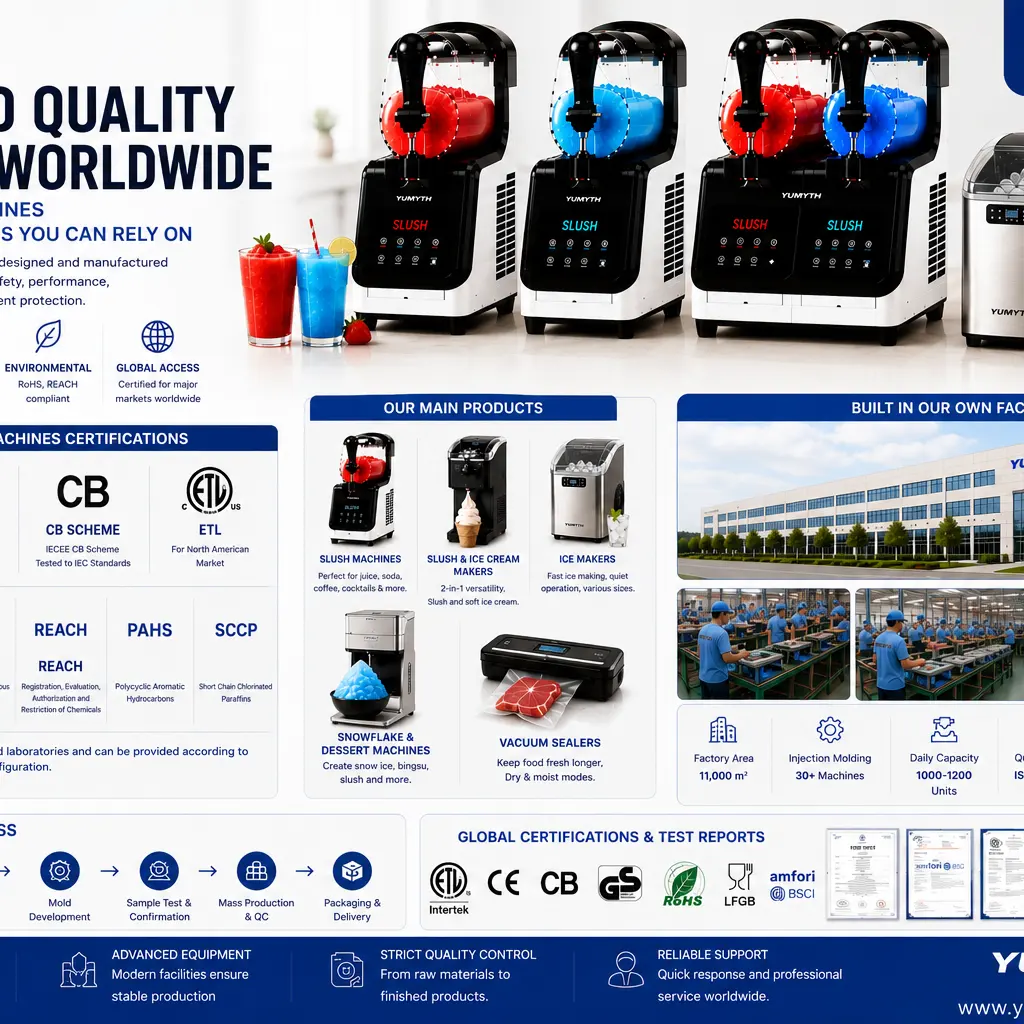
The company's current slush machine FAQ states that their machines meet CE-LVD, CB, ETL, CE-EMC, LFGB, FDA food-contact requirements, RoHS, REACH, SCCP and PAHS. YUMYTH also mentions that the final certification package may be delivered based on the customer's target market and the configuration of the product.
This is an important last point. Checks should be made for specific model, voltage, plug, refrigerant, critical components, firmware and manufacturing plant of an order. A general company certification page or certificate for an appliance similar to the slush machine does not automatically extend to all the customised slush machines.
Electrical Safety: CE-LVD
YUMYTH has CE-LVD in its package of supported compliance.
The Low Voltage Directive (LVD) is the EU Directive on Low Voltage. It is designed to cover the safety hazards of electrical equipment used within the specified voltage range.
An electrical safety evaluation of a compressor-based slush machine might include an evaluation of the following:
- * Electrical safety; and
- * Insulation;
- * Leakage current;
- * Temperature rise;
- * Power-cord construction;
- * Earthing;
- * Waterproofing; and
- * Efficient use of space; and
- * Abnormal operation.
The CE marking is not just a certificate of a laboratory. The manufacturer has to carry out the relevant conformity assessment, to prepare the applicable technical file, to draw up the EU Declaration of Conformity and to affix the CE marking, once all the relevant requirements have been met.
Therefore, buyers are advised to ask for the EU Declaration of Conformity and accompanying test reports, not to look for a CE logo on the rating label.
Electromagnetic Compatibility: CE-EMC
It's also worth noting that YUMYTH also notes its slush machines are certified by CE-EMC.
The European EMC Directive aims to make sure electrical and electronic products do not generate interfering electromagnetic effects and that they are capable of functioning in the presence of recognised electromagnetic disturbances.
A slush machine has many sources of electromagnetic disturbance such as:
- * Compressor switching;
- * Auger motors;
- * Relays;
- * Electronic power supplies;
- * Digital displays;
- * Control boards;
- * Internal wiring.
The conducted emissions, radiated emissions, electrostatic discharge, electrical fast transient, surge events, radio-frequency immunity and voltage interruption are all possible areas of testing for EMC.
Firmware, display, power supply, relay, motor and/or PCB changes could impact EMC performance. Therefore, a customised eVersion should be checked prior to using the compliance outcome of the original eVersion.
CB Scheme Documentation
YUMYTH lists another route to electrical safety certification as CB.
The IECE CB scheme is an international system which is derived from IEC standards. It is designed to enable mutual recognition of test outcomes between participating certification bodies to ensure that manufacturers can achieve approval in various markets without having to repeat all tests from the start.
The CB Test Certificate and CB Test Report can be of value as a technical basis for national certification. However, they do not necessarily give permission to sell freely in all countries.
There may be national deviations, local plugs, voltage versions, label and importer requirements and other registrations which may still apply.
An OEM buyer should expect to see the following in the CB report:
- * Product model;
- * Electrical rating;
- * Standard edition;
- * Compressor;
- * Motor;
- * PCB;
- * Power cord;
- * Critical safety components;
- * Manufacturing facility.
ETL for the North American Market
YUMYTH has this provider in the list of supported providers under its certification portfolio and CE, CB and ETL support in its OEM and private-label services description.
ETL is an Intertek certification mark. The United States OSHA Nationally Recognized Testing Laboratory facilitates testing and certification by recognized organizations within their scope of approval. Registered NRTL means a product has been tested against an appropriate applicable product safety standard for the NRTL certification program.
If purchasing in the United States or Canada, mere assurance by the supplier that he has ETL experience is not sufficient. The buyer should request:
- The certificate or authorization document;
- * Certification listing;
- * Product model number;
- * Applicable standard;
- * Voltage and frequency;
- * Factory address;
- * Certification mark requirements.
The custom compressor, power cord, motor, PCB, thermal protector, enclosure or refrigeration system may need to be reviewed by the certification body.
LFGB Food-Contact Compliance
YUMYTH includes the food-contact compliance support with its slush machines listed as LFGB.
There can be several food contact parts on a home slush machine, such as the vessel used to hold the beverage, the auger, the dispensing valve, the nozzle, seals, and drip structures.
Materials and articles that come into contact with food, such as equipment and utensils, are subject of German LFGB requirements.
The type of test will be dependent on the specific material and contact conditions. Some of the factors that come to mind are:
- * Overall migration;
- * Specific substance migration;
- * Transfer of odors and tastes;
- * Plastic composition;
- * Silicone formulation;
- * Metal surfaces;
- * Contact time;
- * Beverage acidity;
- * Alcohol exposure;
- * Cleaning temperature.
One report does not necessarily apply to a different supplier, colorant, tank material or elastomer formulation. Each food contact report should be matched with the final bill of materials for the OEM buyer.
FDA Food-Contact Requirements
Also, the FDA food-contact safety assistance for products for use in the United States is included in the YUMYTH slush machine FAQ.
Care should be taken with the term “FDA compliant.” It typically means the material is appropriate for use in the context of the applicable requirements for food contact in the United States, and not the FDA general approval to use the whole household slush machine.
Buyers should ask for supplier declarations and test evidence as to the actual materials used in the following:
- * The beverage tank;
- * Auger;
- * Silicone seals;
- * Dispensing components;
- * Lid;
- * Internal metal surfaces.
The documentation should include the resin/material grade, manufacturer, uses, and regulatory basis.
RoHS Environmental Compliance
YUMYTH has included RoHS as one of the environmental requirements that their slush machines support.
The EU RoHS Directive sets limits for the presence of certain hazardous substances in electrical and electronic equipment, such as the presence of both certain specified heavy metals, flame retardants and phthalates.
ROHS control can be applied to parts like:
- * PCBs;
- * Solder;
- * Wiring;
- * Connectors;
- * Motors;
- * Displays;
- * Power cords;
- * Metal coatings;
- * Plastic components.
Complete RoHS file should include component declarations, material records, supplier control and test reports as necessary.
The documentation package can be changed by changing the cable, changing the PCB supplier, changing the solder process, changing the plastic colorant, or changing the electronic component.
REACH, PAHS and SCCP.
YUMYTH also provides environmental and chemical compliance support for its slush machine platforms, as follows: REACH, PAHS, and SCCP.
The REACH is about managing and limiting the use of chemical substances in the European Union. Rubber, plastic or coated surfaces that could come in contact with users are commonly tested for PAHS.
The phrase “SCCP” is mentioned in the public FAQ, but the meaning of the abbreviation and the scope of the test is not explained. Before using this claim in product documentation, buyers should request the supplier or testing laboratory to specify the complete name, test method, applicable limits and components tested.
This is particularly relevant since an unexplained abbreviation should not be reproduced verbatim on the product page, declaration or on packaging.
ISO 9001 and BSCI Are Factory Level Qualifications.
According to YUMYTH’s certification page, the organization's management system is an ISO 9001 certification and that they've had a BSCI audit.
These should be considered separately from product certification.
ISO 9001 is all about the company's quality-management system, which comprises of documented processes, responsibilities, coping with actions and ongoing enhancements.
BSCI is a social-compliance audit system that focuses on working conditions and responsible supply-chain practices.
In neither document is there any indication that a specific model of slush machine has been tested for electrical, EMC, food contact, or environmental standards. They, rather, give details regarding the management and social-compliance systems used by the manufacturing organization.
Certification is based on Final Market Version.
According to the product page of the YX1801 and YX1802 the R290 refrigerant is used and the YUMYTH's are available in both AC100-120V/60Hz and AC220-240V/50Hz.
Variations could include different compressors, motors, cords, plugs, relays, labels or safety components. They should thus be certified individually.
Customisation which may alter the certification file:
- * Changing the compressor;
- * Cooling down the system; and
- Modifying the PCB or firmware;
- * Adding wireless connectivity;
- Rewiring or replacing the power cord or plug;
- * Modifying ventilation openings;
- * Redesigning the housing;
- * Replacing food-contact materials;
- The addition of a new tank or auger.
The certification body / laboratory should decide whether a change can be incorporated into an existing report or if further tests are needed.
What Buyers Must Ask For
Buyers are advised to ask for a certification package before making a mass production order, which includes:
- 1. Safety certificates listing and products;
- 2. Complete test reports;
- 3. EU Declaration of Conformity;
- 4. EMC reports;
- 5. CB Test Certificate and report;
- 6. List ETL information (if applicable);
- 7. Food contact documents, 7. LFGB;
- 8. ROHS record & REACH record;
- 9. Critical component lists;
- 10. ISO 9001 and BSCI documents.
All of the documents should be checked against the approved production sample and bill of materials.
Conclusion
According to YUMYTH, the slush machines are now certified to meet CE-LVD, CE-EMC, CB, ETL, LFGB, FDA food-contact requirements, RoHS, REACH, PAHS and SCCP requirements, depending on the market where the products are being sold.
The company's factory-management level also has ISO 9001 and BSCI.
The key factor for buyers is to check the scope of certification, not just by the certificate logos. All model number, voltage, refrigerant, critical components, manufacturing address and target market information must be identical.
A detailed system-specific compliance file is more persuasive evidence than a supplier compliance list and can minimise risks of customs, retail, certification and market launch.
Related Articles
How We Test Every Ice Maker Before Packaging
2026-09-15
BY YUMYTH
A step-by-step look at refrigerant handling, cooling verification, leak detection, corrective action and electrical safety testing For an ice maker, reliable performance is determined long before the carton is sealed. ...
Guide for Brands Looking for a Reliable Vacuum Sealer OEM Supplier
2026-09-14
BY YUMYTH
When you are sourcing kitchen appliances for your retail brand, finding a dependable vacuum sealer OEM supplier is rarely just about getting the lowest unit price. It is about protecting ...
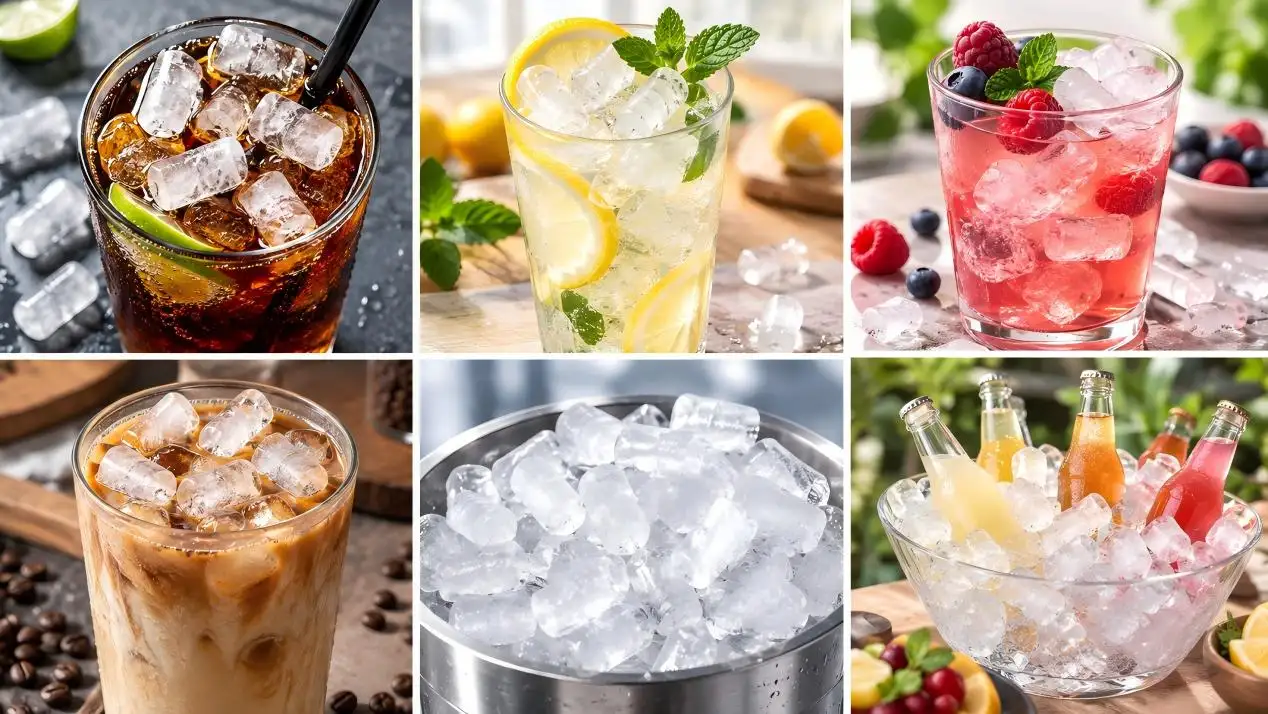
Why Ice Shape Matters: Understanding 10mm × 15mm Cylindrical Nugget Ice
2026-09-14
BY YUMYTH
More Than Ice Production — The Ice Itself Shapes the Consumer Experience When sourcing a nugget ice maker, buyers often focus first on production capacity, water tank size, ice basket ...

Ice Maker Sourcing Guide: How to Find the Right Factory
2026-09-10
BY YUMYTH
Sourcing an ice maker looks straightforward on paper. Find a supplier, agree on a price, place an order. But anyone who has actually done this knows the process is rarely ...