
Private Label Slushie Machine: How It Works and How to Launch Your Brand
Share:
-

-

-

-


Copied

Share:
-
-
-
-
Copied
A private label slushie machine lets you sell a branded frozen drink machine under your own name without designing or engineering a machine from scratch. You select a manufacturer's existing platform, add your branding, define your packaging, and bring a product to market that looks and feels entirely like yours. The machine behind the brand is already engineered, tested, and in production.
For brand owners, distributors, retailers, and hospitality businesses looking to enter the home frozen drink machine category, private label is the fastest route from idea to shelf. This guide explains what private label actually means in the slushie machine context, what you can and cannot customize, how to identify reliable suppliers, and what the process looks like from first contact to a branded machine in your warehouse.
What Is a Private Label Slushie Machine?
A private label slushie machine is a machine manufactured by a third party — a real OEM or ODM manufacturer — and sold under a buyer's own brand identity. The manufacturer produces the machine; the brand owner markets and sells it under their name, logo, and packaging.
Private label is common across consumer appliances, food products, and household goods. In the slushie machine category, it explains why dozens of branded machines on Amazon and in retail stores share the same core design — they are the same ODM platform, sold under different private labels by different brand owners.
The key factor that determines whether your private label slushie machine succeeds or creates problems is the manufacturer behind it. A real manufacturer with documented engineering controls quality, supplies spare parts, and supports your warranty claims. A trading company reselling factory stock cannot do any of that.
Private Label vs. OEM vs. ODM — What's the Difference?
These three terms describe related but distinct sourcing arrangements, and it helps to understand which one applies to your situation.
Private label is the broadest term. It describes any situation where a manufacturer's product is sold under someone else's brand. Both OEM and ODM can result in a private label product.
ODM (Original Design Manufacturer) means the manufacturer owns the product design. You select from their existing platform catalog, add your branding, and sell under your name. Most private label slushie machine arrangements work this way. The engineering is done; you are building a brand around proven technology.
OEM (Original Equipment Manufacturer) means you bring the product specification. The manufacturer builds to your design under your brand. This gives you full engineering ownership and differentiation, but requires longer development timelines (6–12 months) and custom tooling investment. Most first-time private label buyers start with ODM, not OEM.
In practice, when buyers search for a "private label slushie machine," they typically mean ODM — adapting a manufacturer's existing platform with their branding. That is the focus of this guide.
Who Buys Private Label Slushie Machines?
The private label slushie machine market serves a wider range of buyers than most people expect. Here are the main buyer types:
Retail brand owners and Amazon sellers who want to differentiate from generic listings with a branded product, custom packaging, and a more defensible market position than reselling an unbranded unit.
Distributors and importers building a private label appliance portfolio in a specific geography — sourcing a home-use slushie machine for a European or North American retail channel under a house brand.
Hospitality and event businesses that want branded machines for client events, venue installations, or rental programs — machines that carry the business's identity rather than a third-party manufacturer's name.
Subscription and DTC brands launching a frozen drink program with a branded machine as the anchor product — pairing a private label slushie machine with proprietary drink mixes, branded cups, or a membership model.
Restaurant and cafe chains entering the home-use market with a branded machine that extends their restaurant identity into customers' kitchens.
All of these buyers share the same core need: a machine that performs reliably and represents their brand credibly. That depends entirely on the quality of the manufacturer they work with.
What You Can Customize on a Private Label Slushie Machine
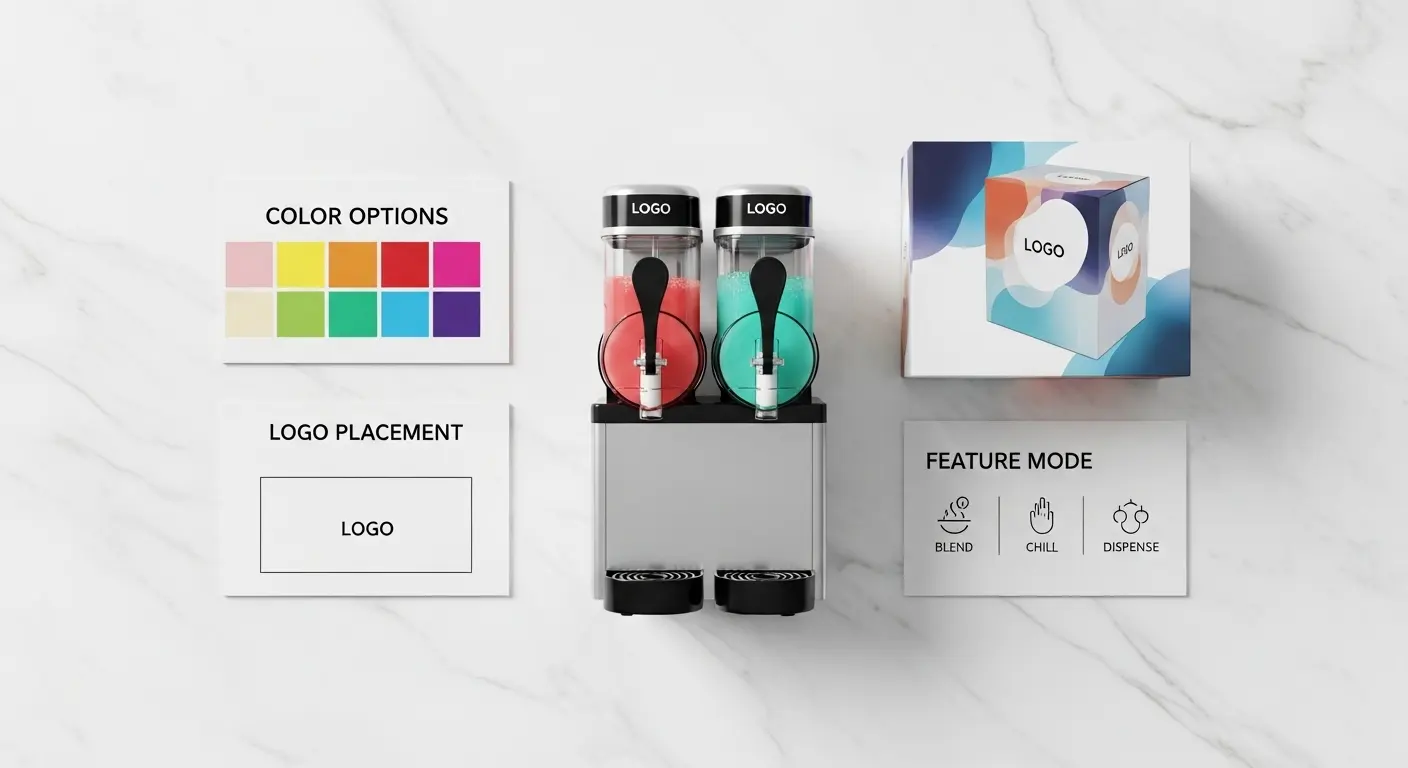
Understanding the customization scope available in a private label slushie machine arrangement helps set realistic expectations before you enter supplier negotiations.
Branding and Exterior Appearance
The most common customizations on a private label slushie machine cover the machine's visual identity. This includes your brand name and logo applied to the machine body — typically through silk printing, laser engraving, or panel insert replacement — and exterior color selection from a manufacturer's available palette or through a custom color run at sufficient volume.
A custom color run typically requires 200+ units minimum to justify the tooling and setup cost. For smaller orders, color selection from available stock options is the practical route.
Packaging and Retail Presentation
Packaging customization is typically the fastest and lowest-cost part of a private label slushie machine order. Box artwork, brand messaging, retail barcode placement, product photography, and instruction manual localization are all within scope for most manufacturers. Some suppliers can also adjust packaging dimensions to meet specific retail shelf or e-commerce shipping requirements.
Custom packaging is the most visible differentiator for a private label product in a retail environment — it is what separates a branded product from a generic box on a shelf.
Feature Configuration
Some private label slushie machine manufacturers allow modification of the preset mode selection — enabling, disabling, or relabeling specific programs for a target market. For example, a brand targeting a children's audience might want the cocktail and wine modes removed. A brand focused on coffee shop accessories might want the coffee and milkshake modes labeled prominently.
What cannot be changed through feature configuration is the underlying control logic — freeze cycle management, auger reversal calibration, and texture control calibration are tied to the machine's certification. These are fixed to the platform.
Market Certification Requirements
If your target market requires CE certification (EU/UK), ETL or UL (North America), PSE (Japan), or another regional standard, the manufacturer needs to either hold those certifications on the specific platform you are ordering, or obtain them for your branded version. Certification under your brand name specifically may add 8–12 weeks to the timeline. Confirm this upfront — it is the most common source of launch delays in private label slushie machine projects.
How to Find a Reliable Private Label Slushie Machine Supplier
Most problems in private label slushie machine sourcing trace back to one decision: choosing the wrong supplier. Here is a practical framework for evaluation.
Verify Manufacturing Identity
Not every supplier on Alibaba, Made-in-China, or GlobalSources is a manufacturer. Many are trading companies — intermediaries who purchase finished machines and mark them up. A trading company cannot supply replacement parts after the factory changes designs. They cannot authorize warranty repairs. They cannot guarantee production consistency across your orders.
Verify manufacturing identity through ISO 9001 certification, factory audit documentation, and the supplier's ability to supply spare parts by component name. A real private label slushie machine manufacturer can provide all three.
Check Platform Engineering Documentation
A reliable manufacturer publishes full technical specifications for the platforms they offer for private label adaptation: material grades, rated power, noise level, coolant type, capacity, dimensions, and loading quantities. If a supplier presents products with vague descriptions — "powerful motor," "food-safe materials," "efficient cooling" — without specific technical data, they do not control their product engineering.
As a reference benchmark: a well-documented private label slushie machine platform should list food-grade ABS, SUS304 stainless steel, food-grade silicone, rated power in watts, noise level in decibels, specific capacity in liters, and container loading quantities. These are engineering outputs. They come from a manufacturer — not from a trading company copying a spec from a factory catalog.
Test Before You Order
Always request a sample unit of the specific platform before committing to a private label production order. Test the machine through at least ten complete use and cleaning cycles. Check freeze time, texture range, noise level, cleaning access, auger behavior with thick and thin mixes, and whether the seal ring seats correctly after reassembly. One sample unit costs a fraction of discovering production quality problems after a full container arrives at your warehouse.
The Private Label Slushie Machine Process: Step by Step
For first-time buyers, here is how a typical private label slushie machine order moves from initial inquiry to delivery.
Step 1 — Define your requirements. Identify your target market (home-use or commercial, regional certification requirements), desired capacity, price point, and volume target. Know whether you need a single-function slush machine or a dual-function slush and ice cream model before entering supplier conversations.
Step 2 — Shortlist and verify manufacturers. Identify 3–5 candidates who can supply full platform documentation, factory verification, and sample units. Filter out trading companies using the verification steps above.
Step 3 — Sample, test, and compare. Order samples from your top two candidates. Test both through equivalent use conditions. The sample stage surfaces differences in build quality, noise, texture control, and cleaning design that spec sheets cannot capture.
Step 4 — Negotiate terms. Establish MOQ, unit pricing at your target volume, lead time, tooling cost ownership (if any), IP protection terms, warranty commitments, and spare parts supply agreement. Get every commitment in writing before paying a deposit.
Step 5 — Pre-production approval. Review branded packaging artwork, logo placement, and any feature configuration changes before production starts. Sign off on a pre-production sample before full run begins.
Step 6 — Production and QC. A reliable supplier integrates quality control at incoming material inspection, in-process assembly, and finished product testing stages. Arrange third-party inspection (SGS, Bureau Veritas, or equivalent) before container loading if the order exceeds 200 units.
Step 7 — Shipping and receiving. Calculate landed cost using the manufacturer's loading quantities — knowing how many units fit per container directly affects freight cost per unit. For a 540-unit container load, sea freight from China to North America typically adds $8–$15 per unit at current rates, depending on destination port and current market conditions.
Yumyth as a Private Label Slushie Machine Partner
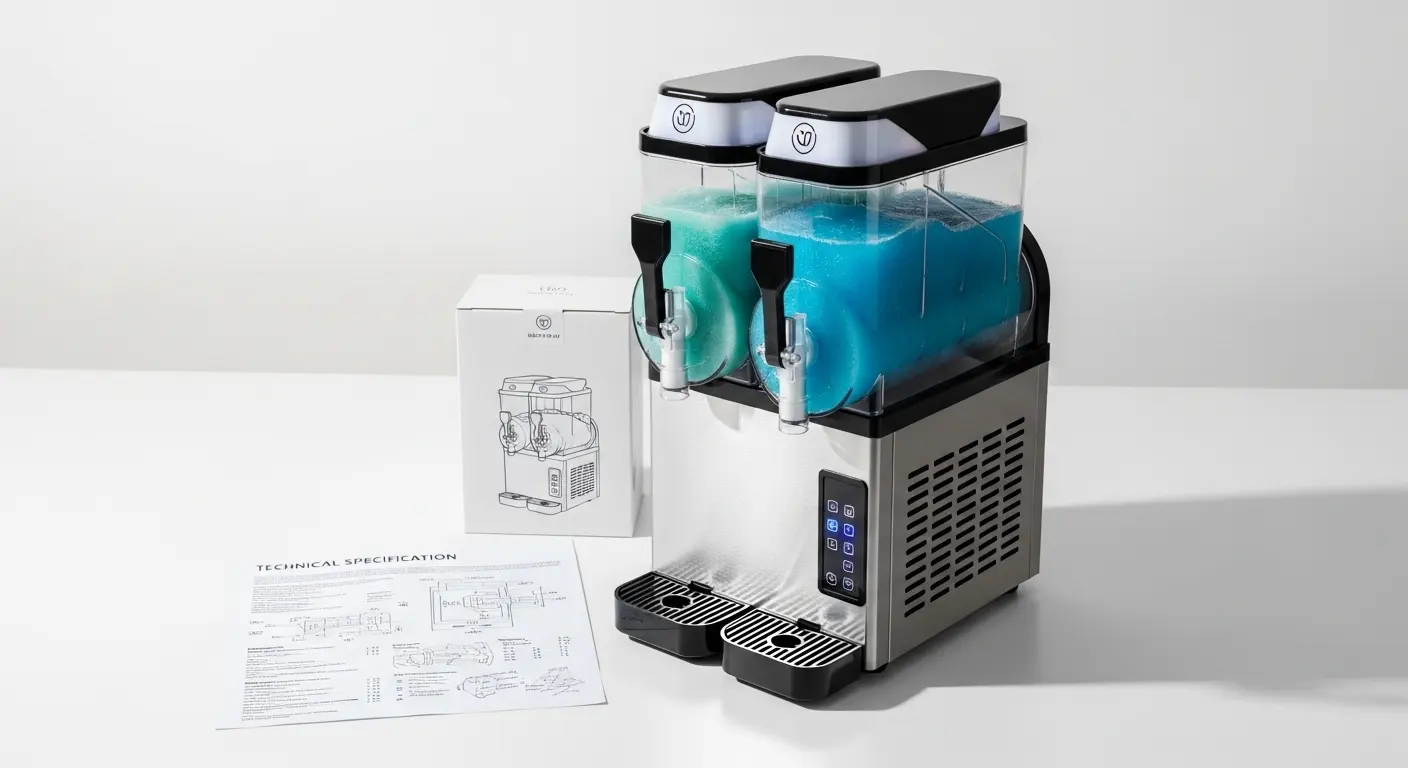
Yumyth operates as a direct private label slushie machine manufacturer with two documented home-use platforms available for ODM and OEM adaptation.
The YX1801 platform — available as the Yumyth Mini Slush Machine — is a 61oz home-use slushie machine rated at 200W, operating at ≤55dB. Contact materials are food-grade ABS, food-grade silicone, and SUS304 stainless steel. Coolant is R290. The machine features six preset programs (Slush, Wine, Milkshake, Cocktail, Coffee, Custom), six-stage texture control, a patented intelligent auger reversal system with automatic jam protection, a 3-minute quick rinse cycle, and a child lock function. It loads at 540 units per 20GP container, 1080 per 40GP, and 1296 per 40HQ.
The YX1802 platform — the Yumyth Slush and Ice Cream Maker — adds ice cream mode alongside the six slush programs, rated at 220W with identical material standards. For private label brands targeting dual-function positioning — a machine that makes both frozen drinks and frozen desserts — the YX1802 platform supports both use cases under a single product identity.
Both platforms support private label customization covering branding, packaging, appearance, and market-specific requirements. Quality control is integrated at incoming material inspection, in-process assembly, and finished product performance testing. For brand owners planning a product line in the home frozen beverage category, the industry insights section covers how the home frozen drink market is evolving and where feature demand is heading — useful context for private label product positioning.
Cost, MOQ, and Timeline: What to Realistically Expect
First-time private label slushie machine buyers frequently underestimate the full timeline and underestimate the cost variables beyond the unit price. Here is a realistic breakdown.
Unit price range. For a quality home-use private label slushie machine on a documented ODM platform, unit prices at ODM MOQ typically fall in the $40–$90 FOB range depending on platform, volume, and customization scope. Below this range, cut corners are almost always present in material grade, component quality, or QC process.
MOQ. For straightforward branding and packaging customization on an existing platform, expect MOQ of 200–500 units for home-use machines. Custom color runs typically require 500+ units. Full OEM with custom tooling typically requires higher volumes to amortize tooling cost.
Timeline — standard ODM private label order:
- Artwork approval and pre-production sample: 2–3 weeks
- Certification under brand name (if required): 8–16 weeks
- Production run: 3–5 weeks
- Sea freight to North America: 20–30 days
- Sea freight to Europe: 25–35 days
Total realistic timeline: 45–75 days for a straightforward private label order on a certified platform. Add 8–16 weeks if certification under your brand name is required from scratch. Plan your launch calendar accordingly — working backwards from your target retail date is the right way to set supplier deadlines.
For private label brands building a broader frozen food appliance line, the ice makers buying guide and vacuum sealers guide cover complementary product categories that pair naturally with a private label slushie machine in retail bundles, DTC programs, and hospitality supply packages.
Frequently Asked Questions
What is a private label slushie machine?
A private label slushie machine is a machine manufactured by a third-party OEM or ODM manufacturer and sold under a buyer's own brand name and packaging. The manufacturer builds and controls the machine's engineering; the brand owner applies their identity — logo, color, packaging — and sells it as their own product. Most private label slushie machine arrangements use ODM, where the manufacturer owns the base design and the brand buyer adapts it for their market.
How much does a private label slushie machine cost?
For a quality home-use private label slushie machine on a documented ODM platform, FOB unit prices typically range from $40–$90 depending on platform specification, customization scope, and order volume. Below this range, compromises in material grade or quality control are common. Add freight, import duties, and certification costs to calculate full landed cost before finalizing your retail pricing.
What is the minimum order for a private label slushie machine?
For straightforward branding and packaging customization on an existing ODM platform, minimum order quantities for home-use private label slushie machines typically start at 200–500 units. Custom color runs generally require 500+ units to justify tooling changeover costs. Full OEM with custom engineering requires higher volume. Confirm MOQ for each specific customization type before entering production discussions.
How long does a private label slushie machine order take?
A standard private label slushie machine order on a certified ODM platform — covering artwork approval, pre-production sample, production run, and sea freight — typically takes 45–75 days from order confirmation to warehouse receipt. If certification under your brand name is required in a specific market, add 8–16 weeks for third-party testing and documentation filing.
How do I know if a private label slushie machine supplier is a real manufacturer?
Ask for specific material grade documentation (food-grade ABS, SUS304 stainless, food-grade silicone), full technical specifications with quantified data (watts, decibels, capacity in liters, dimensions in millimeters), original certification documents matching the specific model, replacement parts availability by component name, and OEM/ODM capability for customization. A real manufacturer can produce all of these without hesitation. A trading company typically provides only marketing materials and approximate figures.
Related Articles

Household Slush Machine: What to Know Before Buying One in 2026
2026-09-24
BY YUMYTH
A household slush machine makes frozen drinks at home. It works differently from a blender. A blender crushes ice into your drink, which adds water and waters down the flavor. ...

How Does a Nugget Ice Maker Work? A Look Inside the Ice-Making Process
2026-09-24
BY YUMYTH
Nugget ice looks simple enough. Small, soft pieces of ice drop into the bin, ready to go into a glass. But making that texture is quite different from making a ...
Nugget Ice Maker for Coffee Shop: How Ice Texture Affects Coffee
2026-09-24
BY YUMYTH
When choosing a Nugget Ice Maker for a Coffee Shop, there are many factors to consider aside from the rate of ice production. At YUMYTH, we consider the downstream implications ...
Why Nugget Ice for Soda Creates a Different Mouthfeel Than Traditional Ice Cubes
2026-09-24
BY YUMYTH
At YUMYTH, we believe there is more to Nugget Ice for Soda than just the effect on temperature. The structure of ice also changes the perception of carbonation, how quickly ...