
Vacuum Sealer for Cheese: Packaging Soft and Hard Varieties
Share:
-

-

-

-


Copied

Share:
-
-
-
-
Copied
A vacuum sealer for cheese must do more than remove air. It must create a reliable seal without crushing the cheese, pulling moisture into the sealing area, or using a reduced-oxygen process that does not suit the product.
Hard and many semihard cheeses are usually easier to vacuum package because they retain their shape and release less free moisture. Soft-ripened, fresh, brined, and high-moisture cheeses need greater caution. Some may require reduced vacuum, a different packaging atmosphere, or a commercially validated process rather than routine vacuum sealing.
The correct method depends on the cheese’s firmness, moisture, shape, intended storage period, packaging volume, and refrigeration controls.
Which Cheeses Are Suitable for Vacuum Sealing?
Cheese should be classified before choosing a machine setting. Appearance alone is not enough: two cheeses that feel similarly soft can have different moisture levels, acidity, salt content, cultures, and microbial risks.
| Cheese category | General vacuum-packaging suitability | Main concerns | Recommended approach |
|---|---|---|---|
| Hard cheese | Generally suitable | Sharp corners, hard rind, bag punctures | Use a suitable barrier bag and protect sharp edges |
| Semihard cheese | Generally suitable to conditional | Moderate compression, surface moisture | Start with controlled vacuum and inspect for deformation |
| Semisoft cheese | Conditional | Moisture migration, compression, product-specific safety requirements | Assess the exact cheese and commercial process before setting the cycle |
| Soft-ripened cheese | Conditional or unsuitable for routine sealing | Delicate rind, shape damage, continued ripening, altered atmosphere | Use gentle control and verify that vacuum packaging fits the product |
| Fresh or high-moisture cheese | Often unsuitable without validation | Free liquid, weak seals, short shelf life, microbial risk | Consider another packaging method or a validated reduced-oxygen process |
| Shredded or sliced cheese | Conditional | Compression, trapped air, large exposed surface area | Use controlled evacuation and consistent portion sizes |
Hard and Semihard Cheese
Cheddar, Parmesan-style cheese, Gouda, and similar firm products normally tolerate vacuum pressure better than fresh or soft-ripened varieties. Their structure resists deformation, while lower free moisture reduces the chance of whey entering the seal area.
These cheeses can still cause packaging problems. A pointed wedge or hard rind may create a pinhole after the bag tightens. Large blocks can also trap air around irregular surfaces.
For firm cheese:
-
Use a bag with adequate puncture resistance.
-
Round or cushion sharp corners where practical.
-
Leave enough bag material for a clean, flat seal.
-
Avoid stacking pieces in a way that creates hidden air pockets.
-
Keep the sealed product refrigerated.
Vacuum packaging may slow oxidation and moisture loss, but it does not make cheese shelf-stable.
Soft-Ripened, Fresh, and High-Moisture Cheese
“Soft cheese” is too broad to function as a packaging rule. Brie and Camembert are soft-ripened cheeses with delicate surfaces and active ripening characteristics. Ricotta and cottage cheese are fresh, high-moisture products with different structures and storage risks.
High vacuum can flatten a soft cheese, damage its rind, or draw moisture toward the bag opening. More importantly, reducing oxygen does not automatically create a safe storage environment.
The FDA Food Code 2022 allows defined retail reduced-oxygen packaging procedures for certain commercially manufactured hard, pasteurized-process, and semisoft cheeses under specified controls. It separately identifies Brie, Camembert, cottage cheese, and ricotta as examples that do not qualify under that particular cheese provision because they can support Listeria monocytogenes growth under modified-atmosphere conditions.
The Food Code is a US model code, not a worldwide rule. Commercial operators must follow the requirements of the country and jurisdiction where the cheese is packed and sold.
Pulse or gentle-pressure control can reduce physical damage, but these functions do not establish microbiological safety. If a fresh or soft cheese has not been validated for vacuum packaging, changing the machine setting is not enough.
Chamber or External Vacuum Sealer: Which Works Better for Cheese?
Both machine types can package cheese, but they evacuate air differently.
An external sealer pulls air from the open end of a textured bag. A chamber machine removes air from the entire chamber before sealing the bag. That difference affects bag selection, moisture handling, control, and throughput.
| Selection factor | External vacuum sealer | Chamber vacuum sealer |
| Typical bag | Textured or embossed bag | Smooth chamber bag; compatibility varies by machine |
| Best fit | Firm, relatively dry portions and lower-volume work | Repeated commercial packaging, irregular portions, and more demanding moisture control |
| Liquid movement | Moisture can be drawn toward the bag opening | Pressure changes occur around the full package |
| Delicate-product control | Depends heavily on pulse or manual stop functions | May offer programmable cycles and controlled chamber venting |
| Equipment footprint | Usually smaller | Usually larger |
| Production volume | Home, test, or limited small-batch use | Deli, processing, and higher-volume applications |
| Main limitation | Liquid can contaminate the seal before the cycle finishes | Product and bag must fit the chamber |
When an External Sealer Is Enough
An external machine can be practical for firm blocks, dry wedges, and occasional packaging. It is also easier to place in a small preparation area.
Choose an external system when:
-
The cheese has little free surface moisture.
-
Portions are firm enough to tolerate bag compression.
-
Packaging volume is limited.
-
Textured bags are readily available.
-
The machine provides pulse or manual vacuum control.
A tabletop vacuum sealer may suit small batches, but it should not be chosen only by maximum vacuum specification. Control over the evacuation cycle matters more for delicate cheese.
When a Chamber Sealer Offers Better Control
A chamber system is often more practical when cheese is packaged repeatedly, portion sizes vary, or moisture management is difficult. Because pressure changes around the entire package, chamber machines can use smooth bags and may provide more repeatable cycles.
Controlled chamber venting can also matter. Instead of allowing atmospheric pressure to return immediately, the machine introduces air gradually. This reduces sudden bag contraction around delicate cheese and sharp edges.
YUMYTH’s CVS101 chamber vacuum sealer is presented as a dual-mode model with chamber and external operation. Its product page states that chamber mode supports smooth chamber bags and textured bags, while external mode requires textured bags. These are model-specific features, not a general rule for every chamber machine.
For larger deli or processing workloads, a broader commercial vacuum sealer assessment should also consider cycle frequency, chamber size, cleaning access, and service requirements.
Choose Vacuum Controls That Protect Cheese Shape and Texture
Maximum vacuum is not always the best target. A very tight package may look effective while flattening the cheese, forcing oil from the surface, or pulling whey into the seal area.
The most useful controls depend on the product:
| Machine function | Packaging problem addressed | Limitation |
| Pulse or manual vacuum | Lets the operator stop before the cheese deforms | Results depend on operator judgment |
| Gentle-pressure mode | Reduces compression on delicate portions | Does not make an unsuitable cheese safe |
| Adjustable vacuum cycle | Supports repeatable settings for different portions | Requires testing and documentation |
| Controlled chamber venting | Reduces abrupt bag contraction after sealing | Usually limited to compatible chamber equipment |
| Moisture mode | Adjusts sealing behavior for damp products | Cannot compensate for a wet or contaminated seal zone |
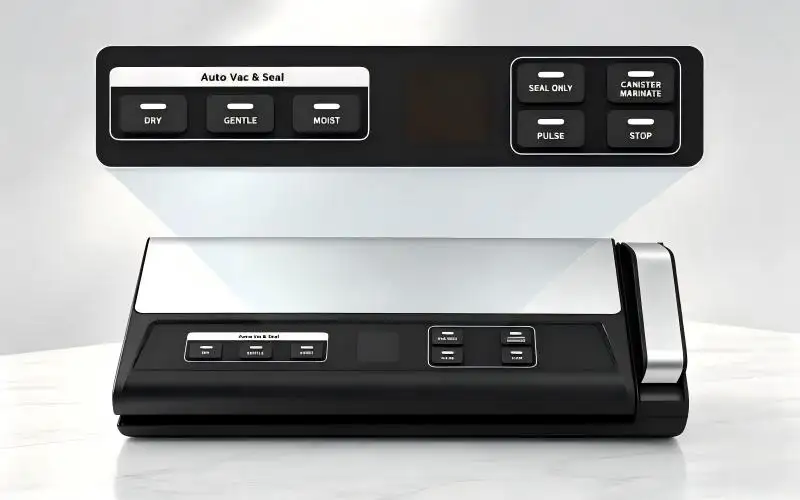
YUMYTH’s VS6606X vacuum sealer lists normal and gentle pressure, pulse control, and dry, moist, and super-moist modes. Such controls can help manage deformation and liquid movement, but the operating point still needs to be tested with the actual cheese, bag, and portion size.
A practical test should evaluate:
-
Whether the cheese keeps its intended shape.
-
Whether oil or whey moves toward the bag opening.
-
Whether air remains trapped around the product.
-
Whether the seal is flat and continuous.
-
Whether the package maintains vacuum during refrigerated storage.
-
Whether the process can be repeated consistently by different operators.
Avoid copying a vacuum percentage from an unrelated machine or cheese variety. Vacuum readings, sensor calibration, bag structure, and product response can vary.
How to Vacuum Seal Cheese Without Crushing It or Wetting the Seal
A controlled process reduces both product damage and seal failure.
-
Confirm that the cheese is suitable.
Identify whether it is hard, semihard, soft-ripened, fresh, brined, or otherwise high in moisture. Commercial operators should confirm that the intended reduced-oxygen process is permitted and validated. -
Chill the cheese sufficiently.
A properly refrigerated portion is usually firmer and less likely to release oil or whey than a warm one. Chilling is not the same as freezing, and freezing is not necessary for every cheese. -
Create consistent portions.
Blocks of similar dimensions respond more predictably to the same vacuum cycle. Check that the largest portion fits the chamber, bag, and sealing width. -
Manage sharp edges.
Hard corners and dry rinds can puncture a bag as atmospheric pressure compresses the film against the cheese. Reposition the wedge, smooth the corner, or use suitable protective material where the process permits. -
Select the correct bag.
Use textured bags for normal external suction sealing. Use chamber-compatible smooth bags in a chamber system unless the machine manufacturer specifies otherwise. -
Leave a clean sealing area.
Provide enough unused bag length above the cheese. Keep this area free from crumbs, oil, whey, folds, and wrinkles. -
Load the product carefully.
Position the bag so liquid does not naturally flow toward the opening. Keep the bag flat across the seal bar. -
Apply vacuum gradually.
Watch the cheese and the bag. Stop pulse evacuation when the film conforms to the product but before the cheese changes shape or liquid approaches the seal zone. -
Complete the seal.
Confirm that the sealing surface is flat. Use the appropriate heat and dwell setting for the bag rather than assuming a longer sealing time is always stronger. -
Allow the seal to cool.
Do not pull or flex the bag immediately. A hot seal can be weakened before the fused layers stabilize. -
Inspect and label the package.
Check for channels, wrinkles, contamination, loose areas, and punctures. Add the product name, packaging date, lot information, and storage instructions required by the operation. -
Return the cheese to refrigeration promptly.
Vacuum packaging does not replace a controlled cold chain.
Select the Right Bag and Seal Configuration
The bag must match both the machine and the product. Thickness alone does not determine package performance.
For cheese packaging, assess:
-
Machine compatibility.
-
Oxygen and moisture barrier.
-
Puncture resistance.
-
Sealant-layer compatibility.
-
Bag width and length.
-
Temperature range.
-
Food-contact documentation for the target market.
Textured bags contain channels that let an external machine draw air toward the opening. Smooth chamber bags do not need these channels because air is removed from the chamber around the package.
Seal quality depends on keeping the bag layers flat and clean. Oil, whey, crumbs, and wrinkles can interrupt the fused area and form a channel through which air returns.
A second seal can provide another closure line when the package or workflow justifies it. It does not guarantee a fixed increase in shelf life. Readers comparing the two arrangements can review the dedicated double seal bar vacuum sealer guide rather than treating double sealing as an automatic requirement for every cheese.
Inspect the finished seal for:
-
Continuous width across the bag.
-
No folds or channels.
-
No cheese particles or liquid.
-
No scorched or excessively thinned film.
-
Adequate distance between the product and seal.
-
No tension pulling against the sealed area.
Refrigeration and Food-Safety Limits After Vacuum Sealing
Vacuum sealing removes much of the air around the cheese, but it does not sterilize the product. Reduced oxygen can slow some forms of oxidation and visible mold development, while creating conditions in which other microorganisms remain relevant.
The package must stay under appropriate refrigeration. The FDA recommends maintaining refrigerators at 40°F or 4°C or below, while commercial regulations may use different critical limits for a specific process.
Shelf life cannot be determined from the vacuum level alone. It depends on:
-
Cheese composition and initial microbial condition.
-
pH, water activity, salt, preservatives, and competing cultures.
-
Hygiene during cutting and packaging.
-
Film barrier performance.
-
Residual oxygen.
-
Seal integrity.
-
Refrigeration temperature and consistency.
-
Handling during distribution and display.
The Oregon State University Extension guidance on home vacuum packaging also emphasizes that vacuum packaging does not remove the need for safe temperature control. Frozen vacuum-packed food should be thawed under refrigeration rather than left warm inside the sealed package.
Commercial retail or processing operations may need a HACCP plan that identifies hazards, critical limits, monitoring, corrective actions, recordkeeping, and verification. Requirements vary by location, product, and process.
Do not rely on smell, appearance, or a tight bag as proof of safety. A swollen, leaking, temperature-abused, or otherwise abnormal package should not simply be opened and resealed.
Storage Packaging Is Not the Same as Cheese Aging
Packaging finished cheese for storage and using vacuum during maturation are different objectives.
Storage packaging aims to preserve an existing product condition. Aging involves controlled biochemical and sensory changes. Vacuum can affect rind development, moisture distribution, texture, and aroma.
A peer-reviewed study of vacuum-packaged Spanish goat cheese found changes in biochemical, viscoelastic, and sensory properties during refrigerated storage. This does not mean vacuum packaging is unsuitable for aging, but it shows why cheesemakers should validate the process against the intended final product rather than treating vacuum as a neutral wrapper.
Common Cheese Vacuum-Sealing Problems and How to Correct Them
| Problem | Likely cause | Corrective action |
| Cheese becomes flattened | Vacuum continued too long; cheese was too warm or soft | Chill the product, use pulse or gentle control, and stop earlier |
| Whey or oil reaches the seal | High moisture, warm product, poor orientation, excessive evacuation | Chill the portion, reposition the bag, reduce vacuum intensity, and keep more bag length above the product |
| Seal contains wrinkles | Bag was not laid flat across the seal bar | Reload the bag and smooth both layers before sealing |
| Package slowly loses vacuum | Contaminated seal, pinhole, weak film, or damaged corner | Inspect the seal and full bag surface; replace the package rather than sealing over an unidentified leak |
| Air remains around the cheese | Irregular shape, poor bag placement, blocked air channels, or early cycle stop | Reposition the cheese and confirm correct bag compatibility |
| Bag punctures near the rind | Sharp corner or insufficient puncture resistance | Reorient or protect the edge and use a more suitable bag |
| Seal appears melted or brittle | Excessive heat or sealing time | Reduce the seal setting according to the bag specification |
| Package inflates during storage | Possible gas formation, temperature abuse, contamination, or process failure | Isolate and reject or evaluate the package under the operation’s food-safety procedure; do not simply reseal |
| Cheese develops unexpected texture or aroma | Excessive compression, prolonged storage, altered ripening conditions | Review the vacuum level, packaging period, temperature, and whether vacuum suits the intended product |
A removable drip tray can make cleanup easier when moisture enters an external sealing area, but it does not prevent a contaminated seal. The process should stop before liquid reaches the closure zone.
How to Choose a Cheese Vacuum Sealer for Home, Deli, or Commercial Use
The right machine is determined by the cheese and workflow, not by the highest advertised vacuum figure.
Use the following buyer checklist:
-
Cheese categories: Identify the firmest, softest, and wettest products that will be packed.
-
Portion dimensions: Measure the largest block, wedge, or retail pack, including bag headspace.
-
Packaging volume: Estimate normal daily output and peak demand.
-
Machine architecture: Decide whether external sealing is sufficient or chamber control is needed.
-
Vacuum control: Check for pulse, manual stop, gentle pressure, or programmable cycles.
-
Bag compatibility: Confirm smooth or textured bag requirements.
-
Seal arrangement: Determine whether one properly formed seal is sufficient or an additional closure line is justified.
-
Cleaning access: Review the seal area, chamber, drip components, and removable parts.
-
Throughput: Ask about cycle time, recovery between cycles, and intended duty level.
-
Service support: Confirm the availability of seal wires, gaskets, pumps, and other replacement parts.
-
Electrical requirements: Verify voltage, frequency, plug, and destination-market configuration.
-
Documentation: Request certificates and test reports for the exact model rather than relying on a general certification list.
-
Application testing: Test the machine with the actual cheese, portion shape, and packaging film.
YUMYTH states that its vacuum-sealer range can be customized in areas such as vacuum strength, sealing modes, sealing time, bag-size compatibility, controls, voltage, branding, packaging, and accessories. These options should be evaluated against a written cheese-packaging specification rather than selected in isolation.
Match the Machine to Portion Size and Packaging Volume
The usable sealing width must exceed the bag opening, while a chamber machine must also accommodate the full package height and depth. A machine that fits small slices may not accept a large wedge with sufficient clearance for the bag and seal zone.
Low-volume users may prioritize compact size and pulse control. A deli or production facility should also evaluate repeated-cycle performance, cleaning time, changeovers, and service access.
Confirm Controls, Bags, Service, and Documentation
Before purchasing, ask the supplier:
-
Which bag structures work in each operating mode?
-
Can vacuum intensity and sealing time be adjusted separately?
-
Is pulse or gentle-pressure control available?
-
What are the usable chamber and sealing dimensions?
-
How is moisture cleaned from the machine?
-
Which components require routine replacement?
-
Which certificates apply to the exact model and destination country?
-
Can the supplier test the equipment with the buyer’s cheese and bag?
-
Can voltage, controls, labels, and packaging be configured for the project?
These questions reveal more about application fit than a single maximum-vacuum number.
Final Cheese-Packaging Checklist
Before starting a batch, confirm that:
-
The cheese category is appropriate for the planned process.
-
Storage and aging objectives are not being confused.
-
The machine and bag are compatible.
-
The portion fits with sufficient sealing headspace.
-
Sharp edges are controlled.
-
Surface moisture and free liquid are managed.
-
The bag mouth is clean, dry, and flat.
-
Vacuum can be stopped before the cheese deforms.
-
The finished seal is continuous and uncontaminated.
-
The package is labeled and returned to refrigeration.
-
Commercial reduced-oxygen requirements have been reviewed for the target market.
Commercial buyers can contact YUMYTH with the cheese type, portion dimensions, moisture behavior, preferred bag, daily volume, voltage, and required controls. Those details provide a practical basis for evaluating a cheese-packaging machine and arranging application testing.
Related Articles
How We Test Every Ice Maker Before Packaging
2026-09-15
BY YUMYTH
A step-by-step look at refrigerant handling, cooling verification, leak detection, corrective action and electrical safety testing For an ice maker, reliable performance is determined long before the carton is sealed. ...
Guide for Brands Looking for a Reliable Vacuum Sealer OEM Supplier
2026-09-14
BY YUMYTH
When you are sourcing kitchen appliances for your retail brand, finding a dependable vacuum sealer OEM supplier is rarely just about getting the lowest unit price. It is about protecting ...

Why Ice Shape Matters: Understanding 10mm × 15mm Cylindrical Nugget Ice
2026-09-14
BY YUMYTH
More Than Ice Production — The Ice Itself Shapes the Consumer Experience When sourcing a nugget ice maker, buyers often focus first on production capacity, water tank size, ice basket ...

Ice Maker Sourcing Guide: How to Find the Right Factory
2026-09-10
BY YUMYTH
Sourcing an ice maker looks straightforward on paper. Find a supplier, agree on a price, place an order. But anyone who has actually done this knows the process is rarely ...