
Slushie Machine ODM vs OEM: Which Development Model Fits Your Appliance Brand?
Share:
-

-

-

-


Copied

Share:
-
-
-
-
Copied
A slushie machine ODM is usually the better choice when your appliance brand wants a faster launch using a proven machine platform with logo, color, packaging, and limited feature customization. OEM is better when you need deeper product differentiation, design ownership, custom tooling, and stronger IP control. Procurement teams should choose based on launch speed, budget, customization depth, certification workload, and long-term brand strategy.
Choosing between ODM and OEM is not a small sourcing detail. It affects how fast your product can launch, how much control your brand has, and how much risk your team carries before the first shipment leaves the factory. A smart choice starts with one question: do you need a proven platform with light customization, or do you need a product that competitors cannot easily copy?
What is the fastest answer: should your brand choose ODM or OEM?
Choose slushie machine ODM if speed, lower upfront cost, and proven engineering matter most. Choose OEM if your brand needs unique design ownership, deeper feature control, and enough volume to justify tooling, prototyping, and longer validation.
ODM is usually the safer path for a new category launch. The manufacturer already has a base machine platform, so your team can focus on branding, packaging, sample approval, and market fit. That makes ODM useful for first-time importers, retailer private labels, and seasonal product launches.
OEM fits brands that already know what they want to build. If your team needs a custom tank layout, control panel, housing design, or performance target, the OEM process gives more room for product control.
| If your main priority is | Better model | Why |
|---|---|---|
| Fast launch | ODM | Existing platform reduces development time |
| Lower upfront cost | ODM | Less custom tooling and engineering work |
| Unique design | OEM | More control over structure and features |
| Stronger IP control | OEM | Better fit for owned product concepts |
| Market testing | ODM | Lets you test demand before deeper investment |
How do ODM and OEM compare for slushie machine development?
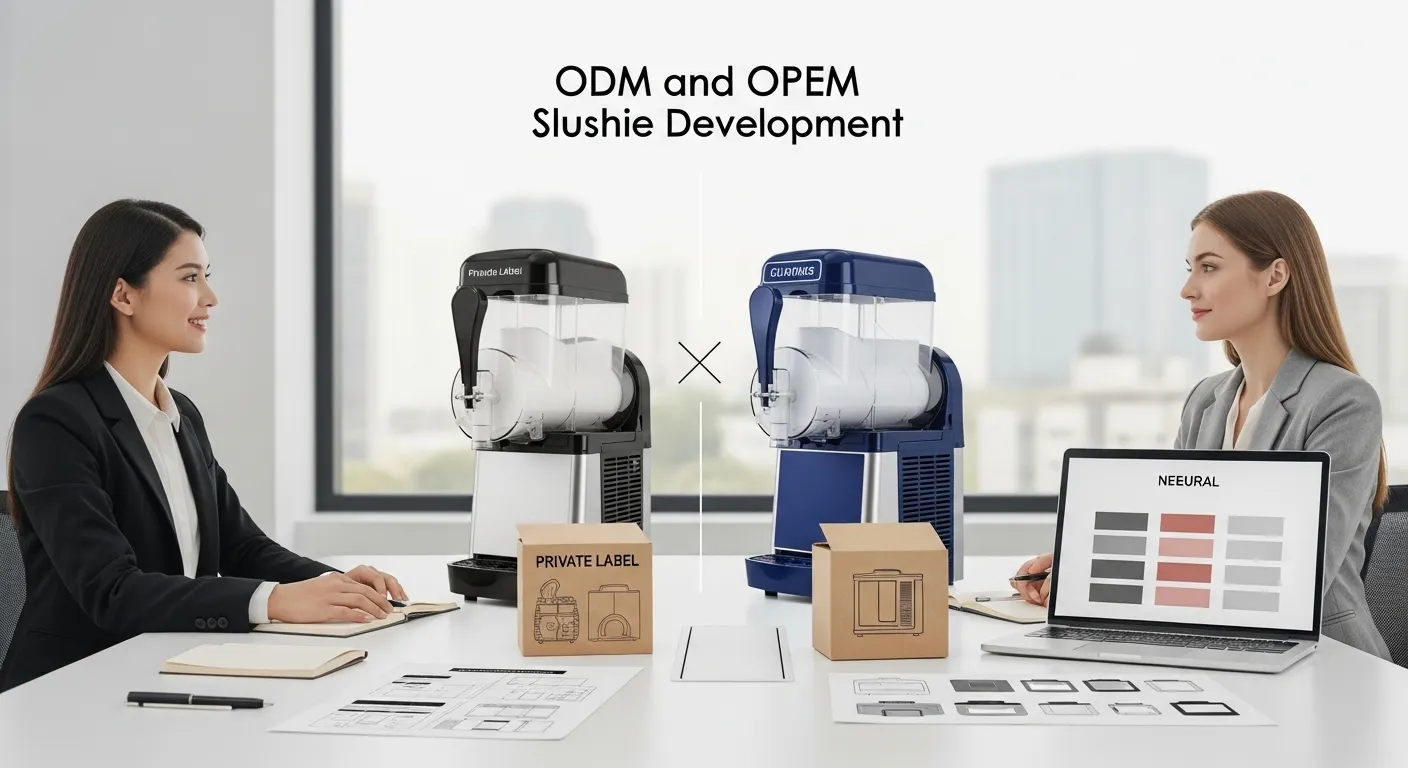
ODM and OEM differ most in ownership, control, speed, and risk. ODM starts from the manufacturer’s existing design. OEM starts from your brand’s product requirements and often needs more engineering, tooling, and validation before production.
| Factor | ODM slushie machine | OEM slushie machine | Procurement takeaway |
|---|---|---|---|
| Base design ownership | Manufacturer usually owns the platform | Brand may define or own more of the design | Ask who owns the product files and tooling |
| Customization depth | Logo, color, packaging, plug, voltage, limited settings | Structure, components, controls, tank design, performance targets | Match scope to real brand needs |
| Upfront cost | Lower in most cases | Higher because of tooling and development | Avoid OEM if you only need branding changes |
| Launch speed | Faster because the base model exists | Slower because samples and testing take longer | Use ODM for tight launch windows |
| Risk level | Lower engineering risk, possible sameness risk | Higher development risk, better differentiation | Pick the risk your brand can manage |
| Certification workload | Existing documents may help if model matches | New changes may require updated documents | Check certificates before ordering |
| MOQ pressure | Often more flexible | Often higher due to tooling and custom parts | Confirm MOQ before design approval |
| Best-fit buyer | New brand, private label, market test | Established brand, premium line, exclusive product | Choose based on strategy, not wording |
A supplier may use both terms loosely. That is why procurement should define the project scope in writing. “Custom logo” is not the same as custom engineering, and “OEM available” does not always mean the supplier can build a new product from scratch.
What does a slushie machine ODM project usually include?
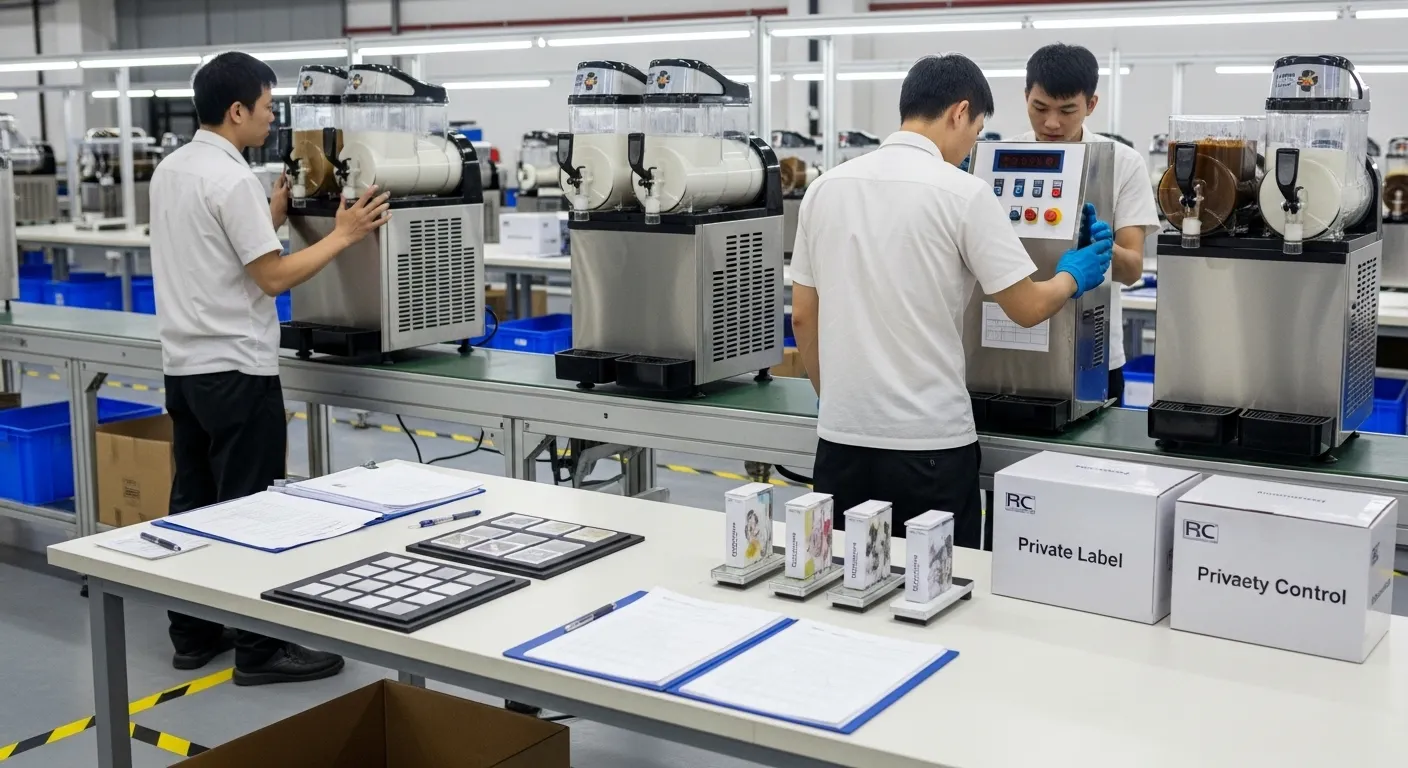
A slushie machine ODM project usually starts from an existing machine platform owned by the manufacturer. Your brand can normally customize appearance, packaging, logo, and some feature settings, but the core engineering stays mostly manufacturer-owned.
In a typical ODM project, the supplier already has a working frozen drink machine. Your team chooses a model, reviews samples, confirms branding details, and checks whether the platform fits your target market. The product may feel branded on the outside, but the inside is still based on the supplier’s design.
Common ODM customization may include:
- Brand logo on the machine body
- Custom color or finish
- Retail carton and manual design
- Plug and voltage options
- Control panel label changes
- Small mode or setting adjustments
- Accessory and spare parts package
- Basic private label documentation
ODM is not a shortcut if the supplier cannot prove the base platform is stable. It only reduces risk when the existing machine has real production history, usable certificates, and sample performance that matches your market.
When is ODM the better choice for a slushie machine brand?
ODM is the better choice when your brand needs to enter the slushie machine category quickly without funding custom tooling. It works best for market testing, private label launches, and buyers who can differentiate through branding, channel, and support.
Choose ODM when speed matters more than deep product ownership. For example, a retailer planning a summer beverage appliance launch may not need a new auger system or exclusive tank structure. It may need a reliable machine, clean branding, good packaging, and a supplier that can support repeat orders.
| Buyer situation | Why ODM fits | Decision point |
|---|---|---|
| Seasonal retailer launch | Faster sampling and production path | Can the supplier meet the launch calendar? |
| First-time importer | Lower development risk | Can samples pass performance checks? |
| Private label program | Branding may be enough | Can the model look retail-ready? |
| Market testing | Lower upfront commitment | Can you reorder if demand grows? |
| Budget-sensitive launch | Less tooling cost | Are warranty and spare parts clear? |
This is where manufacturer selection matters. ODM depends heavily on the supplier’s existing platform, so the buyer needs proof that the machine is already stable, serviceable, and ready for the target market.
When is OEM worth the extra cost and longer timeline?
OEM is worth it when your brand needs a product competitors cannot easily source from the same catalog. It makes sense when you have clear specifications, larger volume potential, IP requirements, and enough timeline for tooling, samples, testing, and production validation.
OEM is not automatically better. It is better only when the brand has a real reason to own the design, enough volume to absorb tooling cost, and enough time to validate the product properly. If you only need a logo, color change, and carton design, OEM may add cost without adding real value.
Choose OEM when your team needs:
- A unique exterior design
- A special tank size or layout
- A quieter machine concept
- A custom control panel
- Specific cooling or texture targets
- Retail exclusivity
- Stronger IP and tooling control
A premium appliance brand is a good example. If the brand wants a quieter slushie machine with a distinct control panel and exclusive housing, a custom OEM order may be worth the longer path. The added work only makes sense when the product difference helps the brand sell or defend its position.
What risks should procurement check before choosing ODM or OEM?
Procurement should verify factory identity, certification documents, sample performance, quality checkpoints, warranty terms, spare parts availability, tooling ownership, and import documentation before choosing ODM or OEM. The wrong model is risky, but the wrong supplier is worse.
A low unit price from a weak supplier is not savings. For appliances, poor documentation, vague warranty terms, and no spare parts support can cost more than the initial price difference. This is true for both ODM and OEM projects.
Supplier and factory verification
Start by confirming whether the supplier is a real factory, a trading company, or a sales office representing several factories. A verified manufacturer should be able to explain production capacity, sample policy, QC steps, warranty terms, and spare parts support without vague answers.
Procurement should ask for:
- Factory profile and production photos
- Sample availability and sample lead time
- MOQ by model and customization level
- QC checklist before shipment
- Warranty terms in writing
- Spare parts list and reorder terms
- Tooling ownership terms for OEM projects
- NDA terms when custom design is involved
Compliance and import documentation
Ask for certificate copies that match the exact model, not only logos on a product page. For consumer products, the CPSC explains that certain products need testing and certification before they can be sold in the United States through its testing and certification guidance.
For a certification mismatch scenario, imagine a supplier claims “ETL available,” but the certificate belongs to another model. Procurement should pause before deposit. The certificate, model number, electrical rating, and product description need to match the machine being ordered.
How do customs delays and documentation risk affect ODM vs OEM projects?
Customs risk comes from unclear product descriptions, missing documents, and mismatched compliance records. ODM may have existing documentation if the base model is already exported. OEM can need updated paperwork because design changes may affect certificates, descriptions, and invoice details.
CBP’s entry summary guidance shows how import entries depend on details such as classification, origin, and appraisement. That is why procurement should collect product descriptions, model numbers, values, and origin details early.
Before shipment, ask the supplier or freight partner to confirm:
- Commercial invoice details
- Product description and model number
- Quantity and declared value
- Country of origin
- Packing list
- Certificate copies, where needed
- Photos of product label and rating plate
- HS code proposal from the logistics side
CBP guidance on commercial invoice requirements points to the need for clear merchandise description, quantities, and values. For OEM projects, update these details after design changes. A new control system, rating plate, or model code should not be treated as a paperwork afterthought.
Which model fits your brand? Use this buyer decision table
Choose the model that matches your constraint, not the one that sounds more advanced. If time and budget are tight, ODM is usually safer. If uniqueness, ownership, and long-term category control matter more, OEM is the stronger route.
The fastest way to decide is to name your main constraint. A startup brand and an established appliance company may both sell slushie machines, but they should not always choose the same development model.
| Brand situation | Best fit | Why | Watch out for |
|---|---|---|---|
| First-time importer | ODM | Lower risk and faster sample review | Do not skip warranty and spare parts checks |
| Seasonal retailer | ODM | Better for short launch windows | Confirm production and delivery timing early |
| Private label buyer | ODM | Branding and packaging may be enough | Competitors may sell a similar base model |
| Premium appliance brand | OEM | Better for unique design and features | Budget for tooling and sample rounds |
| Established category player | OEM | Stronger long-term control | Define IP and tooling terms clearly |
| Demand-testing project | ODM first | Lets you learn before custom investment | Move to OEM only after sales data supports it |
A first-time importer may start with ODM, collect warranty feedback, test sales volume, and then move to OEM. That path lowers early risk and keeps the door open for stronger differentiation later.
What should you ask a supplier before starting?
Ask questions that reveal the real scope before you pay for samples. A supplier’s “ODM/OEM supported” claim is not enough. Procurement needs to know what can be changed, what cannot be changed, and who carries the risk when the project moves into production.
Use this pre-supplier inquiry checklist:
| Question | Why it matters |
|---|---|
| Is this your own machine platform? | Confirms whether the supplier controls the design |
| What can we customize under ODM? | Separates branding changes from engineering changes |
| What changes require OEM development? | Shows when cost and lead time will rise |
| What is the MOQ for each option? | Prevents late budget surprises |
| How long does sampling take? | Helps plan launch timing |
| Which certificates match this exact model? | Reduces compliance risk |
| What QC checks happen before shipment? | Protects against avoidable defects |
| What spare parts are available? | Supports after-sales service |
| Who owns tooling in an OEM project? | Protects long-term control |
| What documents can you provide before shipment? | Reduces import paperwork issues |
For a custom feature request, be specific. If your team wants a different tank capacity and new auger behavior, ask whether the supplier can engineer those changes. If it can only change logo and color, the project is ODM with limited customization, not true OEM.
Getting the Next Step Right
The right slushie machine ODM or OEM choice should come from your launch goal, not supplier wording. Use ODM when you need speed, a proven base platform, and manageable upfront cost. Use OEM when your brand needs stronger product control and has the volume, time, and budget to support deeper development.
Before moving forward, send suppliers the same written requirements and compare their answers side by side. Ask for samples, certificate copies, MOQ, lead time, warranty terms, and spare parts support. A clear brief at the start prevents expensive confusion later.
Frequently Asked Questions
Can we use our designs and ideas?
Yes, but the answer depends on ODM vs OEM scope. In ODM, your design input usually applies to branding, color, packaging, and selected feature adjustments. In OEM, your own design and engineering requirements can shape the actual product platform.
Does this product support customization?
A slushie machine ODM product often supports customization, but not unlimited redesign. Typical ODM customization includes logo, color, packaging, plug, voltage, and sometimes control panel or mode settings. Core structure and base engineering usually remain unchanged.
Can we customize the product?
Yes, but procurement should confirm the exact customization menu before paying for samples. Ask whether the supplier can change only surface branding or also adjust performance, materials, capacity, control logic, and packaging.
What certificate does your company have?
Ask for actual certificate copies, not only logos on a product page. For consumer appliances, buyers should verify safety, food-contact, quality management, and target-market documents before production because certification gaps can block sales or delay import clearance.
What about delivery time?
ODM usually has a shorter delivery path because the base design already exists. OEM normally takes longer because tooling, engineering changes, sample testing, and certification updates may be required before stable production.
What is the warranty for the product?
Warranty should be written into the supplier agreement, not handled as a casual promise. Procurement should confirm coverage length, spare parts access, replacement terms, response time, and whether the supplier can support parts after the first shipment.
Related Articles
How We Test Every Ice Maker Before Packaging
2026-09-15
BY YUMYTH
A step-by-step look at refrigerant handling, cooling verification, leak detection, corrective action and electrical safety testing For an ice maker, reliable performance is determined long before the carton is sealed. ...
Guide for Brands Looking for a Reliable Vacuum Sealer OEM Supplier
2026-09-14
BY YUMYTH
When you are sourcing kitchen appliances for your retail brand, finding a dependable vacuum sealer OEM supplier is rarely just about getting the lowest unit price. It is about protecting ...
Why Ice Shape Matters: Understanding 10mm × 15mm Cylindrical Nugget Ice
2026-09-14
BY YUMYTH
More Than Ice Production — The Ice Itself Shapes the Consumer Experience When sourcing a nugget ice maker, buyers often focus first on production capacity, water tank size, ice basket ...

Ice Maker Sourcing Guide: How to Find the Right Factory
2026-09-10
BY YUMYTH
Sourcing an ice maker looks straightforward on paper. Find a supplier, agree on a price, place an order. But anyone who has actually done this knows the process is rarely ...