
Slushie Machine OEM Guide: Custom Features, Branding, MOQ, and Quality Control
Share:
-

-

-

-


Copied
Share:
-
-
-
-
Copied
A slushie machine OEM project lets appliance brands customize logo, colors, packaging, control panel labels, preset functions, accessories, and sometimes internal performance. The safest path is to define the target market, choose OEM or ODM, confirm MOQ by customization type, approve a tested sample, document tooling and IP ownership, require QC checkpoints, and align certification plus shipping documents before production.
What can you customize in a slushie machine OEM project?
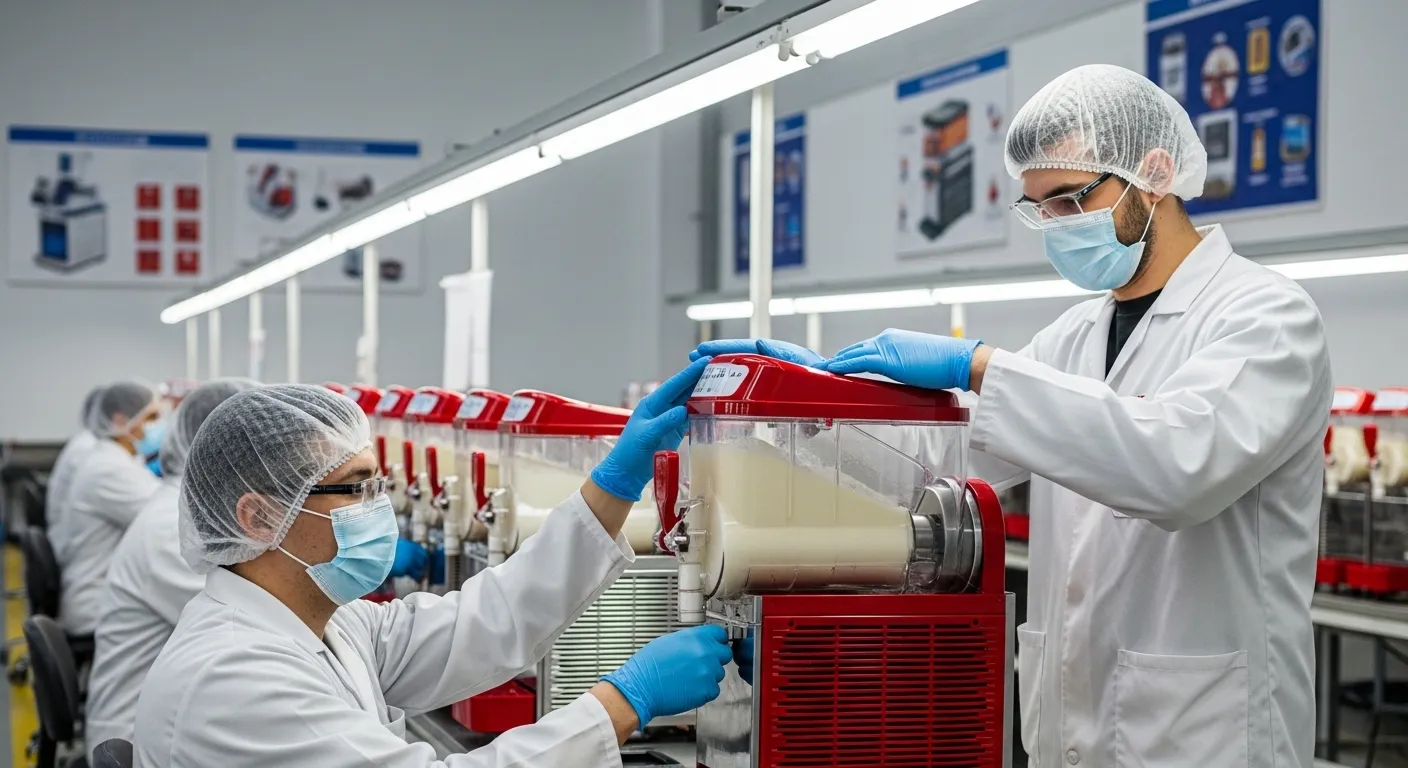
In a slushie machine OEM project, most buyers can customize visible branding first: logo, colors, packaging, manual language, and control panel labels. Deeper changes, such as preset modes, cooling behavior, accessories, and internal structure, usually need engineering review and higher MOQ.
For appliance brands, customization should start with what the customer sees and touches. That usually includes the machine logo, body color, packaging artwork, instruction manual, carton labels, control panel language, and accessory set. These changes help the product match the brand without forcing a full engineering rebuild.
| Customization area | What can change | Buyer should prepare |
|---|---|---|
| Branding | Logo, badge, sticker, carton mark | Logo file, color code, placement request |
| Appearance | Body color, panel style, visible trim | Reference image or color standard |
| Packaging | Retail box, carton, manual, labels | Artwork, language, barcode, compliance text |
| Functions | Preset modes, control labels, dispensing behavior | Function brief and target user scenario |
| Accessories | Spare parts, cups, tools, cleaning items | Accessory list and packaging plan |
Is your project OEM, ODM, or private label?
Choose ODM when speed and lower upfront cost matter; choose OEM when your brand needs a proprietary design, custom tooling, or protected product differentiation. Private label works for simple logo and packaging changes but offers the least control over engineering.
The safest choice depends on how much control your brand needs. If you only need a logo, packaging, and simple brand presentation, private label may be enough. If you want a proven platform with some customization, ODM is usually more practical. If you need exclusive structure, tooling, or deeper feature control, OEM is the stronger route.
| Route | Best for | Main limitation |
|---|---|---|
| Private label | Logo, packaging, fast market testing | Low engineering control |
| ODM | Using an existing machine platform with brand changes | Less product exclusivity |
| OEM | Custom specifications, tooling, protected product design | Higher planning, testing, and MOQ burden |
Before choosing a route, confirm whether the supplier is a real factory, a trading company, or a sourcing platform listing. A deeper manufacturer types review can help buyers avoid treating every supplier profile as the same kind of partner.
Which customization options affect MOQ and cost the most?
MOQ rises when the change affects procurement, molds, production setup, or certification. Logo and packaging are usually lighter changes, while custom colors, control panels, tooling, and new functions need higher volume because they affect materials, testing, or production flow.
Buyers often ask for “small changes” without realizing that factories group changes by production impact. A carton artwork change is not the same as a new mold. A logo change is not the same as changing cooling behavior or adding a new control system.
| Customization request | MOQ impact | Why it matters |
|---|---|---|
| Logo printing | Lower | Usually affects only branding setup |
| Packaging artwork | Lower to medium | Requires print setup and packaging approval |
| Custom body color | Medium | Affects material sourcing or production batch planning |
| Control panel labels | Medium | Affects user interface and approval sample |
| Preset modes or functions | Higher | Requires engineering review and performance testing |
| New mold or structure | Highest | Requires tooling, validation, and clear IP terms |
The lowest MOQ is not automatically the best deal. A low MOQ can be useful for market testing, but it becomes risky if the supplier cannot provide sample approval, material checks, certification support, and pre-shipment inspection.
What should you confirm before requesting a sample?
A sample request should not be vague. Before asking the factory to prepare a sample, define the product target, brand requirements, target market, and testing expectations. This helps the supplier quote the correct version instead of sending a generic machine that does not match your project.
- Target market and selling channel
- Home-use or commercial-use positioning
- Tank capacity and expected drink type
- Voltage, plug type, and manual language
- Logo, color, packaging, and label files
- Control panel language and function request
- Accessory and spare parts requirements
- Certification or documentation expectations
- Sample test criteria and approval process
Food-contact and appliance programs may address labeling, material safety, performance, and quality expectations, so certification planning should start before the sample stage. Useful reference points include NSF home products and appliances information and relevant appliance testing guidance.
How should you test an OEM slushie machine sample?
A sample is not only for appearance approval. Test freeze time, drink texture, dispensing, noise, cleaning access, leakage, control logic, and repeat performance over multiple use and cleaning cycles before approving mass production.
The sample should be checked against the written requirement sheet. If the approved sample has one logo position, one control panel label, one accessory set, and one packaging format, those details should become the reference for mass production.
- Check logo placement, color, panel label, and packaging artwork.
- Test freezing performance and drink texture under normal use.
- Check dispensing flow, leakage, and cleaning access.
- Run repeated use and cleaning cycles.
- Check noise, controls, safety labels, and manual language.
- Compare accessories, spare parts, and carton protection with the order requirement.
- Record pass or fail results before approving mass production.
If the buyer is concerned about syrup flow, maintenance, or blocked dispensing, the sample test can also include a review of clog-resistant design requirements.
What quality control documents and checkpoints should be required?
A reliable OEM order should define QC before production starts: approved sample, material documents, incoming inspection, in-process checks, finished performance tests, carton drop checks, and final pre-shipment inspection. Vague promises such as “we check everything” are not enough.
The buyer should treat the approved sample as the golden sample. That sample should guide materials, appearance, functions, accessories, packaging, and labeling during production. If the supplier changes parts, packaging, or configuration later, the buyer should approve those changes in writing.
| QC checkpoint | What to confirm | Why it matters |
|---|---|---|
| Golden sample | Appearance, function, packaging, accessories | Sets the mass production reference |
| Incoming material check | Key parts and food-contact materials | Reduces hidden quality variation |
| In-process check | Assembly, wiring, seals, controls | Finds problems before final packing |
| Finished product test | Freezing, dispensing, leakage, control logic | Confirms working performance |
| Packaging check | Carton, manual, labels, accessories | Protects brand presentation and shipment accuracy |
| Pre-shipment inspection | Quantity, appearance, function, packing | Gives the buyer one final control point |
Commercial and professional appliance testing can include safety, sanitation, performance, EMC, energy, and related certification services. UL provides appliance testing and certification information for commercial and professional appliances at UL commercial and professional appliances.
Buyers can also use a broader manufacturer checklist when comparing supplier capability, factory communication, QC support, and after-sales readiness.
Which certifications and customs documents can delay an OEM shipment?
Customs delays usually start before the container ships: missing certificates, mismatched product descriptions, wrong HS code, unclear country-of-origin marking, or incomplete invoice and packing data. Align product documents, certification files, and shipping paperwork before final inspection.
Trade.gov states that some products require special certificates for compliance, safety, health, or customs clearance, and exporters should confirm the required documents with the buyer. Import documentation may include commercial invoice, packing list, bill of lading or airway bill, certificate of origin, and extra certificates or permits.
| Document or item | Why it matters | When to confirm |
|---|---|---|
| Commercial invoice | Supports customs declaration and product value | Before shipment booking |
| Packing list | Shows carton, quantity, and packing details | Before final inspection |
| Bill of lading or airway bill | Supports transport and shipment release | At shipment stage |
| Certificate of origin | May be required by destination rules | Before export documents are finalized |
| Product certificates | Support compliance, safety, or market entry | Before mass production approval |
| HS code and product description | Helps avoid mismatched customs information | Before invoice preparation |
| Country-of-origin marking | Supports import compliance and labeling | Before packaging approval |
For official reference, see Trade.gov special documents, Trade.gov import requirements and documentation, and CBP basic import and export guidance.
What timeline should appliance brands plan for?
OEM timelines depend on customization depth. A logo and packaging project usually moves faster than a project with custom tooling, new functions, repeated sample revisions, or certification work. The buyer should plan by process stage instead of expecting one fixed timeline for every supplier.
- Prepare product brief, target market, and customization files.
- Request quotation and confirm OEM, ODM, or private-label route.
- Confirm MOQ, sample cost, tooling cost, and lead-time assumptions.
- Approve sample details and test performance.
- Revise sample if needed.
- Confirm purchase order, QC checkpoints, and inspection rights.
- Start mass production.
- Complete finished testing and pre-shipment inspection.
- Finalize shipping documents and shipment booking.
For home-appliance brands, the timeline should also reflect packaging, manual language, certification expectations, and retail presentation. A related home-use manufacturing guide can support that decision when the URL is available.
What should an appliance-brand OEM checklist include?
An appliance-brand OEM checklist should turn the project into a controlled process, not a loose message thread. It should cover the product, brand, sample, tooling, quality, documents, logistics, and after-sales requirements before the buyer pays a deposit.
- Product type, target buyer, and target market
- OEM, ODM, or private-label route
- Logo, color, packaging, manual, and label files
- Voltage, plug, control panel, and function requirements
- Accessory and spare parts list
- Sample approval plan and pass/fail criteria
- Tooling cost, ownership, and IP terms
- NDA or exclusivity terms if needed
- Golden sample approval
- Incoming material and in-process QC checkpoints
- Finished product testing and pre-shipment inspection
- Certification and document requirements
- Commercial invoice, packing list, shipment details, and certificate of origin
- Warranty terms and defect-response process
If the project includes function-level customization, such as separate drink zones or independent operation, the buyer can review dual mixing options before finalizing the OEM brief.
What should you send a supplier to get an accurate quote?
To get an accurate quote, send a clear supplier brief instead of asking only for a catalog and price. The brief should tell the factory what product you want, where it will be sold, what needs to be customized, and what level of testing or documentation is required.
- Product type and target use case
- Target market and required voltage or plug
- Expected order quantity and sample request
- Logo, color, packaging, and manual requirements
- Function, accessory, and spare parts needs
- Certification or compliance expectations
- QC and pre-shipment inspection requirements
- Shipping terms, document needs, and timeline goal
Full OEM is not always the best first step. It works when the brand needs protected design, tooling control, or exclusive functions, but ODM is safer when the buyer wants faster launch, lower risk, and a proven machine platform.
Frequently Asked Questions
What is a slush machine manufacturer?
A slush machine manufacturer produces or assembles frozen drink machines and may support OEM, ODM, or private-label orders. For OEM buyers, the key difference is whether the supplier controls engineering, materials, testing, and production instead of only reselling finished machines.
How do slush machine manufacturers ensure product quality?
Slush machine manufacturers ensure quality through material checks, assembly checks, sample approval, finished performance testing, and pre-shipment inspection. OEM buyers should ask for written QC checkpoints, not only a verbal promise that the factory tests every unit.
What features should I look for in a slush machine?
Look for the right tank capacity, stable freezing, easy cleaning, safe food-contact materials, reliable dispensing, suitable voltage, and clear control settings. For OEM projects, also check whether the supplier can customize branding, packaging, panel labels, accessories, and function settings.
Where can I find reliable slush machine manufacturers?
Reliable slush machine manufacturers can be found through factory websites, sourcing platforms, trade directories, and referrals, but the listing itself is not enough. Check factory capability, certificates, sample quality, inspection process, communication speed, and whether the supplier is a manufacturer or trading company.
What is the minimum order quantity for slushie machine OEM?
MOQ depends on the customization depth. Logo and packaging changes may need a lower MOQ, while custom color, control panel changes, new molds, new functions, or exclusive structure usually require higher volume because they affect setup, procurement, testing, and production planning.
Can I customize the machine with my logo?
Yes, logo customization is one of the most common slushie machine OEM or private-label requests. The buyer should confirm the logo method, file format, print location, minimum quantity, sample approval process, and whether the same branding appears on packaging and manuals.
How long does a slushie machine OEM order take?
Timeline depends on whether the project is ODM, private label, or full OEM. A simple branding project is usually faster, while custom tooling, new functions, certification work, repeated sample revisions, or incomplete shipping documents can extend the schedule.
Related Articles
How We Test Every Ice Maker Before Packaging
2026-09-15
BY YUMYTH
A step-by-step look at refrigerant handling, cooling verification, leak detection, corrective action and electrical safety testing For an ice maker, reliable performance is determined long before the carton is sealed. ...
Guide for Brands Looking for a Reliable Vacuum Sealer OEM Supplier
2026-09-14
BY YUMYTH
When you are sourcing kitchen appliances for your retail brand, finding a dependable vacuum sealer OEM supplier is rarely just about getting the lowest unit price. It is about protecting ...

Why Ice Shape Matters: Understanding 10mm × 15mm Cylindrical Nugget Ice
2026-09-14
BY YUMYTH
More Than Ice Production — The Ice Itself Shapes the Consumer Experience When sourcing a nugget ice maker, buyers often focus first on production capacity, water tank size, ice basket ...

Ice Maker Sourcing Guide: How to Find the Right Factory
2026-09-10
BY YUMYTH
Sourcing an ice maker looks straightforward on paper. Find a supplier, agree on a price, place an order. But anyone who has actually done this knows the process is rarely ...