Private Label Slushie Machines: Branding, Packaging, and Launch Checklist
Share:
-

-

-

-


Copied

Share:
-
-
-
-
Copied
A private label slushie machine lets a buyer launch a branded frozen drink appliance faster by using an existing factory platform and customizing the logo, color, packaging, manual, labels, and carton details. The safest launch process is to approve brand files, test a physical sample, confirm MOQ, freeze packaging artwork, and align customs documents before mass production.
Private label sounds simple until small details start blocking the launch. A logo file is not enough. Buyers also need approved colors, packaging artwork, manual text, product labels, sample tests, MOQ clarity, and shipment documents that match. This guide walks through the launch steps in the order a buyer should handle them, so branding work does not create quality problems or customs delays later.
What is a private label slushie machine?
A private label slushie machine is a factory-made frozen drink appliance sold under your own brand, usually by adapting an existing OEM or ODM platform with your logo, color, packaging, manual, and market-specific labels.
For most buyers, private label does not mean building a totally new machine from zero. It usually means choosing a tested base model, then making it look and feel like your brand. That can include the machine logo, retail box, carton marks, user manual, warranty card, and label details.
This is different from full OEM development, where the product structure may change. Private label is best when the machine platform already fits your market, and your main goal is a faster branded launch with controlled customization.
Why is private label usually the fastest path to market?
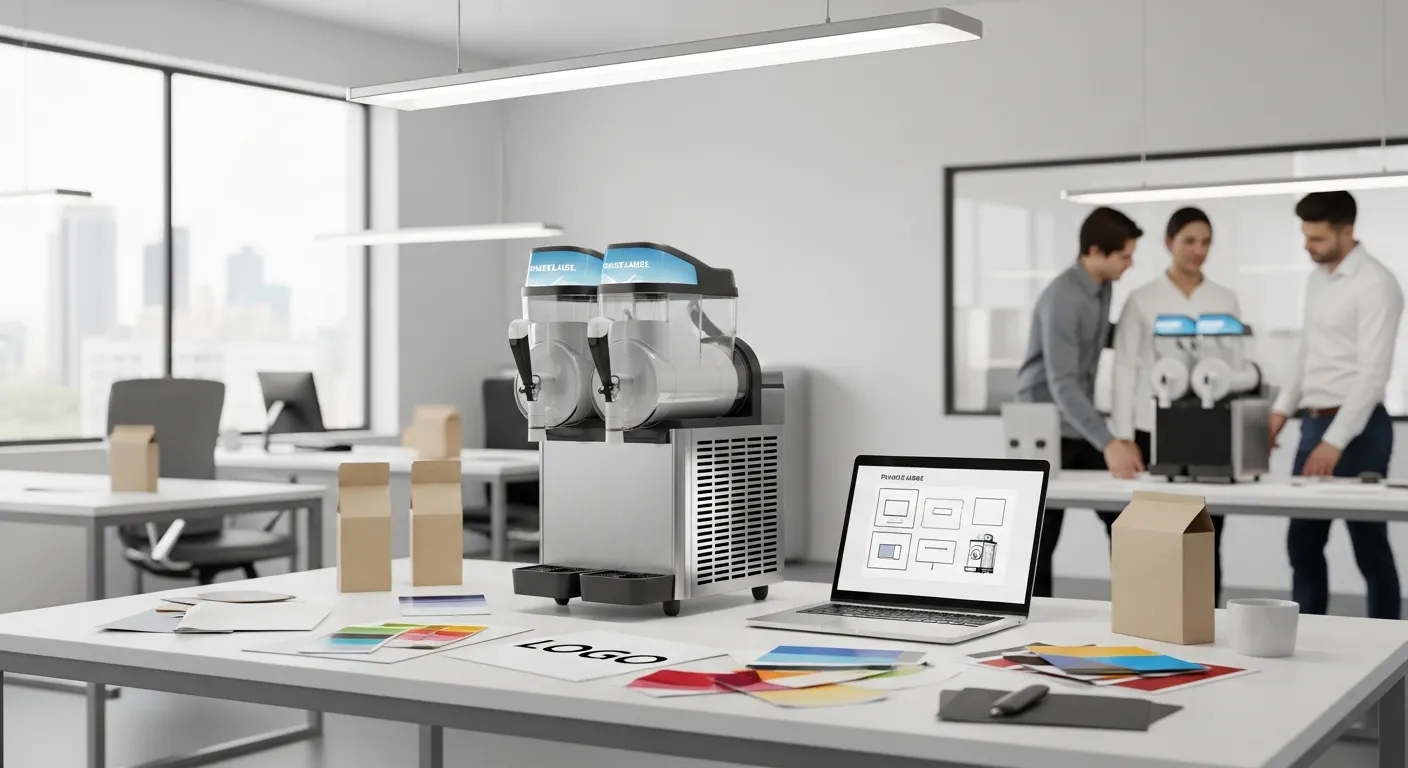
Private label is usually faster because the base machine already exists, so the buyer focuses on logo, color, packaging, manual, and launch documents instead of full engineering, tooling, and long product validation.
Speed matters when you want to test a new channel, launch before a seasonal sales window, or add a branded appliance to an existing product line. A startup selling on a marketplace, for example, may only need a logo, custom box, branded manual, and correct carton marks for the first launch.
| Launch route | Best for | Speed impact | Main risk |
|---|---|---|---|
| Private label | Fast branded launch | Fastest | Weak brand file control |
| ODM | Existing platform with more adaptation | Medium | Scope creep |
| OEM | Deeper product changes | Slowest | Longer testing and tooling |
Private label is not always the best choice. It works when your differentiation is mostly brand, packaging, channel, and speed. OEM is safer when the machine itself must be structurally different, such as a new bowl layout, control system, or cooling design.
For buyers comparing platform-based sourcing, the ODM launch path can help frame what belongs in ODM instead of a simple private-label order.
What can you customize without slowing the launch?
The fastest private-label changes are usually logo placement, packaging artwork, manual branding, carton marks, and approved colorways. Deeper changes such as molds, control panels, or cooling performance should be treated as OEM or ODM development.
A good launch starts by separating fast brand changes from slow engineering changes. If a buyer wants a custom logo on the machine and box, that is usually manageable. If they want a new shell, new buttons, or changed freezing performance, the project should move into custom OEM changes.
| Customization item | Speed impact | Approval needed | MOQ impact | Risk if skipped |
|---|---|---|---|---|
| Logo placement | Low | Logo proof and sample photo | Low to medium | Wrong size or position |
| Retail packaging | Medium | Box artwork and print proof | Medium | Poor shelf presentation |
| User manual | Low | Language and brand review | Low | Confusing customer setup |
| Barcode | Low | Barcode test and layout check | Low | Retail listing issues |
| Carton marks | Low | Shipping mark approval | Low | Warehouse or customs confusion |
| Color shell | Medium | Color reference and sample | Medium to high | Brand mismatch |
| Control panel | High | Design proof and function test | High | Usability or production delay |
| Mold change | High | Tooling sample approval | High | Longer launch timeline |
| Performance tuning | High | Freeze and texture testing | Medium to high | Poor product experience |
A color customization scenario shows why this matters. If the buyer asks for a brand color, the factory needs a clear color reference, sample review under normal lighting, and written approval. A small color difference may not matter online, but it can matter in retail packaging and brand consistency.
What brand files should be ready before asking for a quote?
A buyer should prepare brand files before asking for a final quote because missing details make supplier answers vague. At minimum, send logo files, color references, packaging needs, manual language, target market, barcode needs, and any warning label requirements.
- Logo files in editable format
- Brand color reference, such as Pantone or a clear sample
- Product name and model naming style
- Packaging type, such as mailer box, gift box, or export carton
- Manual language and warranty card content
- Barcode or retail label requirements
- Target sales market
- Country-of-origin and importer label needs
- Any safety wording or market-specific label text
Be careful with origin claims. If packaging or marketing says “Made in USA,” the claim must match the standard explained in the FTC Made in USA guidance. If the product is imported, brand language should not create confusion about where it was made.
How should logo, color, packaging, and manuals be approved?
Approve private-label details in this order: digital proof, physical sample, packaging artwork, manual text, label details, carton marks, and final signed sample. Do not let mass production start while brand files are still changing.
Private-label approval is a sequence, not one email. Buyers should freeze the brand details before production, because late changes can affect printed boxes, labels, manuals, barcodes, and carton marks. Custom packaging should not be treated as decoration. It is part of the launch system.
Digital approval
Start with digital proofs for the machine logo, control panel artwork, box layout, manual cover, warranty card, barcode area, and carton marks. Check the product name, model name, brand spelling, color callouts, and warning text. A retail-ready packaging buyer should also confirm barcode placement and warranty language at this stage.
Physical sample approval
After digital proof, review a physical sample or detailed sample photos. Check logo placement, print quality, color match, manual accuracy, label position, and packaging fit. If the product will enter the U.S. or EU, keep origin wording and market labels consistent with the target market’s rules, including U.S. origin marking guidance from CBP and EU labeling points from Trade.gov.
Do not approve production if the sample looks good but the manual is unfinished. That creates avoidable rework after cartons are printed.
What MOQ should private-label buyers expect?
MOQ for private-label slushie machines depends on the customization type. Logo or carton changes may be easier, while custom colors, gift boxes, control panels, or new tooling usually require higher volume and longer approval time.
Ask for MOQ by customization item, not one general number. A supplier may accept a lower MOQ for logo placement, but require higher volume for custom color shells or printed retail packaging. This is normal because different parts, printing methods, and supplier processes carry different setup costs.
| Custom request | Ask the supplier | Buyer decision |
|---|---|---|
| Logo only | What logo methods are available? | Choose the method that fits launch speed |
| Custom box | What print MOQ applies? | Decide if first order justifies retail packaging |
| Custom color | Is a color sample required? | Approve color before mass production |
| Manual branding | Can the manual be edited? | Check language before printing |
| Control panel change | Does this count as OEM? | Move to a deeper development plan |
A pilot launch may work better with limited customization. For example, a first marketplace batch can use a branded manual, logo, and carton label, then move to full retail packaging after demand is proven. Buyers should also confirm manufacturer capacity before planning a larger rollout.
How do you approve a private-label sample before mass production?
A private-label sample is not approved just because the logo looks correct. The buyer should test freezing, texture, cleaning access, leakage, noise, labels, manual, packaging, and carton marks before releasing mass production.
Do not approve a sample only because the branding looks good. A branded machine that freezes poorly, leaks, or has confusing manual text will create customer complaints faster than a plain machine with stable performance. This is where the OEM quality process becomes useful, even for a private-label project.
- Logo position matches the approved proof
- Shell color matches the approved reference
- Machine freezes properly during a normal test run
- Drink texture is acceptable for the target use
- No leakage appears around seals, tank, or tap
- Noise level is acceptable for the sales channel
- Removable parts fit cleanly
- Manual explains setup, cleaning, and safety clearly
- Product label matches the model and market
- Packaging protects the machine during handling
- Carton marks match the packing list
- Final sample photos are saved before production
A sample failure scenario is simple. If logo and box pass, but freeze time or leakage fails, the sample is not approved. The factory should fix performance issues first, then submit the corrected sample or evidence before mass production starts.
For certain consumer products, importers and sellers may need product safety documents or certificates. The CPSC guidance for businesses explains why retailers should request documentation from suppliers instead of waiting until after problems appear.
Which packaging and label details can create customs delays?
Customs delays often start with mismatched product descriptions, missing origin details, unclear invoices, inconsistent carton marks, or unavailable support documents. Private-label buyers should align packaging, invoice, packing list, model name, and compliance files before shipment.
A private-label shipment can look confusing if each document uses a different name. For example, the product box says “Frozen Drink Maker,” the invoice says “Kitchen Appliance,” and the carton says another model number. That mismatch should be fixed before shipment, not after the goods reach port.
Documents to match before shipment
The commercial invoice, packing list, model name, product description, quantity, and carton count should match the shipment. CBP’s importing guide highlights the need for accurate import information, and CBP Form 7501 data relates to classification, value, origin, and entry details through CBP entry summary guidance.
Labels to verify before shipment
Check the country-of-origin marking, product label, warning label, carton marks, barcode, and importer details before release. For EU sales, label planning may also need CE contact details, plus electrical product rules such as RoHS and WEEE listed in Trade.gov EU import guidance.
Packaging is not only a visual brand asset. It also tells warehouses, customs brokers, inspectors, retailers, and customers what the product is. If the brand name, model number, and document description do not align, delays become much more likely.
What should be in the private-label launch-readiness checklist?
A private-label launch checklist should confirm brand, product, packaging, quality, and shipment readiness before production release. This keeps the buyer from approving a nice-looking design while leaving manual text, carton marks, or customs documents unfinished.
Use this as a go/no-go checklist before deposit, production release, or shipment.
| Launch item | What to check | Approved? |
|---|---|---|
| Brand assets | Logo file, color reference, product name | Yes or No |
| Logo placement | Size, position, print method | Yes or No |
| Color reference | Sample matches approved color | Yes or No |
| Packaging artwork | Box design, barcode, warning text | Yes or No |
| User manual | Setup, cleaning, safety, language | Yes or No |
| Warranty card | Coverage wording and contact details | Yes or No |
| Product label | Model, rating, origin, market details | Yes or No |
| Carton marks | Model, quantity, shipping marks | Yes or No |
| Sample test | Freezing, texture, leakage, noise | Yes or No |
| QC criteria | Inspection points confirmed in writing | Yes or No |
| Invoice details | Product description and model match | Yes or No |
| Packing list | Carton count and quantity match | Yes or No |
| Compliance files | Required certificates or documents ready | Yes or No |
| Shipment release | Final approval recorded | Yes or No |
A buyer preparing a retail-ready launch should complete this before printing the full packaging run. If one item is still changing, mark the launch as not ready. For broader production planning, review frozen drink maker production before scaling the order.
When should you choose private label, ODM, or OEM?
Choose private label when speed and brand presentation matter most, ODM when you need an existing platform adapted, and OEM when the product must be structurally different. The deeper the change, the slower the launch.
The right path depends on how much change you need. A marketplace seller launching a branded home unit may choose private label. A distributor that needs a different tank layout or interface may need ODM. A brand building a new product from the inside out should choose the OEM sourcing route.
| Situation | Best route | Why |
|---|---|---|
| You need a fast branded launch | Private label | Base product already exists |
| You need custom packaging and manual | Private label | Branding work is the main change |
| You need a modified platform | ODM | The base design needs adaptation |
| You need a new structure or function | OEM | Product development is deeper |
| You need performance changes | OEM or ODM | Testing and validation are required |
This choice should happen before quoting. If the buyer asks for private label but keeps adding custom control panels, mold changes, and performance changes, the project will move outside a fast private-label timeline.
What to Do Next
A private label slushie machine launch works best when the buyer controls the small details early. Start with a proven platform, prepare brand files, ask for MOQ by customization item, approve a real sample, and freeze packaging before mass production. Then check shipment documents before release.
Your next step is simple: make a one-page launch file with your logo, color, packaging needs, target market, and sample approval checklist. Send that to the factory before asking for a final quote.
Frequently Asked Questions
What is a private label slushie machine?
A private label slushie machine is produced by a third-party manufacturer and sold under the buyer’s own brand. Most launches use an existing machine platform, then customize visible brand details such as logo, color, packaging, manual, and labels.
Does this product support customization?
Yes, but the type of customization matters. Logo, carton, manual, and packaging changes are usually simpler than custom molds, control panels, or performance changes, which may require longer testing and higher MOQ.
What MOQ should I expect for private-label packaging?
MOQ depends on the supplier and customization depth. Buyers should ask for MOQ by item, because custom gift boxes, color shells, control panels, and logo methods can each carry different setup requirements.
How do you ship the products?
Shipping should be planned after packaging size, carton marks, invoice description, packing list, country of origin, and compliance documents are aligned. The buyer should confirm these details with the factory and freight partner before shipment release.
What is the warranty for the product?
Warranty terms vary by factory and machine platform. Private-label buyers should confirm warranty length, spare parts, who handles customer claims, and whether branded packaging or modified parts affect warranty coverage.
How do I approve a private-label sample?
Approve the sample only after checking both branding and performance. The buyer should test freezing, texture, leakage, cleaning access, manual accuracy, packaging fit, carton marks, and label consistency before mass production.
Related Articles
How We Test Every Ice Maker Before Packaging
2026-09-15
BY YUMYTH
A step-by-step look at refrigerant handling, cooling verification, leak detection, corrective action and electrical safety testing For an ice maker, reliable performance is determined long before the carton is sealed. ...
Guide for Brands Looking for a Reliable Vacuum Sealer OEM Supplier
2026-09-14
BY YUMYTH
When you are sourcing kitchen appliances for your retail brand, finding a dependable vacuum sealer OEM supplier is rarely just about getting the lowest unit price. It is about protecting ...
Why Ice Shape Matters: Understanding 10mm × 15mm Cylindrical Nugget Ice
2026-09-14
BY YUMYTH
More Than Ice Production — The Ice Itself Shapes the Consumer Experience When sourcing a nugget ice maker, buyers often focus first on production capacity, water tank size, ice basket ...

Ice Maker Sourcing Guide: How to Find the Right Factory
2026-09-10
BY YUMYTH
Sourcing an ice maker looks straightforward on paper. Find a supplier, agree on a price, place an order. But anyone who has actually done this knows the process is rarely ...