
How to Evaluate a Slushie Machine Manufacturer: Quality, Testing, and Support Checklist
Share:
-

-

-

-


Copied

Share:
-
-
-
-
Copied
A slushie machine manufacturer should be evaluated by factory proof, cooling performance tests, food-contact material documents, production QC, export support, and after-sales responsibility. Do not judge by price alone. Ask for model-specific certificates, sample test records, batch inspection steps, spare parts terms, and shipment documentation before paying a deposit.
Buying from a manufacturer is a supply decision, not a simple product search. A machine can look good in photos, but still fail on cooling speed, texture control, food-contact safety, or support after delivery. For importers, distributors, and private label brands, the safer path is to check the factory before the order becomes expensive to fix.
Why does choosing the right slushie machine manufacturer matter?
A slushie machine manufacturer should be judged by factory capability, testing discipline, material proof, export readiness, and after-sales support. The safest supplier is the one that can prove stable quality before bulk production.
The manufacturer affects more than the machine body. It affects cooling consistency, drink texture, electrical safety, food-contact parts, lead time, spare parts, and support when something goes wrong. A low quote can look attractive at first, then become expensive if machines fail after arrival.
Slushie machines are used in cafés, convenience stores, bars, restaurants, entertainment venues, and frozen drink businesses. That range of use matters because every buyer has a different duty cycle, recipe, tank size, and support need. A serious factory should understand these use cases before recommending a model.
The main risk is simple: product listings show what a machine claims to be, but they do not prove how the manufacturer controls quality. The buyer’s job is to move from “nice product page” to “verified production partner.”
Is the supplier a real factory, trading company, or marketplace listing?
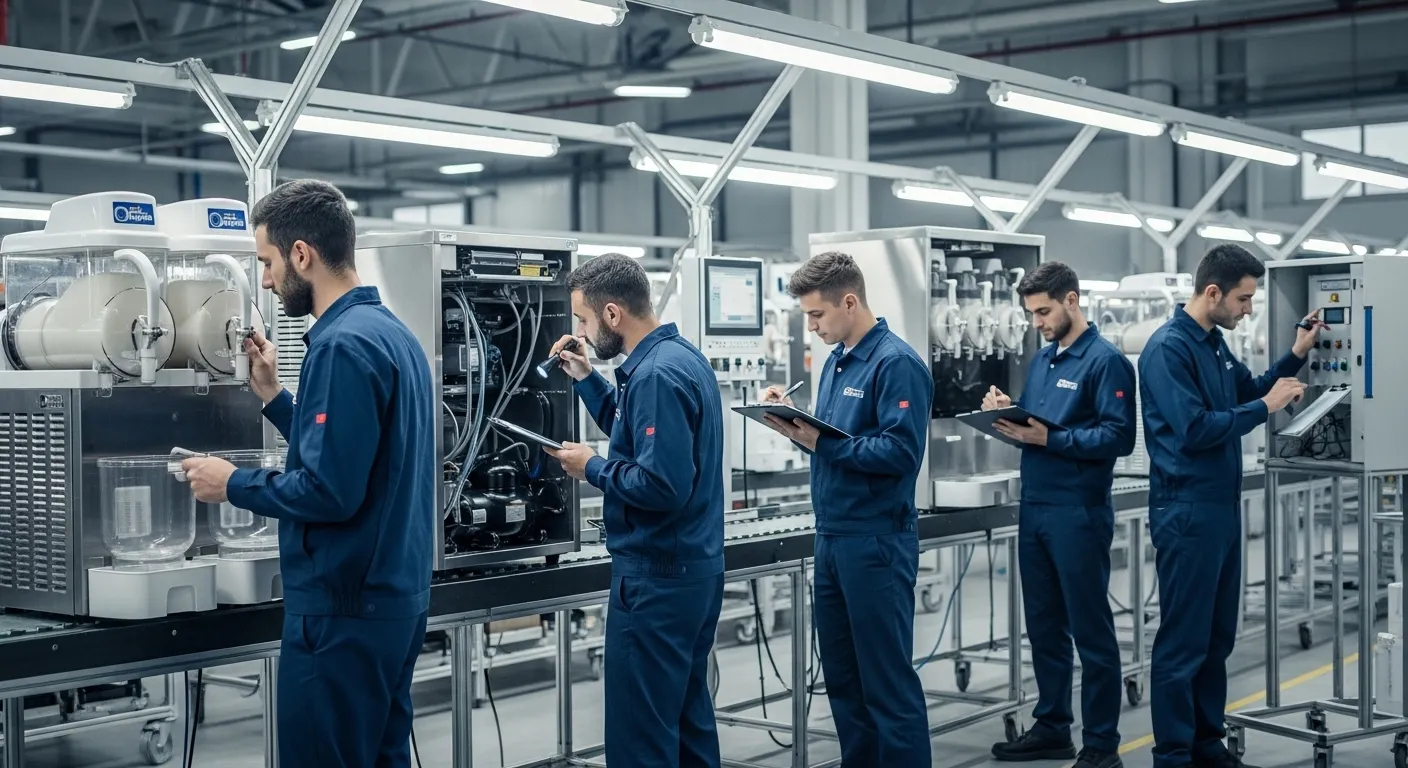
A real manufacturer should prove where the machine is built, how QC is managed, and who handles engineering changes. A trading company can work if responsibility for defects, spare parts, and compliance documents is clearly written.
Start with factory identity. Ask for the factory name, address, business license, production-line photos or video, and the name of the person responsible for quality control. Marketplace badges and supplier profiles can help, but they should not replace direct proof from the supplier.
A trading company is not always a bad choice. It works when the team is honest about who builds the machine and who controls quality. It becomes risky when the seller cannot explain testing, warranty, replacement parts, or who handles a defect claim after delivery.
Use this quick check before comparing prices:
| What to verify | Good answer | Red flag |
|---|---|---|
| Factory location | Clear address and production proof | Vague location or no factory evidence |
| QC ownership | Named QC process and inspection steps | “We check everything” with no details |
| Engineering control | Can discuss model changes and parts | Cannot answer technical questions |
| After-sales role | Written warranty and spare parts terms | Support only promised by chat |
| Export experience | Can prepare documents before shipment | Documents discussed after goods leave |
If the supplier avoids these questions, do not treat the quote as final. You are still missing basic risk information.
What quality checks should happen before bulk production?
Before bulk production, test one approved sample against the exact recipe, voltage, tank fill level, and operating cycle expected in your market. Then require the same checks during production so the bulk order matches the approved sample.
Quality control should start before the deposit is fully committed. The approved sample is the reference point for the whole order. If the factory changes the compressor, auger, tank material, wiring, seal ring, or control board later, the bulk order may not perform like the sample.
For example, a private label brand ordering 500 compact machines should not test the sample with only water or a light juice mix. If the final customer will use higher-sugar recipes, dairy drinks, or long operating cycles, the sample test should match those conditions.
Sample approval checklist
- Test freeze time with the buyer’s target recipe.
- Check texture after repeated dispensing.
- Confirm voltage, plug type, and market version.
- Inspect leakage around bowl, seal ring, and dispenser.
- Record noise, vibration, and motor behavior.
- Confirm packaging, label, logo, and manual details.
Batch QC checklist
- Incoming material inspection before assembly.
- Compressor and motor check during assembly.
- Bowl, auger, seal ring, and dispenser inspection.
- Functional cooling test before packing.
- Final appearance, packaging, and accessory check.
- Photo, video, or test sheet record for the batch.
This is where mixing performance becomes part of supplier evaluation. The buyer is not only checking whether the machine runs. They are checking whether the factory can keep performance stable across a full order.
How can you verify cooling, mixing, and texture performance?
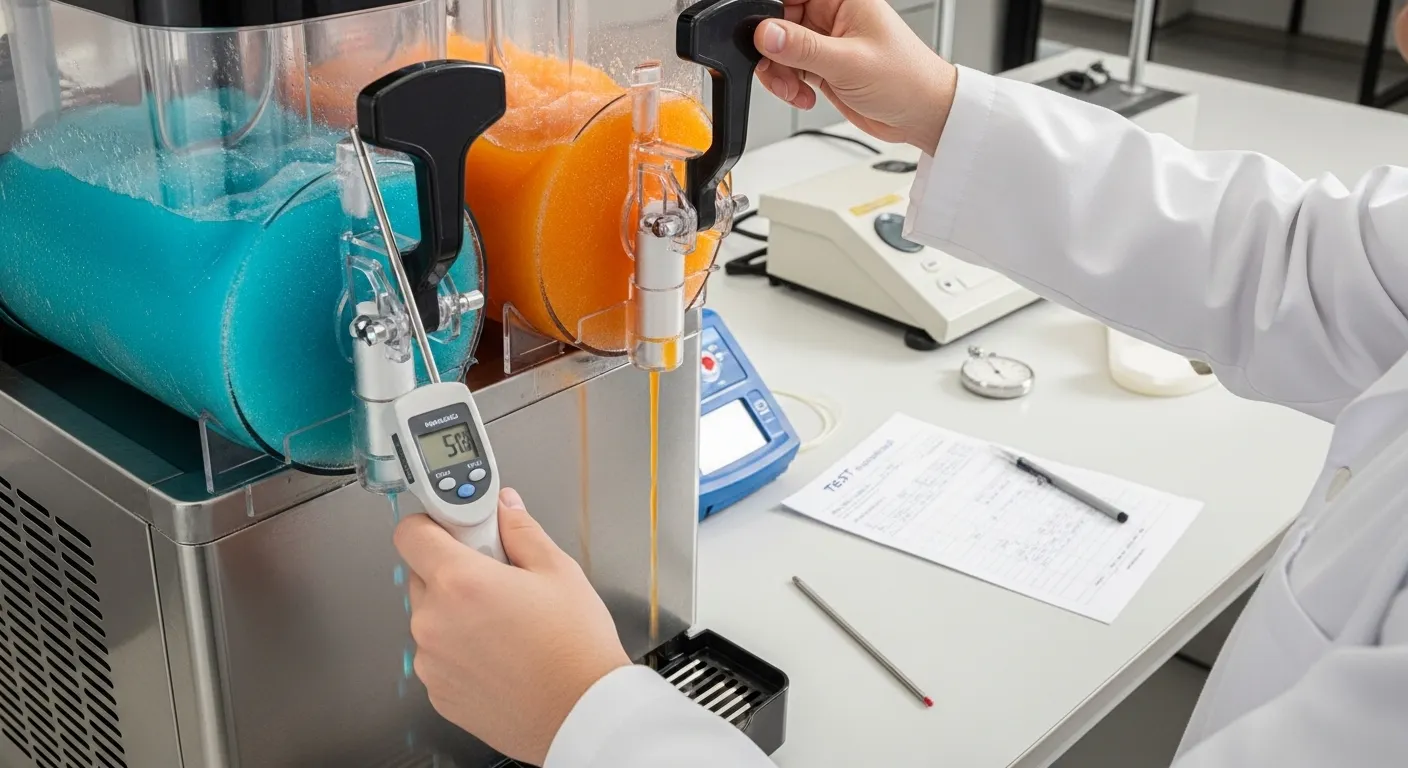
Cooling performance should be verified with real drink formulas, measured freeze time, texture consistency, and repeat operation. A good test checks whether the machine holds stable slush without ice blocks, clogging, leaking, or overheating during practical use.
A slush machine can turn on and still fail the buyer’s real use case. Cooling should be checked by time-to-slush, temperature stability, texture after dispensing, and how the machine performs after running for hours. The test should use the recipe the buyer expects to sell.
Mixing is just as important as cooling. Poor mixing can create uneven texture, ice blocks, or dispenser clogging. If the product will use fruit pulp, thicker syrups, or higher-sugar recipes, the buyer should ask how the auger and bowl design reduce blockage risk.
| Performance area | What to test | Why it matters |
|---|---|---|
| Freeze time | Time from liquid to usable slush | Shows cooling strength |
| Texture stability | Slush quality after repeated serving | Protects customer experience |
| Mixing behavior | Auger movement and drink circulation | Reduces uneven freezing |
| Clog resistance | Dispensing with real recipe | Helps avoid service complaints |
| Heat control | Long-cycle operation | Shows duty-cycle reliability |
| Night mode | Low-demand holding condition | Useful for commercial locations |
A supplier demo with a simple water-based juice is not enough if the buyer plans dairy drinks or thicker recipes. The buyer should request a test with the closest possible formula and ask how anti-clog design is handled in the chosen model.
Which material and certification documents should a buyer request?
Ask for documents tied to the exact model and material, not generic certificates. Food-contact proof should identify the bowl, seal ring, auger, and other drink-contact parts, while electrical certificates should match the voltage and market version ordered.
The phrase “food grade” is too vague by itself. Buyers should ask which parts touch the drink, what materials are used, and whether the proof applies to the exact model being ordered. The bowl, seal ring, auger, valve, and internal chamber are the parts that deserve close attention.
For U.S. food-contact review, FDA explains that the status of a food-contact material depends on the regulatory status of its component substances, with indirect additives addressed in parts of 21 CFR 174-179. For the EU market, food-contact materials include items such as machinery and kitchenware, and they must follow EU food-contact and good manufacturing practice rules when placed on the market through the European Commission’s food contact materials framework.
Use this document check before accepting a safety claim:
| Document or proof | What it should match | Buyer question |
|---|---|---|
| Food-contact declaration | Bowl, auger, seals, valves | Which drink-contact parts are covered? |
| FDA-related material proof | Exact material and component | Does this apply to this model? |
| EU food-contact proof | EU version and material list | Is it valid for this market? |
| CE or ETL/UL document | Electrical version and voltage | Does it match my plug and voltage? |
| RoHS or LFGB where needed | Model and material batch | Is this certificate current? |
| Product manual | Ordered model | Does it match the final machine? |
This is also where food-safe materials deserve deeper review. A certificate screenshot is not enough. Ask whether the certificate applies to the exact model, voltage version, material, and market being ordered.
What export and customs support should the manufacturer provide?
Customs delay risk drops when the manufacturer prepares accurate product descriptions, packing details, certificates, and shipment documents before departure. Incomplete or inaccurate entry data can delay FDA review for regulated products, so documentation should be checked before goods leave the factory.
Export support should be discussed before production ends. At minimum, the buyer should review the commercial invoice, packing list, bill of lading or airway bill, certificate of origin when needed, product description, model number, quantity, and certificate copies. Trade.gov lists documents such as a bill of lading or airway bill, commercial invoice or packing list, and certificate of origin among common import documentation needs for certain markets.
For U.S. imports, FDA-regulated products enter through CBP and may be referred to FDA for review. The FDA import process also explains that incomplete or inaccurate entry information can delay review. That is why document consistency matters before shipment.
| Risk | What causes it | What to request | When to check |
|---|---|---|---|
| Wrong product description | Generic wording on invoice | Clear model and product name | Before invoice approval |
| Certificate mismatch | Certificate names another model | Model-specific certificate copy | Before final payment |
| Packing mismatch | Cartons differ from packing list | Final packing photos and list | Before loading |
| HS code confusion | Supplier guesses without review | HS code discussion with broker | Before shipment booking |
| Missing origin proof | Certificate prepared late | Certificate of origin if required | Before vessel or flight |
| FDA entry delay | Incomplete entry data | Accurate product and manufacturer data | Before goods depart |
For example, a shipment may say “kitchen appliance” on the invoice, “slush machine” on the packing list, and another model name on the certificate. That mismatch can slow review and create avoidable questions. The manufacturer should help fix this before the goods leave.
How should after-sales support be judged before paying a deposit?
After-sales support should be measured in writing before payment. A supplier who gives clear warranty terms, spare parts access, response times, and defect claim steps is safer than one who only says “we support you” in chat.
Ask what happens if a compressor fails, a bowl cracks, a seal leaks, or a control board stops working after delivery. A distributor buying 300 units should not discover after arrival that spare seal rings, valves, or troubleshooting guides were never included.
Use this support checklist:
- Warranty period and what parts it covers.
- Parts excluded from warranty.
- Spare parts list and unit pricing.
- Suggested spare parts for the first order.
- Response time for technical issues.
- Video or document support for repairs.
- Who pays for replacement parts and shipping.
- Claim process for damaged or defective units.
- Support terms for distributors and private label buyers.
The lowest quote is not always the best procurement decision. It works only when the supplier can prove material quality, test records, and spare parts support. Without that proof, the cheap price simply moves the cost into defects, delays, and support problems.
What red flags should make you reject a manufacturer?
Reject a manufacturer if they cannot prove model-specific compliance, testing, production control, and after-sales responsibility. A cheap quote is not a saving if the machines arrive late, fail in use, or cannot clear documentation review.
Red flags usually appear before payment. The problem is that buyers often ignore them because the price looks good or the sample photo looks professional. Treat unclear answers as risk signals, not small communication issues.
| Red flag | Why it matters | Safer response |
|---|---|---|
| Refuses model-specific certificates | Generic proof may not apply | Pause until documents match |
| Cannot explain QC steps | Bulk quality may drift | Ask for inspection process |
| Pushes deposit before sample test | Buyer loses control early | Approve sample first |
| Vague spare parts answer | Support may fail later | Request parts list and terms |
| Unrealistic low price | Materials may be downgraded | Compare compressor and material details |
| No export document plan | Customs risk increases | Review documents before shipment |
| Avoids factory proof | Supplier role is unclear | Confirm manufacturer identity |
A trading company is not automatically a bad choice. It becomes risky only when it cannot name who controls QC, who owns the warranty, and who supplies spare parts after the sale.
What final checklist should buyers use before ordering?
Use a scorecard before choosing a supplier. It helps the buyer compare manufacturers on proof, not pressure. If two suppliers offer similar machines, the one with clearer testing, documents, spare parts, and export support is usually the safer partner.
This checklist should be filled before deposit, then reviewed again before final payment.
| Evaluation area | What to ask | Acceptable proof | Red flag | Status |
|---|---|---|---|---|
| Factory proof | Where is the machine built? | License, address, production video | No clear factory evidence | Pass or fail |
| Sample test | Was the real recipe tested? | Video, test sheet, approved sample | Only generic demo | Pass or fail |
| Cooling performance | How fast does it freeze? | Freeze-time record | No measured test | Pass or fail |
| Material safety | Which parts touch the drink? | Material list and documents | “Food grade” only | Pass or fail |
| Certificates | Do they match the model? | Model-specific copies | Screenshot only | Pass or fail |
| Production QC | What is checked during assembly? | QC checklist | No written process | Pass or fail |
| Export support | Are documents checked early? | Invoice, packing list, certificate copies | Late document handling | Pass or fail |
| Spare parts | What parts are available? | Parts list and pricing | No clear parts plan | Pass or fail |
| Warranty | Who pays for what? | Written warranty terms | Chat promise only | Pass or fail |
| Cleaning design | Is daily cleaning practical? | Bowl and dispenser access check | Hard-to-clean structure | Pass or fail |
Cleanability should not be treated as a minor detail. If staff cannot clean the bowl, valve, and dispenser easily, support issues will appear after the sale. For that part of the evaluation, review the machine’s cleaning-friendly design before confirming the model.
Getting the Next Step Right
A good slushie machine manufacturer makes the buying process easier to verify. They can show where the machine is built, how it is tested, which materials touch the drink, what documents support export, and how support works after delivery.
Before choosing a supplier, send one checklist to every candidate and compare the answers side by side. Do not reward vague replies with a deposit. Choose the factory partner that gives clear proof before production, not excuses after shipment.
Frequently Asked Questions
What should I ask a slushie machine manufacturer before ordering?
Ask for factory proof, model-specific certificates, sample test results, production QC steps, spare parts terms, warranty scope, and export document support. These answers show whether the supplier can manage the full order, not only quote a low price.
How do I know if a slushie machine supplier is a real manufacturer?
A real manufacturer should provide a factory address, production-line evidence, QC process details, and responsibility for engineering, testing, and after-sales support. Marketplace badges help, but they should not replace direct documentation.
What quality tests are important for slushie machines?
The key tests are cooling time, texture stability, leakage, motor noise, dispensing flow, repeated operation, and cleaning access. For bulk orders, the factory should repeat these checks during production and final inspection.
What is the lead time for bulk orders?
Lead time depends on quantity, customization, certificate requirements, and production schedule. Treat any quoted lead time as conditional until the manufacturer confirms sample approval, packaging artwork, material availability, and inspection timing in writing.
What documents help reduce customs delays?
Common documents include commercial invoice, packing list, bill of lading or airway bill, certificate of origin, and any required compliance certificates. For regulated products, inaccurate or incomplete entry data can slow review.
Who are the major players in the frozen slush machine market?
Brand lists can help with market awareness, but they do not replace manufacturer verification. Buyers should focus on the specific factory’s testing, materials, certificates, spare parts, and export support before comparing names.
Related Articles
How We Test Every Ice Maker Before Packaging
2026-09-15
BY YUMYTH
A step-by-step look at refrigerant handling, cooling verification, leak detection, corrective action and electrical safety testing For an ice maker, reliable performance is determined long before the carton is sealed. ...
Guide for Brands Looking for a Reliable Vacuum Sealer OEM Supplier
2026-09-14
BY YUMYTH
When you are sourcing kitchen appliances for your retail brand, finding a dependable vacuum sealer OEM supplier is rarely just about getting the lowest unit price. It is about protecting ...

Why Ice Shape Matters: Understanding 10mm × 15mm Cylindrical Nugget Ice
2026-09-14
BY YUMYTH
More Than Ice Production — The Ice Itself Shapes the Consumer Experience When sourcing a nugget ice maker, buyers often focus first on production capacity, water tank size, ice basket ...

Ice Maker Sourcing Guide: How to Find the Right Factory
2026-09-10
BY YUMYTH
Sourcing an ice maker looks straightforward on paper. Find a supplier, agree on a price, place an order. But anyone who has actually done this knows the process is rarely ...