Frozen Drink Maker Manufacturer Guide: Specs, Certifications, and Supplier Questions
Share:
-

-

-

-


Copied

Share:
-
-
-
-
Copied
A frozen drink maker manufacturer should be evaluated by more than price. Before sourcing, check whether the supplier controls engineering, can document food-contact materials, proves cooling performance, provides model-matching certifications, supports sample testing, prepares accurate customs documents, and commits to warranty and spare parts. Use a supplier-question checklist before approving samples or bulk production.
Choosing the wrong supplier can turn a good product idea into delayed shipments, failed samples, unclear certificates, and after-sales problems. A strong manufacturer should make sourcing easier before money changes hands. That means clear specs, test proof, material details, packaging support, and written service terms. Start with the questions that reveal whether the supplier can support real production.
What should you verify before choosing a frozen drink maker manufacturer?
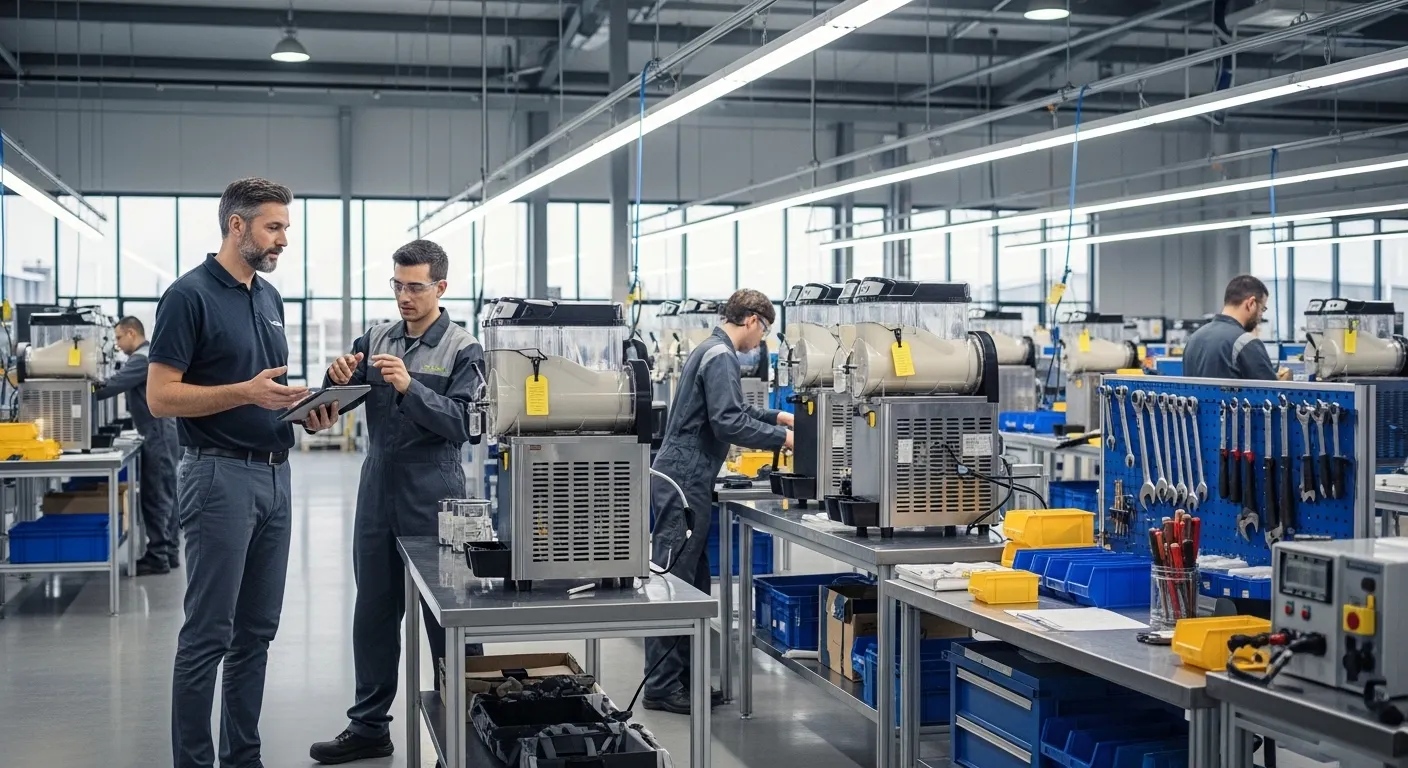
A frozen drink maker manufacturer should be checked for engineering control, food-contact materials, cooling performance, capacity claims, certifications, QC process, packaging support, and spare parts. If a supplier cannot document these areas, treat the quote as incomplete.
Price matters, but it should never be the first filter. A low quote can hide weak cooling, fragile parts, missing certificates, poor packaging, or no spare-parts plan. The better first question is simple: can this supplier prove what they claim?
Use this quick qualification checklist before you request a sample:
| Check area | What to ask | Red flag |
|---|---|---|
| Supplier identity | Are you the factory, trading company, OEM partner, or ODM supplier? | Vague answers about production control |
| Cooling system | What compressor, cylinder, auger, or scraper setup is used? | Freeze-time claims without test conditions |
| Materials | Which parts touch the drink? | Only says “food grade” |
| Compliance | Which certificates match this exact model? | Certificate model does not match product |
| QC | What tests happen before shipment? | No written inspection process |
| Packaging | Can you share carton size, marks, and packing method? | Packaging details given after production |
| Warranty | Which parts are covered and for how long? | No spare-parts list |
If you need the broader supplier landscape first, review Yumyth’s guide to manufacturer types before narrowing your shortlist.
Is the supplier a real manufacturer, OEM partner, ODM partner, or reseller?
A real manufacturer can explain material grades, engineering changes, testing steps, and spare parts by model. A reseller may quote quickly, but usually cannot prove deep control over design, QC, or long-term component availability.
Do not treat every supplier title the same. A factory, OEM partner, ODM partner, and reseller can all sell frozen drink machines, but they do not carry the same sourcing risk. The difference shows up when you ask technical questions.
| Supplier type | What they usually provide | Best fit | Main risk |
|---|---|---|---|
| Manufacturer | Factory-controlled models and production | Buyers who need stable repeat orders | Quality depends on factory systems |
| OEM partner | Builds to your requested specs or brand plan | Private-label buyers | Requires clear specs and approval process |
| ODM partner | Offers existing platforms with changes | Buyers who need faster customization | Design changes may be limited |
| Reseller | Sources from other factories | Small test orders or mixed catalogs | Weak control over QC and spare parts |
If you plan to create a private-label model, use the OEM process as the next step after supplier screening. If you need an existing platform with design changes, compare whether ODM customization fits better.
The cheapest supplier is not always the lowest-cost supplier. A low unit price works only when certificates, packaging, spare parts, and QC are already proven.
What type of frozen drink maker are you actually sourcing?
The right frozen drink maker depends on the drink type, serving volume, installation environment, and support model. A home appliance, open-bowl slush unit, carbonated system, and multi-flavor dispenser solve different sourcing problems.
Start with the product category before you compare specs. A countertop home frozen drink maker and a commercial slush machine may look similar in photos, but they serve different buyers and support needs.
| Buyer situation | Better machine type | What to check first |
|---|---|---|
| Retail appliance brand | Home countertop frozen drink maker | Safety documents, retail packaging, user manual |
| Cafe or small drink shop | Open-bowl slush or granita machine | Hopper size, cleaning access, freeze recovery |
| Convenience store | Commercial frozen beverage dispenser | Daily output, service access, spare parts |
| Carbonated drink program | Carbonated frozen beverage system | CO2 setup, dispenser system, technician support |
| Multi-flavor retail program | Multi-bowl or multi-flavor machine | Capacity, controls, cleaning process |
A private-label appliance brand may need a 61 oz countertop unit for retail shelves. In that case, the buyer should check food-contact reports, retail carton strength, manual quality, possible GCC needs, and replacement-part support before approving the first sample.
When does CO2 matter?
CO2 matters only when the drink program is carbonated. Many open-bowl slush machines do not need CO2 because they freeze a non-carbonated liquid mix. If your product is a carbonated frozen beverage, ask the supplier how the gas system works and who can service it.
For buyers focused on compact retail appliances, a home-use manufacturer resource can help separate consumer-unit needs from commercial equipment needs.
How should you evaluate the cooling system?
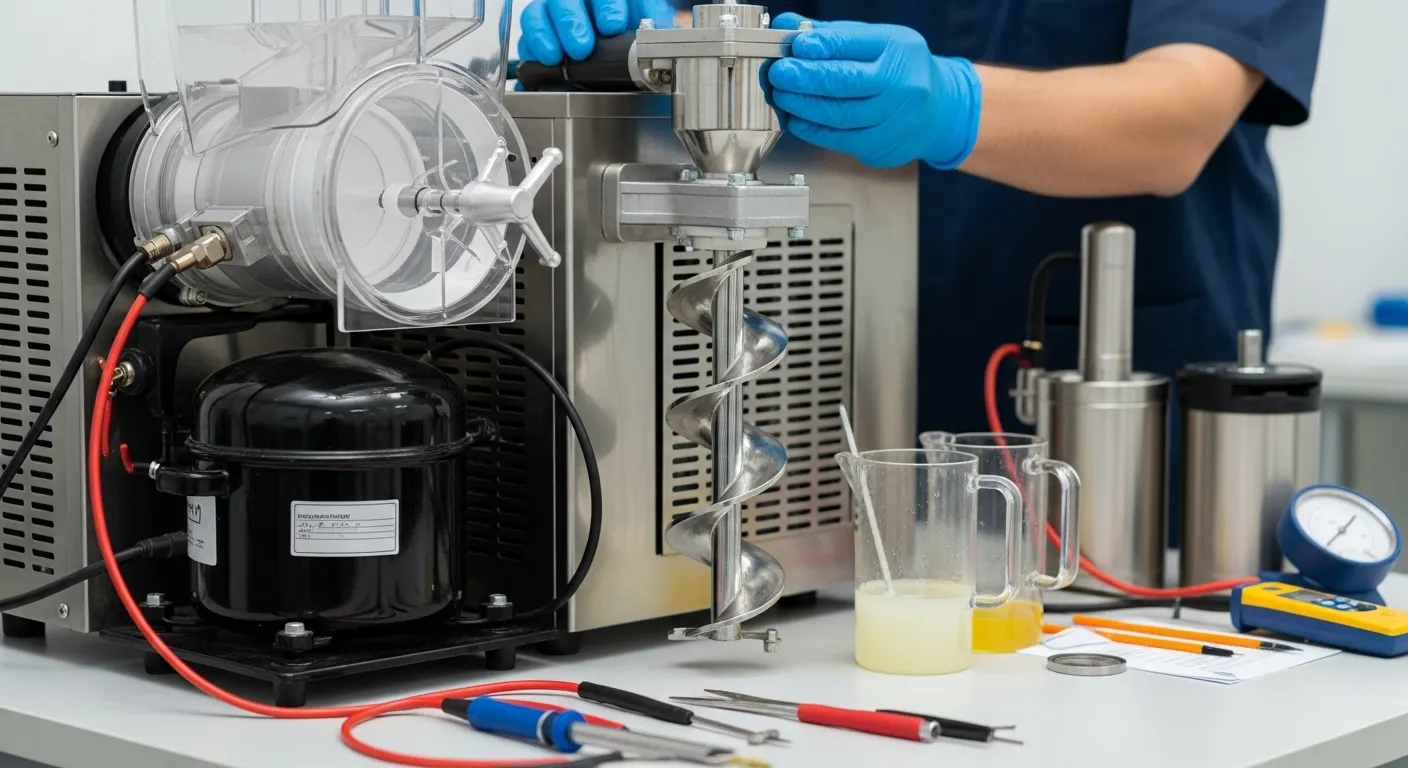
Evaluate cooling by asking how the machine freezes liquid, what compressor and cylinder system it uses, what test conditions support the freeze-time claim, and how the auger or scraper maintains texture during serving.
A fast freeze-time claim is not useful unless the supplier states the test conditions. Starting liquid temperature, sugar level, ambient temperature, batch size, and drink formula can change the result. Ask for the test setup, not only the best number.
Most frozen drink machines chill liquid in a cold chamber while a moving part keeps the mix from freezing into a hard block. That moving part may be an auger, scraper, or stirring system. It helps create the small ice crystals that give the drink its texture.
Ask these cooling questions before sample approval:
- What compressor brand or specification is used?
- What is the freezing cylinder or cooling chamber design?
- What liquid temperature was used in the freeze-time test?
- What sugar level or brix was used during testing?
- What room temperature was used?
- How does the machine control texture during service?
- What happens when the bowl is refilled during peak use?
For a cafe-chain buyer, daily service matters more than a single lab-style freeze test. The sample should be tested for freeze recovery after refilling, dispensing speed, cleaning access, and texture consistency during repeated use.
Which material and food-contact documents should you request?
Ask for food-contact documentation for every part that touches the drink, including bowl, tank, auger, scraper, seal ring, and dispensing path. “Food grade” is not enough without material grade and test-report support.
Food-contact safety starts with the drink path. The supplier should name the material used for each part that touches liquid or ice crystals. This includes the bowl or tank, lid contact areas, auger, scraper, valve, seal ring, nozzle, and dispensing channel.
The U.S. FDA explains that food-contact substances can include materials used in processing equipment and food preparation surfaces, not only packaging. That is why buyers should ask for material details and supporting test reports, not a simple “food grade” line in a catalog.
Use this request list:
| Part | What to request |
|---|---|
| Bowl or tank | Material name, grade, and test report if available |
| Auger or scraper | Material grade and wear-risk notes |
| Seal ring | Material type and replacement schedule |
| Dispensing valve | Material and cleaning method |
| Liquid path | Food-contact statement for all drink-touching surfaces |
| Updated parts | Written notice if materials change before production |
A supplier that cannot list drink-contact parts clearly is not ready for serious procurement. That gap can become a compliance issue, a taste issue, or a warranty issue after shipment.
Which certifications matter for a frozen drink maker manufacturer?
Certifications should match the exact model, voltage, market, and use case. Ask for the certificate, test report, model number, issuing body, validity status, and whether any design change would require retesting.
A certificate logo in a product image is not enough. The model number, voltage, factory name, and report date must match the machine being shipped. If any of those details do not match, ask for clarification before sample payment.
Certification needs depend on your market and sales channel. For North America, an ETL Listed Mark can show that a product was independently tested and certified by a Nationally Recognized Testing Laboratory. For commercial foodservice, sanitation marks may also matter. Intertek describes the ETL Sanitation Mark as a way to show compliance with applicable NSF/ANSI sanitation standards for foodservice equipment.
| Document or mark | What it helps prove | What to check |
|---|---|---|
| ETL Listed Mark | Electrical safety certification by an NRTL | Model, voltage, and issuing body |
| ETL Sanitation or NSF/ANSI sanitation | Foodservice sanitation compliance | Exact use case and product category |
| GCC | Required for some U.S. general-use products under CPSC rules | Importer, model, rule, and test basis |
| Food-contact test report | Drink-touching material support | Part name and material grade |
| Internal QC report | Factory inspection before shipment | Serial number, test date, and result |
The CPSC explains that certain general-use products require a written General Certificate of Conformity based on testing or a reasonable testing program. For overseas products, the importer is responsible for issuing the GCC. That makes early document review important for private-label and retail buyers.
How do you test samples before approving bulk production?
Sample testing should prove the machine can work in your real market, not only in the supplier’s showroom. Test the same drink types, serving pattern, voltage, and cleaning routine your customers will use.
A single sample test should record performance and failure points. Do not rely on “looks good” feedback from a short demo video. Put the unit through repeated cycles and write down the results.
Use this sample-test workflow:
- Check carton condition, plug type, voltage, manual, and accessory list.
- Run the machine with water first to check leaks and noise.
- Test the main drink formula under recorded room temperature.
- Record first freeze time and refill recovery time.
- Test thick syrup, juice, dairy mix, or alcohol if relevant.
- Dispense repeatedly to check clogging and flow control.
- Clean the unit and record cleaning time.
- Inspect seals, valves, auger, bowl, and scraper after use.
- Share findings with the supplier before price negotiation.
One buyer may test a sample with juice, dairy mix, and thick syrup. The decision point is not only taste. The buyer should record freeze time, clogging, dispensing smoothness, leakage, noise, and cleaning time before approving bulk production.
Which packaging and customs documents prevent shipment delays?
Customs delays often start before shipment when invoice, packing list, model number, origin, carton marks, or importer data do not match. Ask the manufacturer for complete export documents before the cargo leaves the factory.
Packaging is part of sourcing, not an afterthought. A frozen drink maker can pass a sample test and still create problems if the carton is weak, the marks are wrong, or the shipment documents do not match the product.
Bangladesh Customs lists import-release documents such as invoice, packing list, transport document, country of origin certificate, insurance document, and importer documents. Other markets may differ, so confirm the destination rules with your broker before shipment.
| Document or detail | Who prepares it | What to check |
|---|---|---|
| Commercial invoice | Supplier or exporter | Product name, model, value, buyer, seller |
| Packing list | Supplier or exporter | Carton count, weight, dimensions, model |
| Bill of lading or airway bill | Forwarder or carrier | Consignee, shipment route, cargo details |
| Country of origin certificate | Supplier or issuing body | Origin matches invoice and product |
| Insurance document | Buyer, supplier, or forwarder | Coverage and shipment value |
| Carton marks | Supplier | Model, quantity, handling marks, buyer code |
| Certificate model | Supplier or test body | Must match shipped goods |
For example, a buyer imports 500 units. The cartons say model YX1802, but the invoice only says “frozen drink machine.” That mismatch can create questions. Align the invoice, packing list, carton marks, certificate model, and origin certificate before the cargo leaves the factory.
What should you ask about warranty, spare parts, and after-sales support?
A low unit price is risky if the manufacturer cannot supply spare parts, diagnose failures, or support warranty claims. Ask for a written spare-parts commitment before approving production.
Warranty terms should be clear before the purchase order. Ask what parts are covered, what is excluded, who pays shipping, and what proof is required for a claim. A vague one-year warranty is weak if no process is written down.
Spare parts matter because real failures often involve small components. Seal rings, dispensing valves, control boards, augers, scrapers, lids, and compressors may need support during the product life. If the supplier cannot name these parts, they may not support your customers well.
Ask these support questions:
- What is the warranty period for the full machine?
- Which parts have shorter coverage?
- Which spare parts are stocked for this model?
- How long will spare parts remain available?
- What is the response time for technical issues?
- Can you provide replacement videos or service guides?
- Do you support distributors with part lists and diagrams?
A control board may fail after five months. In that case, the supplier should confirm the part name, replacement lead time, cost, shipping method, and whether the buyer or end user can replace it. That is where real supplier support matters.
What supplier questions should you send before requesting a quote?
Send supplier questions before asking for final pricing. Good answers will make the quote more accurate, and weak answers will help you remove risky suppliers early.
Use this checklist as your procurement message:
| Question area | Questions to send |
|---|---|
| Supplier identity | Are you the factory for this model? Can you share production photos or factory documents? |
| Model control | Is this your own model, OEM model, ODM platform, or sourced model? |
| Cooling system | What compressor, cooling chamber, auger, or scraper design is used? |
| Test conditions | What were the freeze-time test conditions? What drink brix was used? |
| Materials | Which parts touch the drink, and what material grade is each part? |
| Certifications | Which certificates match this exact model and voltage? |
| Sample test | Can we test juice, dairy mix, syrup, or alcohol-based formulas? |
| QC | What inspections happen before shipment? Can you share a sample QC report? |
| Packaging | What are the carton size, gross weight, packing method, and carton marks? |
| Customs documents | Can you provide invoice, packing list, origin certificate, and certificate copies before shipment? |
| Warranty | What is covered, what is excluded, and how are claims handled? |
| Spare parts | Which parts are stocked, and how long are they available? |
If the project moves toward private label, connect this checklist with Yumyth’s custom sourcing process. It helps turn early supplier screening into a clearer OEM discussion.
What to Do Next
Choosing a frozen drink maker manufacturer should feel like a controlled sourcing process, not a price hunt. Start with supplier identity, then verify cooling, materials, certifications, sample performance, packaging, documents, warranty, and spare parts. Shortlist only the suppliers that answer with model-specific proof. Then request samples, test them under your real use conditions, and fix open questions before bulk production. That approach gives you a cleaner quote, fewer shipment surprises, and a safer path to launch.
Frequently Asked Questions
What should I ask a frozen drink maker manufacturer first?
Ask whether they are the actual manufacturer, what model they produce, which materials touch the drink, which certifications match that model, and whether they can provide samples, QC records, packing details, and spare-parts support. These answers show whether the supplier can support real sourcing.
How do frozen drink machines work?
Frozen drink machines chill the liquid mix inside a cold chamber while an auger, scraper, or stirring system keeps the mixture moving. This creates small ice crystals instead of one solid block, which gives the drink its slush texture.
What types of frozen beverage machines are there?
The main types include home countertop frozen drink makers, open-bowl slush or granita machines, carbonated frozen beverage systems, and multi-flavor commercial dispensers. The right type depends on drink style, serving volume, installation needs, and whether CO2 is required.
How do I know if a frozen drink maker is food-safe?
Ask for material details and food-contact test reports for every drink-contact part, including the bowl, auger, seal ring, scraper, and dispensing path. The answer should name the material grade, not only say “food grade.”
Which certification should I ask for?
Ask for certifications that match your sales market and model, such as ETL or other NRTL safety certification for North America, sanitation certification where commercial foodservice requires it, and GCC documentation where applicable. The certificate must match the exact model and voltage.
What customs documents should I confirm before shipment?
Confirm the commercial invoice, packing list, bill of lading or airway bill, country of origin certificate, insurance document, and importer documents required in the destination market. These details should match the model, carton marks, and certificate records.
Why do spare parts matter when choosing a manufacturer?
Spare parts matter because failures often involve components such as seal rings, valves, augers, control boards, or dispensing parts. A manufacturer that can name and supply those parts protects your warranty promise and reduces replacement-unit losses.
Related Articles
How We Test Every Ice Maker Before Packaging
2026-09-15
BY YUMYTH
A step-by-step look at refrigerant handling, cooling verification, leak detection, corrective action and electrical safety testing For an ice maker, reliable performance is determined long before the carton is sealed. ...
Guide for Brands Looking for a Reliable Vacuum Sealer OEM Supplier
2026-09-14
BY YUMYTH
When you are sourcing kitchen appliances for your retail brand, finding a dependable vacuum sealer OEM supplier is rarely just about getting the lowest unit price. It is about protecting ...
Why Ice Shape Matters: Understanding 10mm × 15mm Cylindrical Nugget Ice
2026-09-14
BY YUMYTH
More Than Ice Production — The Ice Itself Shapes the Consumer Experience When sourcing a nugget ice maker, buyers often focus first on production capacity, water tank size, ice basket ...

Ice Maker Sourcing Guide: How to Find the Right Factory
2026-09-10
BY YUMYTH
Sourcing an ice maker looks straightforward on paper. Find a supplier, agree on a price, place an order. But anyone who has actually done this knows the process is rarely ...