
Home Slushie Machine Manufacturer Guide: What Importers and Brands Should Check
Share:
-

-

-

-


Copied
Share:
-
-
-
-
Copied
A home slushie machine manufacturer should be judged by more than presets, capacity, and countertop design. Importers and private-label brands should verify factory role, food-contact materials, sample testing, pilot-run consistency, packaging protection, compliance documents, and spare parts support before approving mass production.
A home slushie machine can look perfect on a retail page and still become a sourcing problem. The real risk appears after the first sample: weak seals, poor carton protection, unclear documents, missing spare parts, or inconsistent production. This guide helps importers and private-label brands check the factory behind the product before they commit to a deposit, pilot run, or mass order.
What should importers check before choosing a home slushie machine manufacturer?
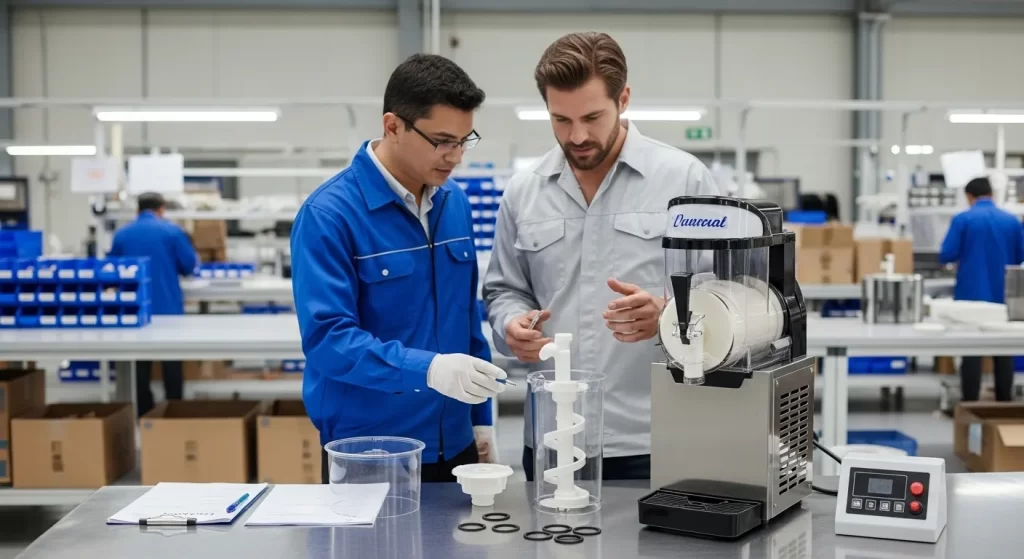
A good home slushie machine manufacturer should prove factory control, stable product specs, food-contact material documents, production testing, packaging readiness, and after-sales support before mass production.
Start by confirming who you are buying from. Some suppliers control molds, parts, assembly, and testing. Others are trading companies or resellers. That difference affects pricing, customization, warranty support, spare parts, and how fast problems can be fixed after delivery. A broader look at manufacturer types can help you place each supplier in the right category.
Use the sample as the beginning of your check, not the final proof. A good sample shows potential. It does not prove every unit in a 500, 1,000, or container-size order will perform the same way.
- Supplier role: OEM, ODM, factory, trading company, or reseller
- Product control: housing, tank, auger, cooling system, PCB, and software
- Material proof: food-contact plastic, silicone seals, and metal parts
- Testing process: freezing time, noise, leakage, rinse cycle, and continuous use
- Packaging: retail carton, master carton, manual, barcode, and plug type
- Support: spare seals, spouts, augers, warranty parts, and defect handling
The cheapest sample is rarely the safest private-label choice. It works only when the supplier can still document materials, testing, packaging, and spare parts.
Why is consumer appeal different from manufacturing reliability?
Consumer appeal helps the product sell; manufacturing reliability keeps returns, customs issues, and warranty claims under control. Importers should judge the supplier behind the appliance, not only the features shown on a product page.
Consumer pages often focus on no-ice use, presets, drink modes, rinse cycles, and easy cleaning. That matters because buyers care about convenience. SharkNinja, for example, presents home slushie machines around no-ice frozen drinks, capacity, preset programs, and cleaning support on its product page.
Importers need another layer of checks. A product must look good in a kitchen, survive shipping, pass basic testing, match market documents, and stay serviceable after sale.
| Consumer appeal | Manufacturing reliability |
|---|---|
| Modern countertop look | Stable housing material and assembly |
| Preset drink modes | Tested software settings across recipes |
| No-ice slush making | Cooling system performance under load |
| Easy cleaning claim | Removable parts, seal access, and rinse testing |
| Large capacity | Motor load, carton size, and warranty risk |
| Low retail price | Consistent parts, spare support, and QC records |
A product grid can tell you what consumers may like. It cannot tell you whether the factory can repeat the same quality for the next production batch. Ask for proof before you treat a nice-looking appliance as a safe import product.
Which home slushie machine capacity options should a private-label buyer compare?
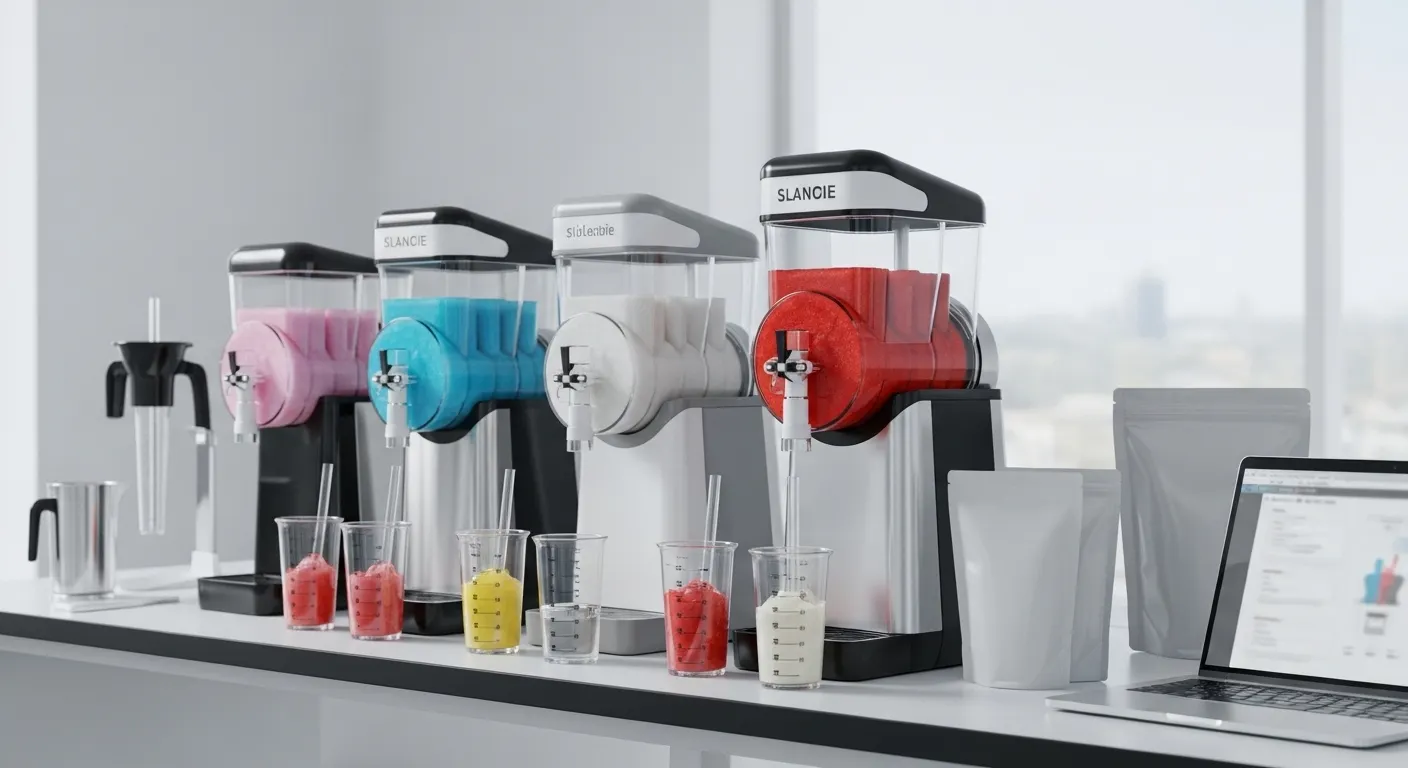
For private-label home slushie machines, the safest starting range is usually a compact to mid-size model that supports family use without becoming too bulky, costly, or difficult to ship.
Capacity affects more than serving size. It changes the cooling load, motor stress, carton size, shipping cost, retail shelf fit, and return risk. A 2.5L model may look stronger than a 1.8L model on a sales page, but the better choice depends on your buyer, price point, and support plan.
Use capacity as a positioning decision, not only a feature claim.
| Capacity type | Best fit | Importer check |
|---|---|---|
| Compact model | Small kitchens, couples, light home use | Check countertop footprint, noise, and retail box size |
| 1.8L to 2.5L model | Family use and mainstream private label | Balance capacity, carton weight, cooling time, and price |
| 3.7L to 4.4L model | Parties, hosting, premium home use | Test motor load, tank strength, spout durability, and packaging |
A simple example helps. If your first order is 500 to 1,000 units, a 1.8L model may reduce carton volume and warranty stress. A 2.5L model may sell better if your market wants family-size drinks. Test both before choosing the retail hero product.
If your product line includes separate flavor tanks or split recipe control, compare dual mixing models before you approve the final design.
What housing and cleaning design details should be audited?
The best housing design is not only compact and attractive; it must make cleaning obvious. Importers should reject designs with fixed food-contact seals, weak spouts, unstable bases, or hard-to-reach residue traps.
Home buyers judge the machine after the first few uses. If cleaning feels messy, slow, or confusing, complaints can rise fast. Importers should inspect the parts that touch liquid, sugar, fruit mix, dairy-style drinks, and alcohol blends if the machine supports them.
The housing should feel stable on a countertop. The tank should be easy to remove. The spout should not drip after use. The seal ring should be accessible, because a small seal failure can turn into a return, a replacement request, or a bad review.
- Removable vessel, auger, spout, drip tray, and seal areas
- Smooth food-contact surfaces with no residue traps
- Clear access around gaskets and dispensing parts
- Rinse or cleaning cycle that matches the manual
- Stable base that does not move during mixing
- Power cord, plug type, and control panel placement
- Replacement seal rings and spout parts by model number
Food-contact material claims should be backed by documents, not only sales language. For deeper material checks, review the guide on food-safe materials.
Automatic cleaning is useful, but it does not replace removable food-contact parts. A rinse mode without accessible seals and auger parts can still create hygiene complaints.
How should a manufacturer prove the machine works reliably?
A manufacturer should prove reliability through sample testing, pilot-run testing, and clear QC records. The machine should be tested with real recipe conditions, not only water or one ideal drink mix.
Home slushie machines deal with different sugar levels, fruit syrups, mocktails, and sometimes alcohol recipes. Thick liquids can stress the auger. Low-sugar liquid may freeze poorly. A good supplier should explain the safe recipe range and show how the machine performs inside that range.
Sample test
The first sample test should check the user experience and the engineering basics. Record freezing time, noise, vibration, leakage, dispensing smoothness, tank fit, cleaning time, and control accuracy. Test the same machine more than once so you can see whether results stay stable.
For example, test a fruit syrup drink, a soft drink, and a low-sugar liquid. If one recipe causes heavy freezing, slow mixing, or blocked dispensing, ask the supplier how the auger, motor, and software settings handle that condition. This is where clog-resistant design becomes a real buying issue, not only a feature phrase.
Pilot run test
A pilot run checks whether the factory can repeat the result. If the sample passes, ask for a small production batch before approving a large order. For a first 500 to 1,000 unit order, even a small pilot run can expose part mismatch, poor assembly, weak cartons, or manual errors.
Ask the factory to record testing steps for leakage, cooling, noise, display function, rinse cycle, and packaging checks. If the supplier cannot explain what gets tested before carton sealing, do not treat the quote as ready for mass production.
Which compliance and import documents should be ready before shipment?
Before shipment, importers should align the commercial invoice, packing list, transport document, country-of-origin proof, product specs, and required compliance certificates with the customs broker. Missing or inconsistent documents are a common delay trigger.
Customs delays often start before the goods leave the factory. The problem may be a missing document, a model-name mismatch, an unclear product description, or a compliance file that was requested too late. Ask for document samples before production finishes.
Trade.gov lists common export documents such as the commercial invoice, packing list, certificate of origin, air waybill, and bill of lading in its export document guidance. For Bangladesh import context, Trade.gov also discusses import documents and registration requirements in its Bangladesh import documentation guide.
| Document or check | Why it matters |
|---|---|
| Commercial invoice | Confirms product description, value, seller, buyer, and shipment details |
| Packing list | Helps match carton count, model names, weight, and packaging data |
| Bill of lading or air waybill | Confirms transport details for sea or air shipment |
| Certificate of origin | Supports country-of-origin declaration where required |
| Product specification sheet | Helps broker classify and review the product |
| Compliance certificates | Needed when the destination market requires product safety proof |
| HS code discussion | Should be reviewed with the customs broker before shipment |
Bangladesh Customs lists several documents for import release, including invoice, bill of lading or air waybill, packing list, country-of-origin certificate, insurance documents, and VAT/BIN-related records on its customs clearance page. For U.S. shipments, the CPSC explains that it works with CBP on imported consumer-product review through its import resources.
A simple mistake can create delay. If the invoice says “kitchen appliance,” the packing list says “slushie machine,” and the carton label shows another model name, ask your broker to review everything before shipment.
What packaging checks protect a home slushie machine during import?
Packaging should protect the tank, handle, spout, display, compressor base, and retail presentation. A working sample can still fail in the market if the carton cannot survive normal handling.
Home slushie machines include parts that can crack, shift, or loosen during transport. The tank may be clear plastic. The spout may sit outside the main housing. The control panel may be exposed. Ask the supplier to show retail carton layout, foam structure, master carton design, and how accessories are packed.
- Retail carton artwork matches model, plug type, and market language
- Master carton protects retail boxes during stacking
- Foam or molded pulp supports tank, handle, display, spout, and base
- Manual, barcode, rating label, and warning label are correct
- Spare seal rings or accessories are packed in a fixed location
- Carton marks match invoice, packing list, and model name
- Sample carton is checked after drop or handling simulation if available
A packaging scenario is easy to miss. The sample may work well, but the handle and tank may sit too close to the carton wall. Ask for stronger protection before production, because a cracked tank after delivery can become a warranty issue and a retail complaint.
Supplier audit checklist for home slushie machine importers
A supplier audit should confirm what the factory controls, what it outsources, which tests it performs, which documents it can provide, and how it supports defective parts after delivery.
This checklist helps you compare suppliers before deposit, sample approval, and mass production. Keep it short enough for your team to use, but specific enough to expose weak answers.
| Audit area | What to ask | Good sign | Warning sign |
|---|---|---|---|
| Supplier role | Are you OEM, ODM, factory, trading company, or reseller? | Clear role with factory details | Vague answer or changing company names |
| Product control | Which parts do you design or control? | Clear control over housing, tank, auger, PCB, and assembly | Supplier only shares catalog photos |
| Material proof | Can you provide food-contact material documents? | Plastic, silicone, and metal specs are available | “Food grade” claim with no document |
| Sample testing | What tests are done before sample approval? | Cooling, leakage, noise, rinse, and dispensing checks | Only basic power-on test |
| Pilot run | Can we approve a small run before mass order? | Supplier accepts pilot review | Pushes full order without pilot proof |
| Packaging | Can you show retail and master carton structure? | Carton layout, foam plan, labels, and manual ready | No carton details before production |
| Documents | Can you prepare invoice, packing list, origin proof, and specs? | Shares document samples early | Waits until shipment week |
| Spare parts | Which parts are available after sale? | Seal, spout, auger, tank, and control parts listed | No model-based spare part plan |
| Defect handling | How are claims reviewed? | Clear photo, video, batch, and part process | No written process |
This is where buyer discipline matters. A supplier may answer quickly during sales chat, but the audit should test whether the factory can support a real order after the first shipment. Use this checklist together with the broader slushie manufacturer guide if you also need to compare supplier categories.
One practical example: a seal ring fails after six months. A real manufacturer should identify the model, batch, and part number. A reseller may not know which factory made that batch, which slows replacement and increases customer frustration.
When should you reject a home slushie machine supplier?
Reject the supplier if they cannot document food-contact materials, testing steps, packaging protection, spare parts, and export documents. A low unit price is not useful if the shipment creates returns, customs holds, or warranty failures.
Do not reject a supplier because one answer needs clarification. Reject them when the pattern is weak. If the supplier avoids material proof, refuses pilot-run checks, gives unclear packaging answers, or cannot prepare document samples, the risk is already visible.
Large capacity is not always the best choice. It works when the motor, cooling system, carton design, and warranty plan are proven. A smaller model is safer when your first order needs lower shipping risk, simpler support, and easier retail positioning.
| If you see this | What it means | Best action |
|---|---|---|
| Vague material specs | Food-contact claim is not proven | Request documents or pause approval |
| No pilot-run data | Sample quality may not repeat | Delay mass production |
| Weak carton protection | Higher damage and return risk | Require packaging revision |
| No spare parts plan | Warranty support will be slow | Ask for part list by model |
| Inconsistent document names | Customs review may slow down | Ask broker to review before shipment |
| Unclear supplier role | You may be dealing with a reseller | Verify factory identity |
Price matters, but it should not control the full decision. A slightly higher supplier cost can be safer when it reduces returns, replacement shipments, and customs friction.
What to Do Next
Choosing a home slushie machine manufacturer is a product decision and a supply-chain decision at the same time. Start with the sample, then check the factory role, material proof, testing records, carton design, shipment documents, and spare parts plan. Do not approve mass production because the product looks good in photos.
Before you place the next order, build a simple supplier file. Include the quotation, sample test notes, packaging photos, document samples, compliance records, and after-sales parts list. That file will help your team compare suppliers clearly and avoid repeating the same checks each time.
Frequently Asked Questions
What is a home slushie machine manufacturer?
A home slushie machine manufacturer designs, builds, or controls production of countertop frozen drink machines for household use. For importers, the key issue is whether the supplier controls engineering, testing, materials, packaging, and after-sales parts.
Is it necessary to add ice when making slush?
Many modern home slushie machines do not need ice because they use compressor cooling or similar freezing technology. Importers should still test different liquids, because sugar level, alcohol level, and recipe thickness can affect freezing performance.
How does a slushie machine work?
A slushie machine chills liquid while mixing it so small ice crystals form without freezing into a solid block. For manufacturer evaluation, ask how the cooling system, motor, auger, and software settings are tested across recipes.
What capacity is best for a home slushie machine?
Most private-label buyers should start with a compact to mid-size home model unless their market clearly wants party-size machines. Larger capacity can improve appeal, but it may increase carton size, shipping cost, motor load, and warranty risk.
What documents should an importer ask for before shipment?
Importers should ask for a commercial invoice, packing list, transport document, certificate of origin, product specification sheet, and required compliance documents for the destination market. The customs broker should review these before cargo leaves the factory.
Does a home slushie machine need automatic cleaning?
Automatic cleaning is not mandatory, but it is valuable for home users and private-label brands because it reduces residue complaints. Importers should still confirm that contact parts can be removed, washed, dried, and replaced easily.
Related Articles
How We Test Every Ice Maker Before Packaging
2026-09-15
BY YUMYTH
A step-by-step look at refrigerant handling, cooling verification, leak detection, corrective action and electrical safety testing For an ice maker, reliable performance is determined long before the carton is sealed. ...
Guide for Brands Looking for a Reliable Vacuum Sealer OEM Supplier
2026-09-14
BY YUMYTH
When you are sourcing kitchen appliances for your retail brand, finding a dependable vacuum sealer OEM supplier is rarely just about getting the lowest unit price. It is about protecting ...

Why Ice Shape Matters: Understanding 10mm × 15mm Cylindrical Nugget Ice
2026-09-14
BY YUMYTH
More Than Ice Production — The Ice Itself Shapes the Consumer Experience When sourcing a nugget ice maker, buyers often focus first on production capacity, water tank size, ice basket ...

Ice Maker Sourcing Guide: How to Find the Right Factory
2026-09-10
BY YUMYTH
Sourcing an ice maker looks straightforward on paper. Find a supplier, agree on a price, place an order. But anyone who has actually done this knows the process is rarely ...